Login to access
Want to subscribe?
This article is part of: Enterprise Platforms
To find out more about how to join or access this report please contact us
This report explores how UK organisations are approaching AI in communications and customer operations — the challenges they face, the use cases they prioritise, the outcomes they expect, and what they need to adopt AI with confidence. It draws on a recent STL Partners survey of 300 UK businesses across small office/home office (SOHO) businesses, small and medium-sized businesses (SMBs) and large enterprises segments.
Why AI is becoming a practical priority in customer operations
Customer operations are under growing pressure. Expectations are rising, service environments are becoming more complex, and organisations are being asked to improve responsiveness and consistency without adding more cost. That pressure is now translating into action: Gartner finds that 91% of customer service leaders are under executive pressure to implement AI, while PwC reports that 70% of executives believe customer expectations are evolving faster than their organisation can adapt.
AI is rising up the agenda because it offers a practical way to respond to these pressures. In customer operations, some of the earliest and clearest value pools are already emerging in customer experience and service delivery – from smarter routing and faster information access to more consistent responses and lower-effort interactions. That is one reason investment is accelerating: Gartner reports that 75% of service and support leaders have increased their budgets for AI initiatives, and by 2028 more than half of customer service organisations are expected to double their technology spend.3
For organisations with substantial customer interaction volumes, the implication is clear: AI is no longer just a future innovation theme. It is becoming a practical priority for improving both customer-facing performance and operational efficiency.
Research methodology
BT and RingCentral partnered with STL Partners to explore where AI is creating the most practical value in communications and customer operations for UK businesses.
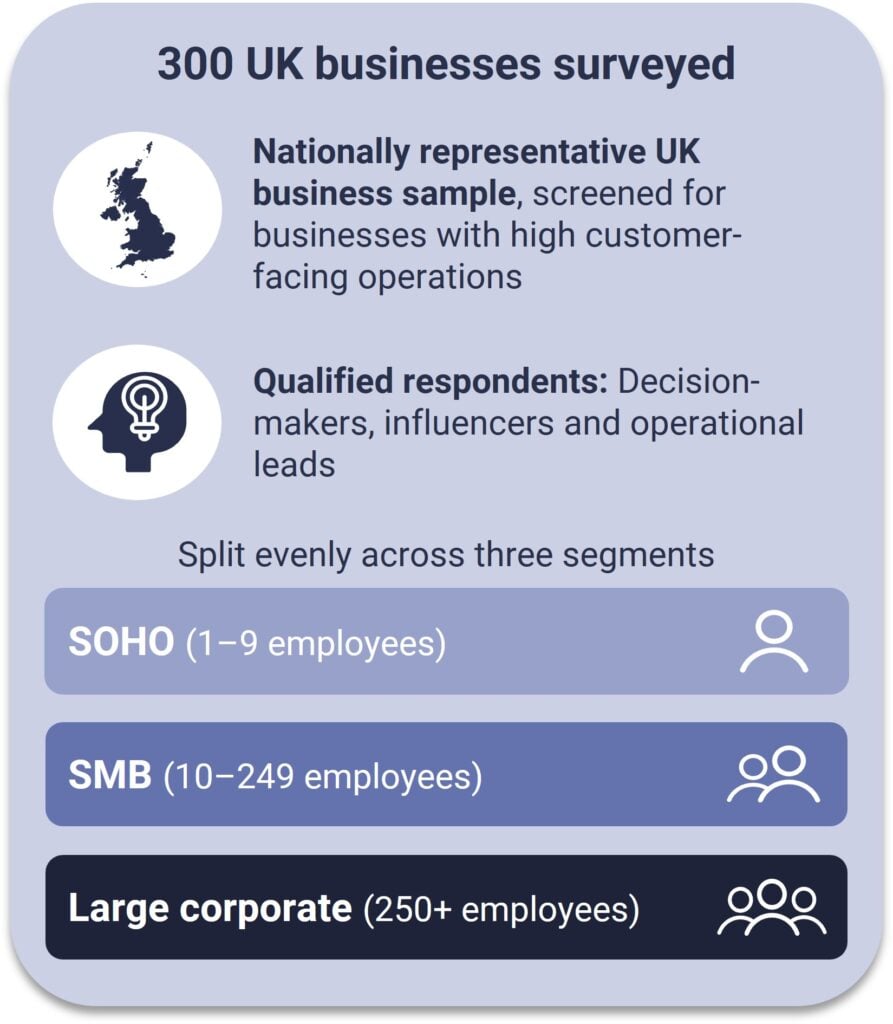
This report presents insights from a recent STL Partners-conducted survey of 300 UK businesses, drawn from a nationally representative sample of the UK business landscape and screened for organisations where customer communications and interactions are a meaningful part of operational activity.
The sample was split evenly across SOHO businesses, SMBs and large corporate segments. The research explored current challenges, AI adoption and maturity, priority use cases, expected business value, key performance indicator (KPI) impact and barriers to implementation of AI in customer communications.
Survey overview