Login to access
Want to subscribe?
This article is part of: Enterprise Platforms
To find out more about how to join or access this report please contact us
As the bottleneck shifts from commitment to commercial execution, telcos need an API-specific playbook – not a one-size-fits-all approach. Drawing on extensive demand-side research, this series of reports delivers actionable guidance on pricing logic, charging models and GTM channel strategies for emerging APIs. This report focuses on KYC Match.
STL Partners conducted a comprehensive research programme to define strategic recommendations for network API pricing and GTM strategy.
Project overview
Focus on three priority APIs:
- KYC Match/Age
- Location Retrieval
- Quality on Demand (QoD)
Primary research: To understand API value propositions, current user issues and viable GTM channels
- 18 interviews with telcos, distributors and enterprises
- 318 respondents surveyed from enterprise customers and platforms
Secondary research: To understand alternative solutions and their price points
- 20 competing products benchmarked across features and pricing
Pricing guidance
- Price points for three named APIs: USD value and multipliers vs alternatives, split by geography with indicative ranges.
- Pricing drivers: Factors influencing willingness to pay and premium potential.
- Pricing model: Commercial models telcos should pursue beyond per-transaction pricing.
GTM guidance
- Priority partners: Which partner groups telcos should target to reach end customers.
- Roadmap: Key steps operators should take to launch and commercialise APIs.
- The telco role: The proposition and differentiators for telcos in each API, including role in the value chain beyond base API provider.
Playbook structure: Each API section answers the same key commercial questions – from opportunity assessment through pricing, packaging and GTM strategy
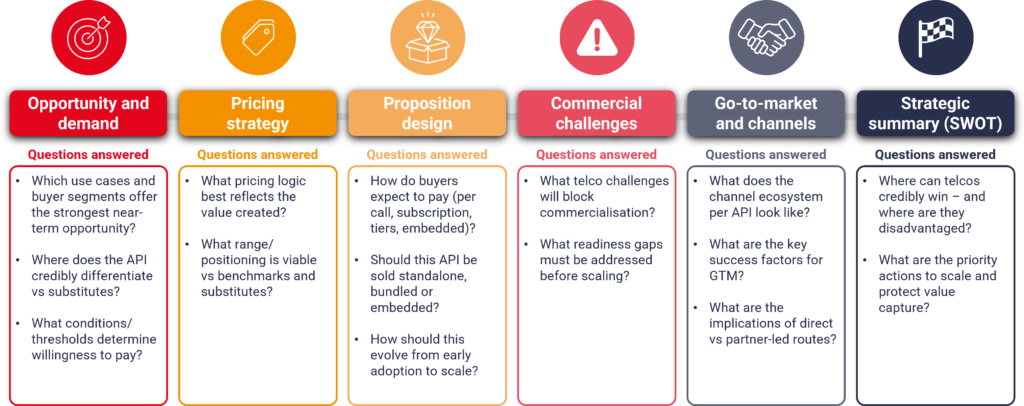
Source: STL Partners
If you are not a subscriber, enter your details below to download an extract of the report
Practical next steps to monetise KYC Match
1. Baseline deliverability first
Quantify match performance across customer base, attribute completeness, and confidence drop-offs; define what you can credibly support.
2. Adopt graded assurance outputs (not just yes/no)
Implement fuzzy logic / confidence scoring and workflow-specific thresholds (low-risk onboarding vs step-up vs high-risk).
3. Package as an assurance signal within an identity solution
Position KYC as an additional signal (alongside other capabilities) reducing manual review and heavier checks.
4. Start GTM within identity ecosystems
Prioritise identity verification (IDV)/risk platforms to integrate into existing decision flows and generate proof-of-value
This is the first report in a three-part series that offers practical guidance on pricing, charging models, and go-to-market strategies for emerging APIs. In this report, we focus on KYC Match.
Table of contents
- Executive summary
- Introduction
- KYC Match commercial playbook
- Pricing strategies
- Go-to-market strategies
Related research
- Enabling customer centricity in enterprise networks through NaaS
- Why Layer 1 needs NaaS: A guide for enterprises
- The telecom industry in the AI era: How telcos can follow the money
- Enterprise AI: What are the best opportunities for telcos?
- Networks for AI: Segmenting the growth