Login to access
Want to subscribe?
This article is part of: Enterprise Platforms
To find out more about how to join or access this report please contact us
Network-as-a-service (NaaS) offers enterprises more than flexibility – it can unlock material, measurable financial gains. This report explores the quantitative benefits of Layer 1 NaaS across three real-world scenarios.
Layer 1 connectivity: The foundation for mission-critical enterprises
For enterprises with performance-critical, data-intensive and compliance-driven operations, Layer 1 (L1) connectivity provides the physical backbone while allowing the enterprise to retain control of network design, topology, security and protocols. These dedicated optical links are ultra-low latency, high-bandwidth and highly secure, making them ideal for enterprises which require full control over performance, security and data sovereignty.
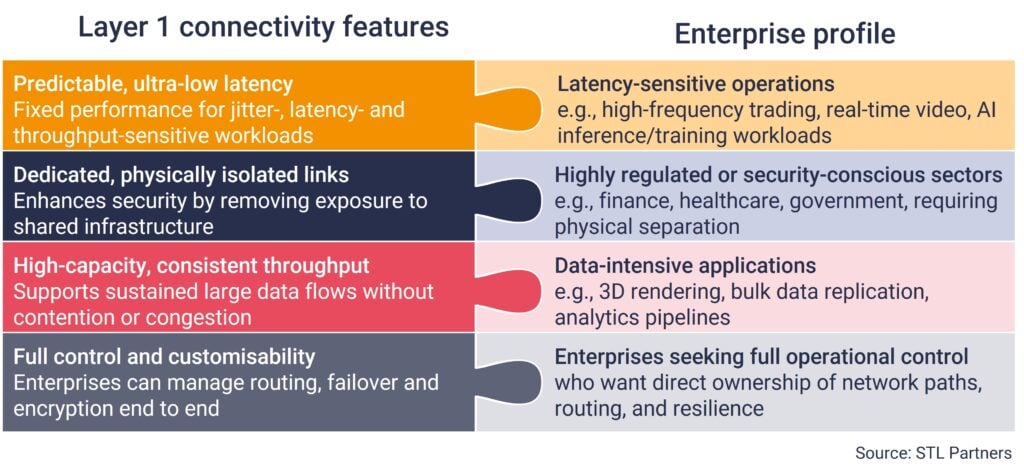
While L1 underpins much of the global internet and cloud backbone, it is also used by select enterprise segments that depend on deterministic, high-performance connectivity. These are typically very large organisations with skilled in-house teams for whom network performance is a key competitive differentiator. Common adopters include large media streaming platforms (e.g., Netflix), cloud and managed service providers, global banks and digital-native manufacturers (e.g., Tesla) – all of which require secure, low-latency, high-throughput infrastructure to support their business-critical workloads. Typical enterprises that choose to consume connectivity through L1 network services are outlined in the figure below.
Layer 1 connectivity enterprise profile
If you are not a subscriber, enter your details below to download an extract of the report
Enterprises relying on L1 connectivity are often pioneers in digital experiences and so are typically the first to feel the friction between legacy infrastructure models and evolving digital demands. Several key trends that these enterprises are facing include:
- AI and data-intensive workloads becoming more dynamic and distributed, with training, inference and storage increasingly split across multiple locations. This shift creates demand for bursty, high-throughput links and on-demand scalability that traditional networking models struggle to support.
- Increasingly decentralised infrastructure, as enterprises scale across data centres, cloud regions and edge sites – creating a need for low-latency, high-resilience interconnectivity across geographies.
- Growing expectation for cloud-like orchestration means enterprises want to manage their physical network infrastructure with the same automation, visibility and control they experience in the cloud. Traditional static provisioning and long-term fibre contracts no longer align with these demands.
Table of contents
- Executive summary
- Unlocking the Layer 1 NaaS opportunity
- Layer 1 connectivity: The foundation for mission-critical enterprises
- NaaS: A response to enterprise demand for greater flexibility, visibility and control
- Layer 1 NaaS: Becoming a reality
- Quantifying the value proposition of L1 NaaS
- Scenario 1: Scaling connectivity for dynamic network demand
- Scenario 2: Accelerating innovation without long-term lock-in
- Scenario 3: Building network resilience for distributed global operations
- Conclusion
- Recommendations for enterprises
- Recommendations for service providers
- Appendix
- Enterprise NaaS cost-benefit estimation
Related research
- Enabling customer centricity in enterprise networks through NaaS
- The telecom industry in the AI era: How telcos can follow the money
- Enterprise AI: What are the best opportunities for telcos?
- Networks for AI: Segmenting the growth