Login to access
Want to subscribe?
This article is part of: Edge Insights
To find out more about how to join or access this report please contact us
Our telco AI data centre forecast examines the rise of AI factories alongside the evolution of network edge infrastructure, showing how AI-driven demand is accelerating growth in telco compute capacity. How will data sovereignty requirements and new industrial AI applications reshape the telco compute capacity landscape?
This forecast focuses on network edge data centres and AI factories
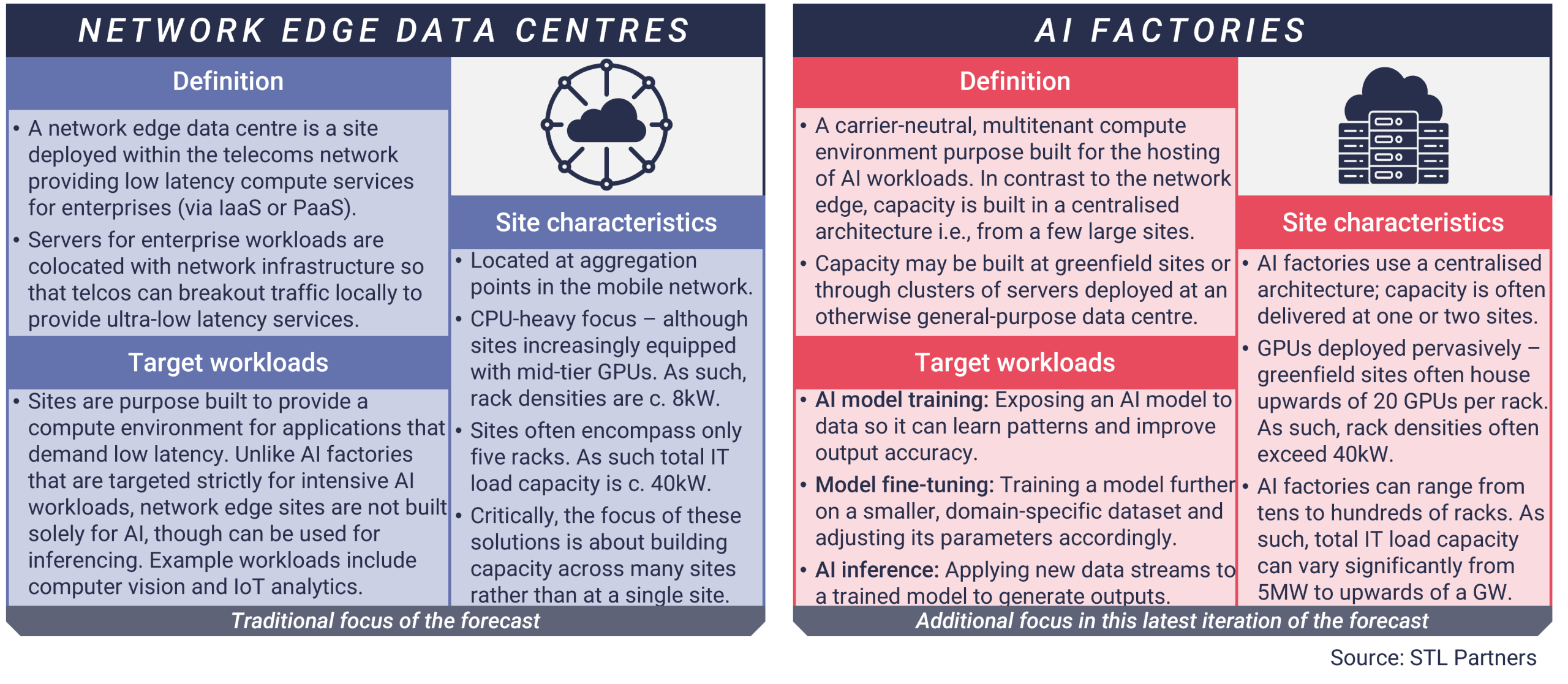
This report focuses on two emerging domains in which operators are seeking to host enterprise AI workloads: network edge data centres and AI factories. To distinguish between these compute models, STL Partners has adopted the following definitions:
If you are not a subscriber, enter your details below to download an extract of the report
Our updated forecast reflects the new compute infrastructure opportunities available to telcos
- Since the publication of the previous edition of the Network Edge Data Centre Forecast, STL Partners has recognised the need to broaden our analysis to reflect the expanding role telcos are playing in enterprise workload hosting. In particular, operators are increasingly investing in AI factories – centralised facilities purpose-built to host AI workloads – as an additional channel through which they can serve enterprise compute demand.
- Indeed, demand for infrastructure capable of hosting AI workloads – and particularly workloads with sovereignty and latency constraints – represents a significant growth opportunity that many telcos across the globe are seeking to capture through network edge and AI factory deployments.
- Accordingly, this updated forecast no longer examines network edge capacity in isolation. In addition to forecasting capacity deployed at the network edge, it now assesses the IT load capacity being developed through telco-operated AI factories. This provides a comprehensive view of key third-party compute opportunities available to telecom operators.
How can this forecast be used:
- Assess investment strategies across large-scale AI factory capacity, distributed edge infrastructure or a hybrid approach.
- Provide visibility into compute capacity at the local-market level, enabling competitive benchmarking and identification of strengths and gaps in edge and AI propositions.
- Quantify the total addressable market and identify the telcos most likely to invest in future compute capacity.
Table of contents:
- Executive Summary
- Introduction
- Quantifying telco capacity and strategies: The network edge
- Definition
- Network edge forecast
- Market dynamics
- Case studies
- Quantifying telco capacity and strategies: AI factories
- Definition
- AI factory forecast
- Market dynamics
- Case studies
- Quantifying telco capacity and strategies: Network edge and AI factory combined
- Telco strategies: Traditional cloud and colocation
- Methodology
- Factors impacting edge build
- AI factory methodology
Related research:
- Network edge data centre forecast: Building the base
- What is the role of edge computing in an AI world?
- The rise of AI at SK Telecom
- Telco network edge computing: Lessons from early movers
- Navigating sovereign AI: Telco strategies, trade-offs and pathways