Login to access
Want to subscribe?
This article is part of: Consumer
To find out more about how to join or access this report please contact us
With recent advances in AI, smart homes may actually become smart, generating considerable value for homeowners, telcos and a broader ecosystem of device and solution providers.
Introduction
A “connected home” or “smart home” refers to a household in which many appliances and devices are connected, enabling consumers to monitor their usage, as well as activity within the building. In some cases, a connected home may also be semi-automated. For example, if a connected sensor detects no movement in a room for an hour, a smart home system might turn off the lighting and heating in that space or sound the alarm in the case of an “assisted living” service monitoring an elderly person.
As the primary providers of connectivity to households, telcos are seemingly well-placed to play a valuable role in the connected home market. But connected home revenues have remained elusive for telcos, as consumers have gravitated towards point solutions supporting specific devices or appliances. In many cases, these point solutions are provided by the major tech players, such as Amazon, Google and Tesla with their Ring range security cameras, or the Powerwall home battery system.
Smart home can unlock new value for households and solution providers
If you are not a subscriber, enter your details below to download an extract of the report
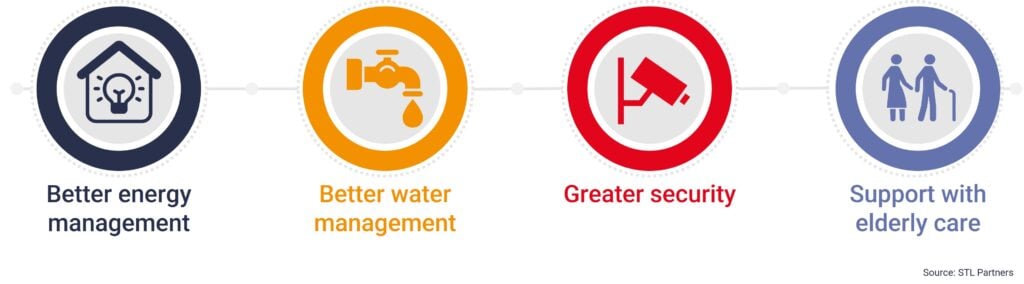
This report considers whether consumers are finally ready to move beyond such point solutions to adopt a broader proposition that would enable them to manage multiple aspects of their homes with the help of AI. In particular, it explores whether the advent of increasingly capable image recognition systems could give the connected home market renewed momentum. This report looks at key drivers, such as better energy and water management, and demand for home security and assisted living solutions, while explaining how various telcos are addressing these segments.
It then considers the challenges telcos face in the smart home market and gives recommendations on how operators could approach this opportunity.
Table of contents
- Executive Summary
- The case for a fully connected home
- Energy and water management
- Smart metering
- Home energy management systems
- Security and assisted living
- Security systems
- Assisted living
- Telcos’ strengths and weaknesses
- Recommendations for telcos
- Go-to-market considerations
- Conclusions
Related research
- Consumer innovation tracker
- Where does consumer innovation thrive?
- Securing the smart home: Lessons from leading telcos
- Creating consumer value with smart Wi-Fi
- Can telcos square the sustainability circle for consumers?