Login to access
Want to subscribe?
This article is part of: Edge Insights, Network Innovation
To find out more about how to join or access this report please contact us
AI-RAN is emerging as a critical area of innovation for telcos. While early pilots confirm technical feasibility, the path to commercialisation remains less clear. We explore the practical pathways for telcos to capture near-term value and prepare for long-term opportunities.
AI-RAN is a hot topic – and early signs are promising
AI-powered radio access networks (AI-RAN) are attracting growing interest from telcos, with early pilots demonstrating technical feasibility for both telco-centric network use cases and third-party AI workloads at the network edge. For instance, SoftBank has partnered with Red Hat to co-develop AI-RAN solutions that leverage open-source platforms, aiming to make RANs more intelligent and adaptive for next-generation services, such as 5G/6G use cases and AI-driven applications. In another initiative, Red Hat and SoftBank have implemented AI-RAN in live networks to improve energy efficiency and traffic management, demonstrating how AI can directly enhance network performance and sustainability.
While early demonstrations of AI in the RAN are encouraging and show clear technical feasibility, the commercial path is still evolving. Initial deployments have delivered tangible benefits. In network optimisation, for instance, telcos have reported 10% gains in spectral efficiency, up to 20% higher downlink throughput and 15-20% reductions in energy use by applying machine learning to RAN functions. As the RAN is responsible for 75% of telcos’ total power consumption, adopting better resource optimisation and power use could significantly reduce their energy consumption and advance their sustainability goals.
However, the broader commercial opportunity, particularly for models that extend beyond internal efficiency gains, remains in the exploratory phase. There is growing industry interest in how AI-RAN might contribute to long-term value creation via revenue growth derived from new AI services – but for now, its most proven impact lies in helping telcos run existing networks more efficiently.
There are three emerging AI-RAN deployment models, each representing a higher level of ambition, complexity and potential upside for telcos:
- Telco-centric (or ‘AI-for-RAN’)
- Hybrid ecosystem (‘AI-and-RAN’)
- Open marketplace (‘AI-on-RAN’).
Three emerging AI-RAN deployment models
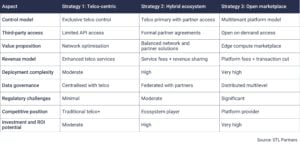
While all models are technically viable, they differ significantly in terms of control and operational requirements. These models are not mutually exclusive, meaning that telcos may evolve from one to the next over time, depending on strategy and market maturity.
If you are not a subscriber, enter your details below to download an extract of this report.
The aim of this report
There is strong agreement in the industry that AI will play a key role in the evolution of the RAN. The focus now is on identifying the most viable pathways to commercialise and operationalise it – both within existing operations and, over time, through new services and partnerships. This report aims to provide a structured exploration of AI-RAN from a commercial and operational perspective, with the following objectives:
- To outline a range of AI-RAN implementation strategies.
- To evaluate the associated business models for each strategy.
- To assess the conditions under which each strategy delivers value to telcos – considering the scale and timing of investments, potential cost efficiencies and opportunities for incremental revenue.
- To stimulate informed discussion and engagement around AI-RAN adoption and its commercial implications.
The report does not advocate for a specific AI-RAN strategy. Rather, it presents a set of preliminary analyses, assumptions and business cases intended to support telcos and vendors in evaluating AI-RAN options and shaping their strategic direction.
Table of contents
- Executive summary
- Recommendations
- AI-RAN is gaining momentum, but the commercial path needs to be explored further
- AI-RAN is a hot topic – and early signs are promising
- Efficiency benefits and, potentially, new revenue streams
- Ecosystem dynamics are still forming – offering players the chance to shape outcomes
- The aim of this report
- Mapping the AI-RAN landscape: Three models, rising complexity
- Overcoming commercial barriers: Evolving mindsets and models
- What scale of demand is needed for a six-year payback?
- The critical role of ecosystem partnerships
- Shaping the telco role in AI-RAN
- Our recommendations
Related research
- Skywatch: STL Partners’ satellite tracker
- Telco generative AI adoption tracker
- Networks for AI: Segmenting the growth
- Edge computing market sizing forecast: Fourth release