Login to access
Want to subscribe?
This article is part of: Consumer, Enterprise Platforms, Executive Briefing Service
To find out more about how to join or access this report please contact us
With core connectivity revenue growth proving elusive, telcos are looking to increase efficiency while expanding their offerings and generating new revenue streams. This report scopes out the opportunities for telecom operators in supporting digital identification and authentication.
Overview of the digital identity opportunity
The digital economy suffers from sever identity-related pain points across fake content and reviews, age-appropriate content, phishing, fake personas and bots, advertising and marketing waste, and transaction fraud. As illustrated below, some of these are rapidly expanding and the need for solutions to address them will become increasingly urgent and important.
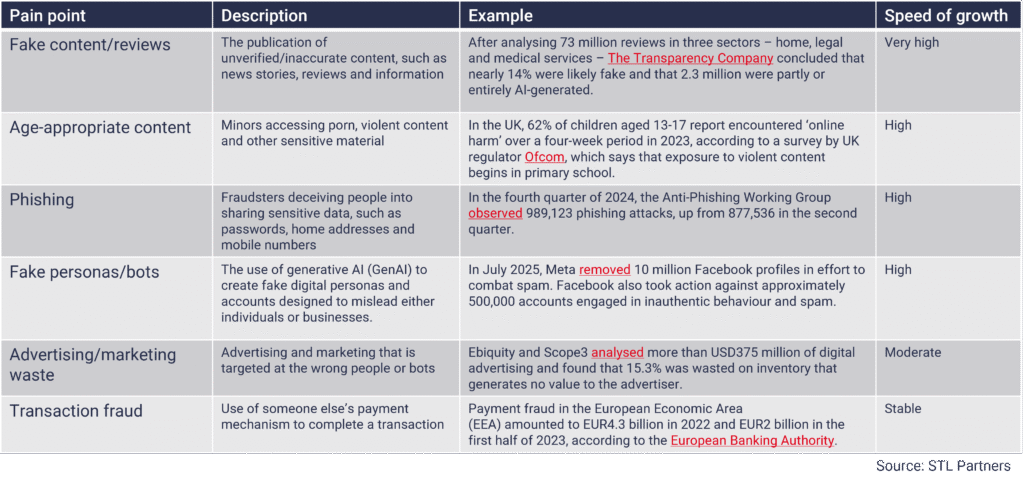
Alongside these challenges, websites and online businesses also need to distinguish between humans and bots. With the rise of agentic AI and search summaries generated by AI, consumers are less likely to visit websites directly.
As a result, one of the Internet’s primary business models – the attention economy, which is funded by digital advertising, is at risk of breaking down.
Websites and apps are responding by requiring more rigorous registration processes. For example:
- Although Reddit users are not required to post under their own names, the social media platform wants to ensure people posting to its site are human rather than AI bots. It is exploring the use of World ID, the eyeball scanning technology from Worldcoin venture.
- TikTok is using network APIs from telcos for authentication and is looking to employ them to support age verification.
If you are not a subscriber, enter your details below to download an extract of this report.
Key technical enablers of digital identity services
Telco enablers:
- SIM cards, which are designed to securely grant access to services
- Standardised network APIs, which operators can use to easily share real-time network information with third parties
- SMS and RCS – operator-managed messaging services
- AI analysis of the behavioural data captured by telecom networks, such as locations visited and calls made
Non-telco enablers:
- Fingerprint and facial recognition through smartphones – Apple and Google dominate this
- Authentication apps such as Microsoft Authenticator which supports two-factor authentication for access to Microsoft accounts
- Digital wallets that reside on smartphones – again Apple and Google dominate this
- AI analysis and behavioural data captured by handset operating systems and apps (such as locations visited)
Table of contents
- Executive summary
- Overview of the digital identity opportunity
- Online advertising
- Targeted advertising and marketing
- In-person authentication
- Identification
- Conclusions
Related research
- Mobile network APIs: Building successful commercial models
- How well do telcos work together?
- 5G: The next phase
- Digital identity: Four steps to maximising value