Login to access
Want to subscribe?
This article is part of: Network Innovation
To find out more about how to join or access this report please contact us
The telecom industry is going through a period of material change in respect to the silicon it utilises. This report examines the key dynamics and considerations in the locations where processing demand is at its highest: the RAN and AI factories.
Silicon has risen up the agenda for operators
The digital economy is going through significant change in relation to the silicon it is leveraging; telecom is no exception. There have been several internal and external changes that have driven silicon considerations up the agenda for telcos.
Internal forces
Network disaggregation:
- In disaggregated networks, operators can theoretically take greater ownership in determining the hardware (and by extension the silicon) that is deployed in different areas of the network. A role that previously lay more definitively with NEPs.
- To achieve the ultimate vision of disaggregated networks – and its promised benefits of flexibility, adaptability and lower cost – operators must become more discerning customers. This means understanding hardware down to the silicon level to ensure procurement decisions meet performance, efficiency and cost criteria.
AI for networks:
- The telecom industry is investing heavily in the systematic, end-to-end deployment of AI across the network stack. These investments aim to improve efficiency, reduce operating costs, manage rising network complexity, and enhance adaptability, with the ultimate goal of achieving high levels of network autonomy.
- This ambition is prompting operators to evaluate the silicon they require in order to support AI that will enable a self-configuring and self-optimising network.
External forces
Networks for AI:
- As traditional connectivity services become commoditised, operators have looked to new avenues of growth.
- One such service beyond connectivity is AI factories. This refers to data centres architected specifically to host the three primary types of AI workload, training, inferencing and fine-tuning, enabling telcos to support and monetise enterprise AI.
- This area of monetisation requires operators to consider the silicon they must operate to enable them to process the corresponding workloads – i.e., AI accelerators, such as GPUs, to host enterprise AI workloads.
Macro pressures:
- There is an array of macroeconomic and geopolitical factors that are making silicon decisions in the telecoms industry more critical.
- These include:
- Energy costs
- Net-zero targets
- Margin pressures
- Geopolitical tensions
- Shortages in chip supply
If you are not a subscriber, enter your details below to download an extract of the report
This report examines the silicon dynamics in two key environments
This report focuses on the locations within a telecoms operator’s estate where processing demand is highest, and where the choice of silicon matters most – AI factories and the RAN.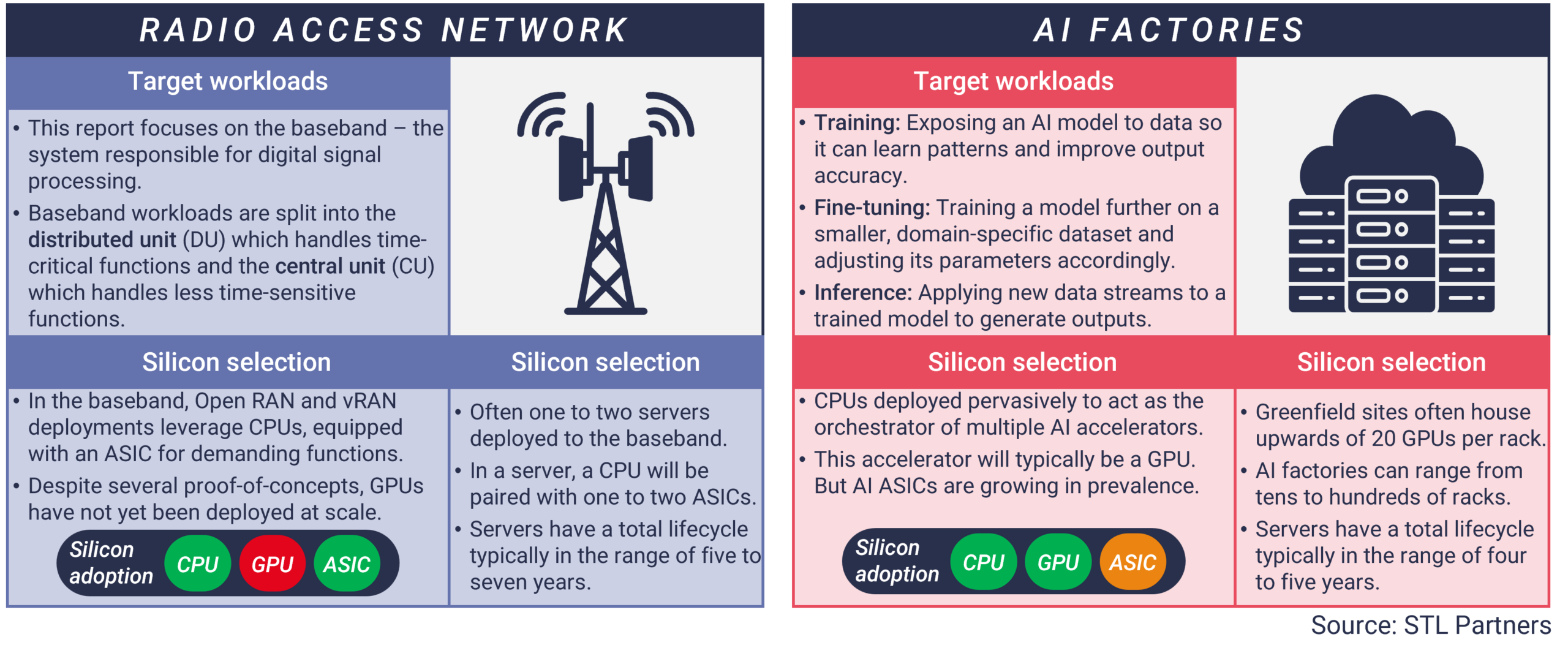
Table of contents:
- Executive summary
- Introduction
- Silicon implications for hosting enterprise AI workloads
- AI is transforming the silicon landscape, driven by Nvidia GPUs
- There are significant challenges in hosting accelerated compute
- AI ASICs will disrupt this landscape in the medium-term
- Operational, not technological, sovereignty is a key consideration
- Recommendations for operators hosting enterprise AI workloads
- Silicon implications for embedding AI in the network
- The drive for network autonomy will not materially change silicon in the telco network
- The same is true for greater integration of AI in the RAN for internal usage
- Disaggregation at the RAN has not materially altered the underlying silicon landscape
- Recommendations for operators embedding AI in the network
- Silicon taxonomy
Related research:
- Hyperscalers in the telco vertical: The future is hybrid
- The telecom industry in the AI era: How telcos can follow the money
- Telefónica – Autonomous networks case study
- Telco cloud deployment tracker Q1 2025: The various flavours of open RAN
- Sovereign AI: A strategic playbook
