
hero-banner

Consulting Category Archives

From opportunity discovery to go-to-market: incubating a new data centre venture for a Nasdaq-100 hardware company

Case study overview

STL Partners worked alongside a Nasdaq-100 hardware company over 16 months to help identify, validate and launch a new venture in the data centre market. Starting with a broad scan of opportunities across the data centre ecosystem, the engagement narrowed to a high-potential play in liquid cooling monitoring and maintenance, before progressing through demand validation, go-to-market preparation and partner engagement.

STL supported a growing client team to:

  • Identify the highest-value opportunities across the data centre industry with respect to the client’s existing capabilities and hardware IP
  • Quantify the addressable and obtainable market, and validate both demand and willingness to pay through multiple industry surveys at critical junctures
  • Secure internal sponsorship and external partnerships needed to take the venture to market

“STL were an invaluable part of our team for the first year of our new venture in liquid cooling. Their deep market and commercial expertise in data centres combined with a flexible and bespoke approach to the engagement was a combination we would’ve really struggled to find with a different consultancy.”

Head of New Ventures Group, Nasdaq-100 hardware company

What was the approach?

STL Partners delivered an integrated, multi-phase programme that took the client from a long list of possible plays through to active partner conversations.

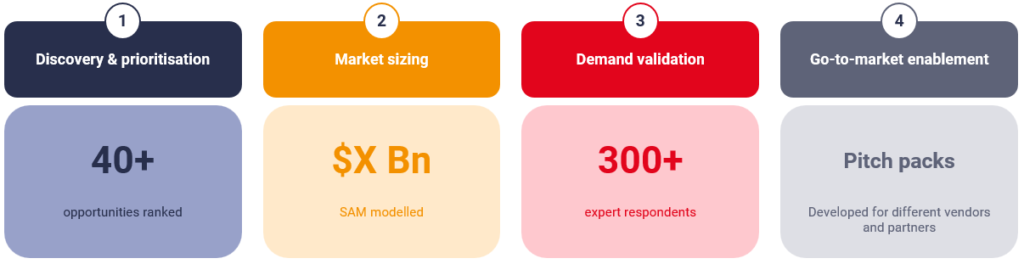
1.Opportunity discovery and prioritisation

We ran a structured scan of the data centre ecosystem, combining desk research with expert interviews to surface and assess opportunities across hardware, power, cooling and connectivity. Over 40 opportunities were ranked against market attractiveness and right-to-win criteria, and a shortlist of top ventures was taken forward for deeper evaluation. The client then chose to proceed with a liquid cooling monitoring and maintenance solution as the priority opportunity.

2.Market sizing for chosen priority opportunity

For the chosen priority opportunity in liquid cooling monitoring and maintenance, we built a bottom-up TAM/SAM/SOM model to quantify the addressable market for data centres. This gave the client the confidence to invest in product development and shaped the framing of the commercial case to internal stakeholders.

3.Demand validation through two industry surveys

We designed and ran two large-scale industry surveys, gathering responses from more than 300 expert respondents in total. The surveys validated the SAM assumptions, tested customer archetype hypotheses and refined go-to-market messaging, confirming an untapped commercial opportunity and informing how the venture should be positioned in the market.

4.Go-to-market enablement and internal advocacy

In parallel, we produced segment-specific pitch packs to accelerate conversations with coolant distribution unit (CDU) vendors and data centre operators, and developed internal steering committee decks that secured sponsorship across the wider business, enabling continued investment in the venture.

Key results from the project

  • 40+ opportunities in the data centre market space evaluated and ranked, with top ventures shortlisted for pursuit
  • TAM/SAM/SOM built for the priority opportunity in liquid cooling monitoring and maintenance
  • 300+ expert respondents across two surveys validated SAM assumptions and refined go-to-market messaging
  • $X billion dollar untapped SAM identified in liquid cooling monitoring and maintenance
  • $3 million dollar annual run rate of investment unlocked internally for the venture
  • Partnership in the works with a leading CDU vendor to take the product to market
  • Integrated team support delivered over 16 months including venture pitch, competitor analysis and go-to-market activities


Validating the business case for enterprise AI infrastructure and platform services​

Case study overview

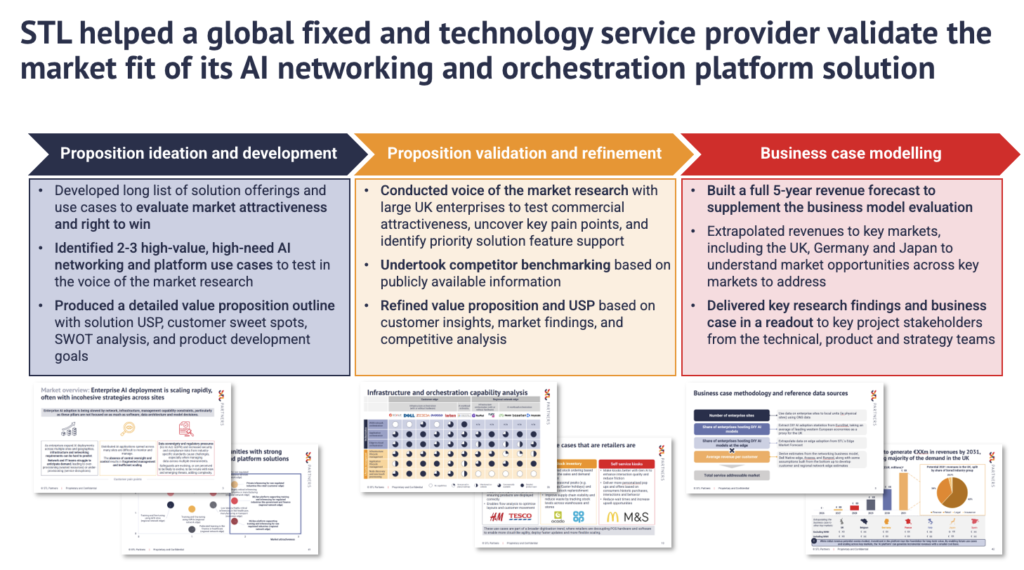
STL supported a global telecoms and technology service provider to validate the value proposition for its AI-enabled WAN, and workload management and orchestration platform solution, to develop a business case for launch.​

Enterprises are increasingly exploring how to deploy AI across diverse operational environments but often lack cohesive infrastructure and management strategies. As a result, organisations face challenges predicting infrastructure demand, monitoring distributed edge AI workloads, and meeting evolving data sovereignty and regulatory requirements. ​

A global fixed and technology service provider identified two emerging AI service opportunities – an AI-enabled WAN, and an AI workload management and orchestration platform solution – that seek to address enterprise AI demand and deployment bottlenecks.​

Our client engaged STL Partners to help define and validate the value proposition and assess its commercial potential. The project aimed to gather direct feedback from potential enterprise customers on key pain points, infrastructure preferences and willingness to pay, while also analysing the competitive landscape and market opportunity.


What was the approach?

To address the problem statement, STL Partners was asked to conduct a structured validation process to assess the market fit of the client’s solutions, spanning three key stages: proposition ideation, validation and refinement, and business case modelling.​

This included voice of the customer interviews with senior enterprise decision-makers, market analysis and stakeholder workshops, bringing together an assessment of the market attractiveness and client’s right to win across both solution areas. Building on these insights, STL developed a five-year business case to evaluate revenue potential. ​

The outcome was a set of strategic recommendations to refine its AI value proposition aligned to priority target customer segments and solution feature set and define a practical go-to-market and investment strategy.


Key results from the project

  • Evaluated 11 enterprise AI opportunities (e.g. private inferencing, training, fine-tuning by industry and edge location) on market attractiveness and client’s right to win to tailor solution to market demand​
  • Identified 3 high-value use cases across 3 target industries with strong demand for edge AI infrastructure for the client to address​
  • Interviewed 6 large UK enterprises in a voice of the market research to validate market fit and customer value​
  • Assessed 11 competitors against a comprehensive capability evaluation framework with 25 criteria’s spanning infrastructure and edge and AI workload orchestration capabilities​
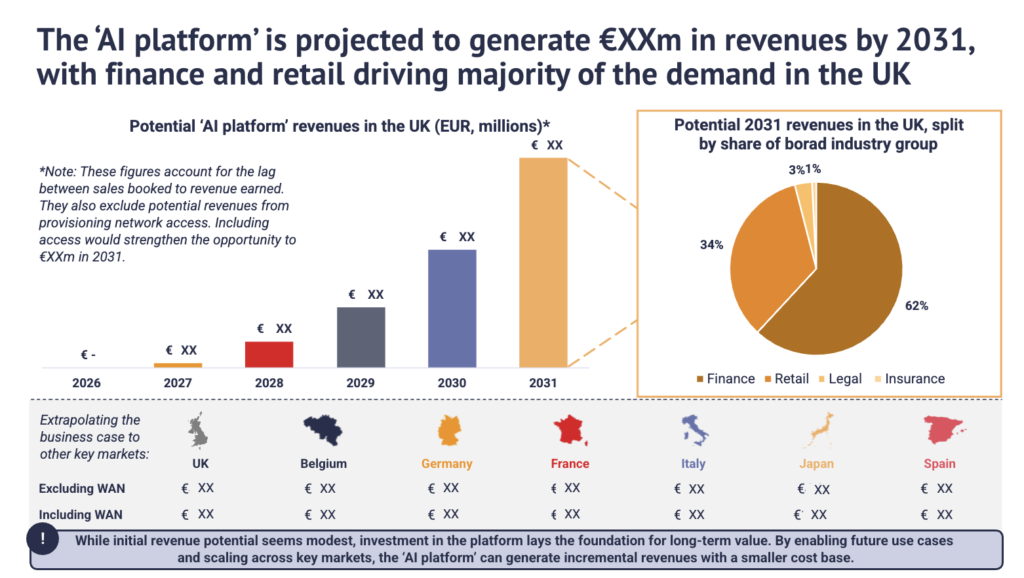
  • Modelled a 5-year revenue forecast to support business case evaluation, extrapolating to 6 additional markets to reflect client’s reach

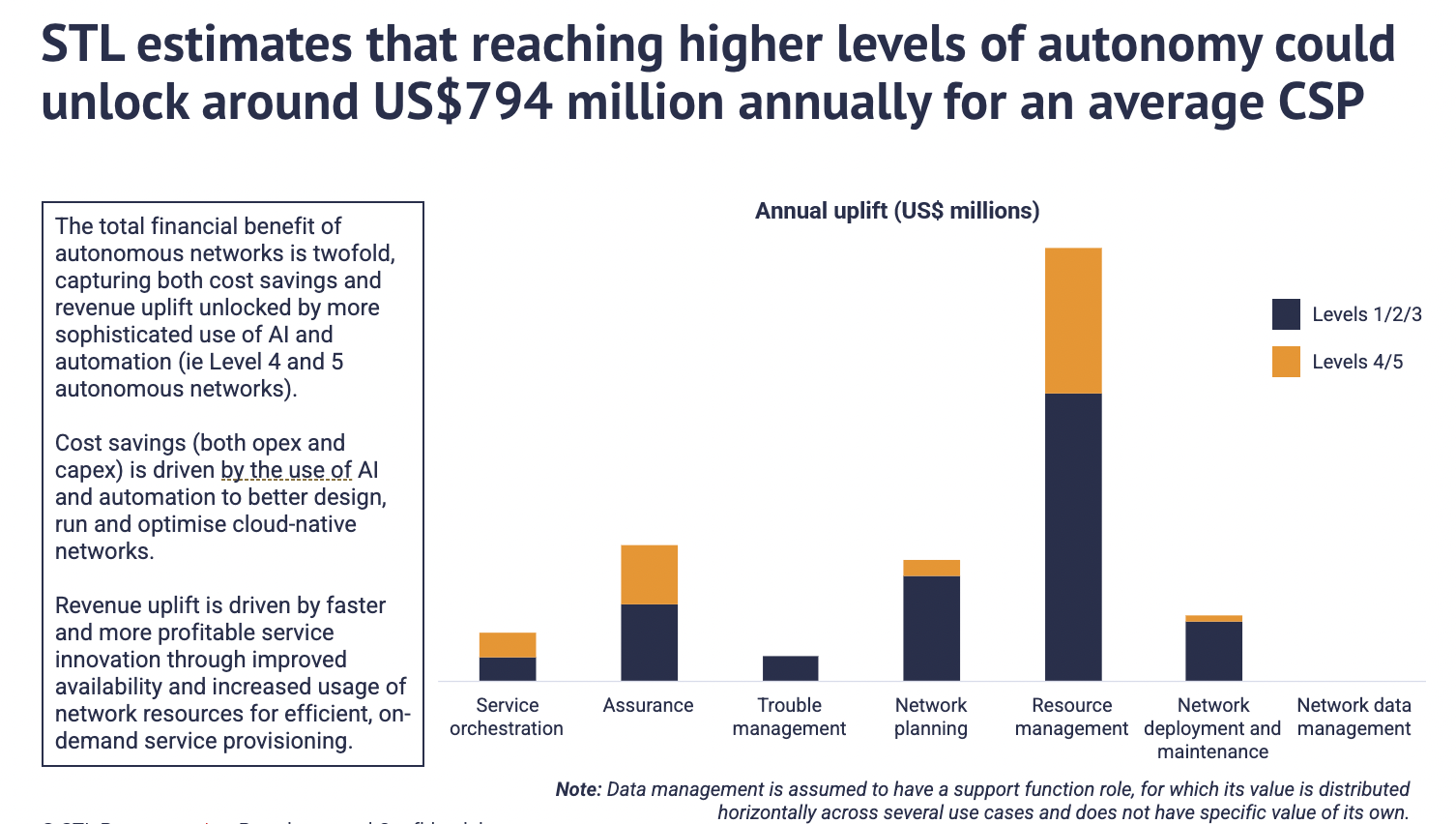
Assessing the $800M potential of driving higher levels of network autonomy​

Case study overview

STL helped a major NEP evaluate how service providers can achieve higher network autonomy, leveraging our unique financial model to quantify the financial benefits of Level 4 and 5 autonomy.​

CSPs are facing rising network complexity and growing pressures to deliver new servicesprofitably. ​

To address this, they must move towards greater network autonomy, but many encounter significant challenges when adopting advanced automation and intelligence.​

A major network equipment provider asked STL Partners to identify the fundamental challenges service providers face in achieving greater network autonomy and recommend practical efforts for overcoming these. ​

Our client asked STL to develop a thought-leadership report outlining how CSPs can navigate these challenges and implement the fundamental enablers needed to accelerate their journey to higher levels of network autonomy, unlocking the full financial promise of automation and intelligence.


What was the approach?

To address the key problem statement, STL conducted targeted interviews with service providers to evaluate their current progress, approach, and key challenges in achieving greater network autonomy, gathering direct insights from industry experts and senior executives. Combined with STL’s existing research on the financial benefits of greater network autonomy, the insights delivered fresh perspectives and practical insights.​

To complement this analysis, STL tested and iterated its financial model that explores the impact of AI, automation and analytics (A3) on networks, and explored the financial benefits for telcos that move from Level 1/2/3 to Level 4/5 network autonomy (as defined by the TMForum).


Key results from the project

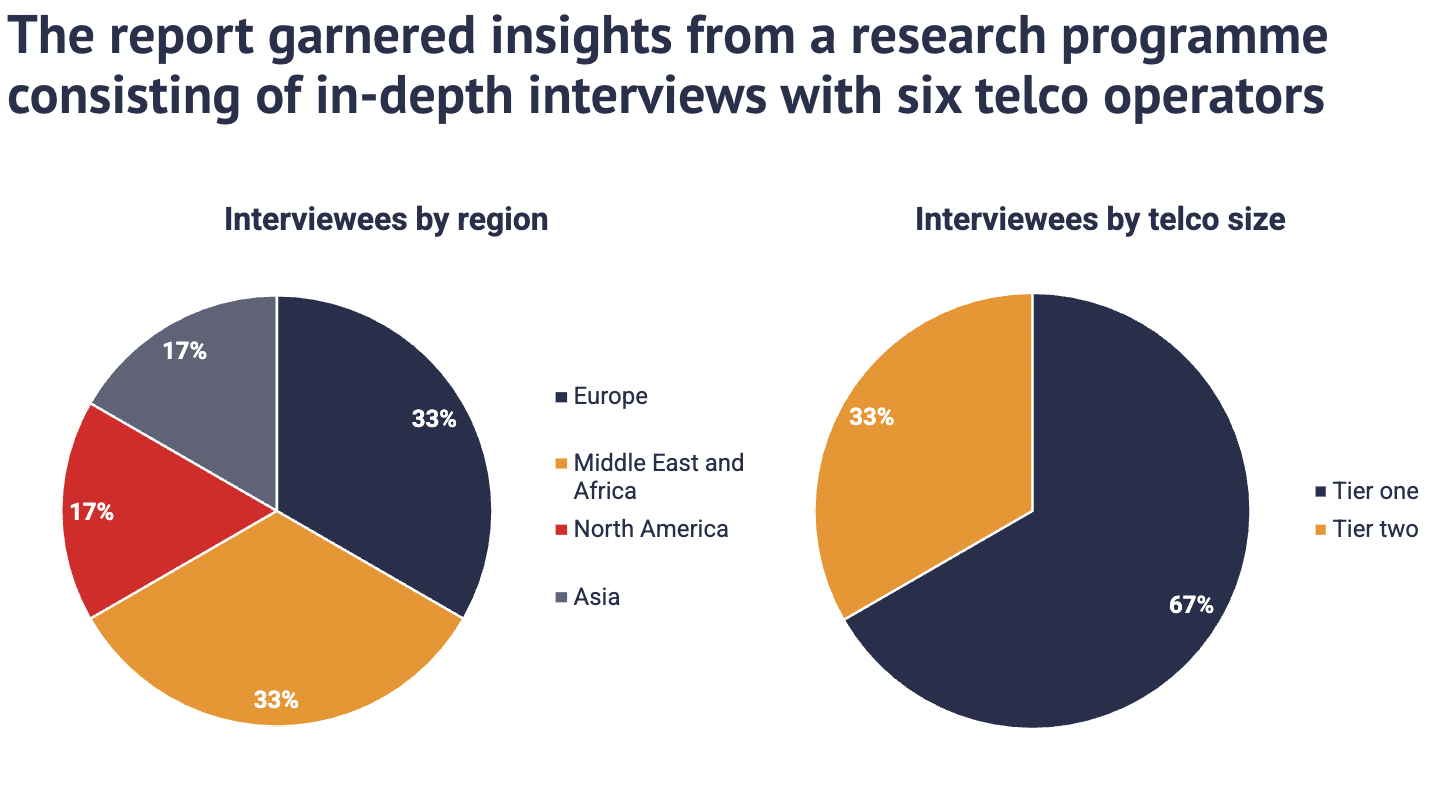
  • Interviewed 4 global operators, including both Tier-1 and Tier-2 CSPs​
  • Evaluated the 5 key challenges service providers face in moving beyond Level 1 to 3 network autonomy​
  • Identified AI and automation capabilities to achieve Level 4/5 autonomy​
  • Highlighted 6 operators case studies on their progress to maturing network autonomy​
  • Defined 5 actionable recommendations for service providers to overcome key challenges​
  • The research has been cited by leading industry forums across creditable public domains, including Forbes and the TM Forum.

Evaluating how AI is transforming the future of enterprise connectivity​

Case study overview

STL Partners collaborated with a global technology leader to explore how AI is shaping enterprise network demands and how these shifts should inform future network development roadmaps.​

We conducted a series of in-depth interviews with enterprises to understand both the current impact of AI and the future outlook for networking requirements — including implications for latency, reliability, security, and more.​

​The research enabled us to categorise AI applications into four broad profiles, each with distinct implications for network design and performance. We also highlighted nuances across industries and use cases.​

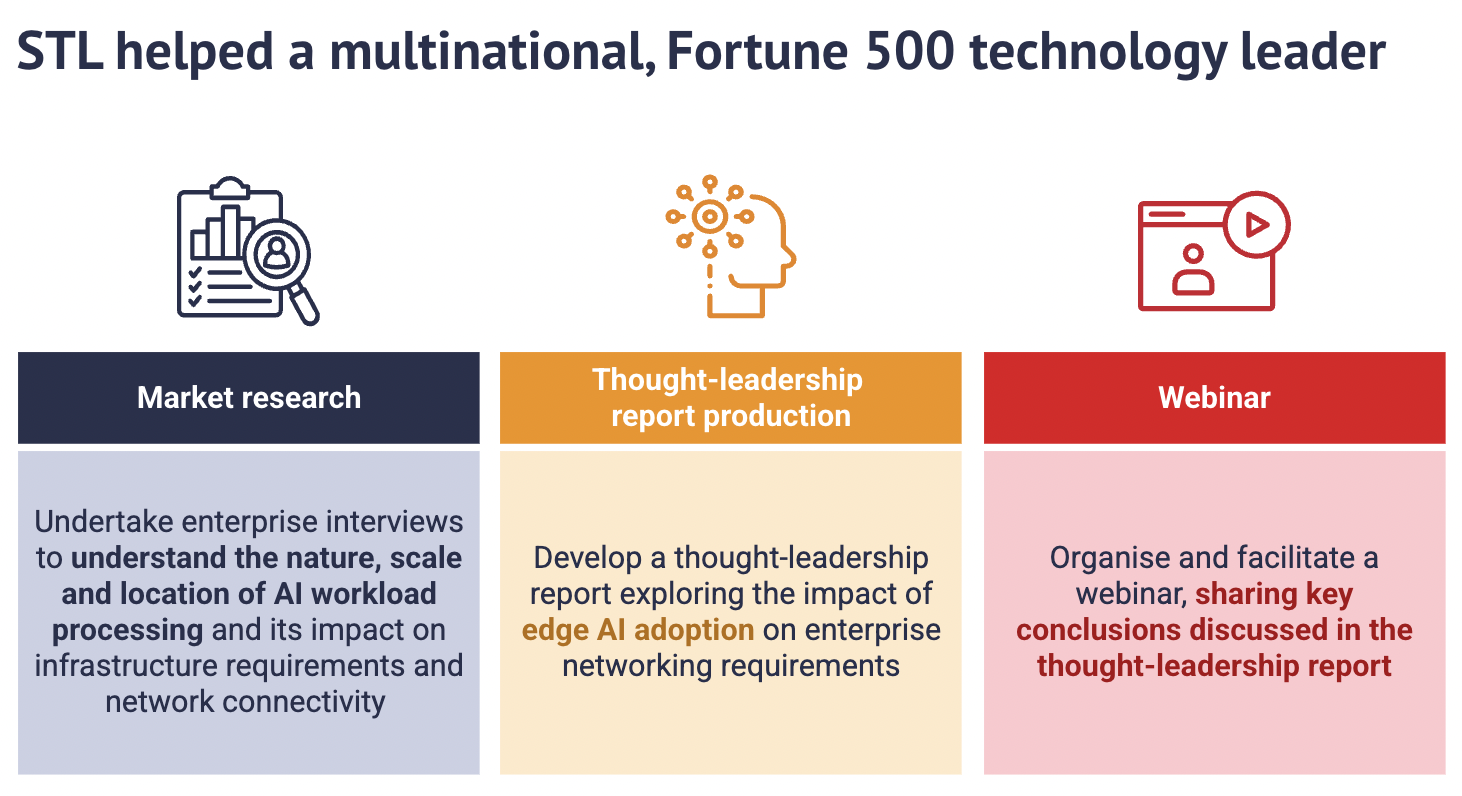
​Drawing on these insights, STL developed a concise thought leadership report and hosted a webinar to share research findings.​

​We also created a set of key questions for network and IT decision-makers to consider when developing their AI strategies and infrastructure roadmaps. These insights — centred on the location and nature of AI workloads — along with the broader analytical framework, formed the basis for practical, forward-looking strategic recommendations.


What was the approach?

STL Partners designed a three-phase project to deliver strategic insights and marketing assets on howAI is reshaping enterprise networking and connectivity.​

​We began with a series of in-depth interviews with senior network and IT decision-makers from large enterprises across multiple verticals. These conversations explored how organisations are adopting AI today and how use cases are likely to evolve — examining the types of AI applications being deployed, where workloads are processed across the edge-to-cloud continuum, and how this impacts network performance, reliability, and security.​

Drawing on these insights, STL developed a practical framework to help enterprises assess the impact of AI on their future networking requirements. This framework underpins a thought-leadership report and supporting webinar designed to engage key industry stakeholders.


Key results from the project

  • Interviewed 4 senior network decision-makers across large enterprises from various industry verticals​
  • Defined 4 enterprise AI use case areas​
  • Produced a thought-leadership report on the impact of edge AI on enterprise networking ​
  • Hosted an industry webinar, with 150+ live attendees and 500+ leads

​​Showcasing AI’s impact on telecoms and unlocking new operator monetisation opportunities​ 

Case study overview

STL worked with a global OSV to engage telecom operators globally on the topic of AI, identifying the priorities, pain points and practical lessons shaping operators’ AI strategies.

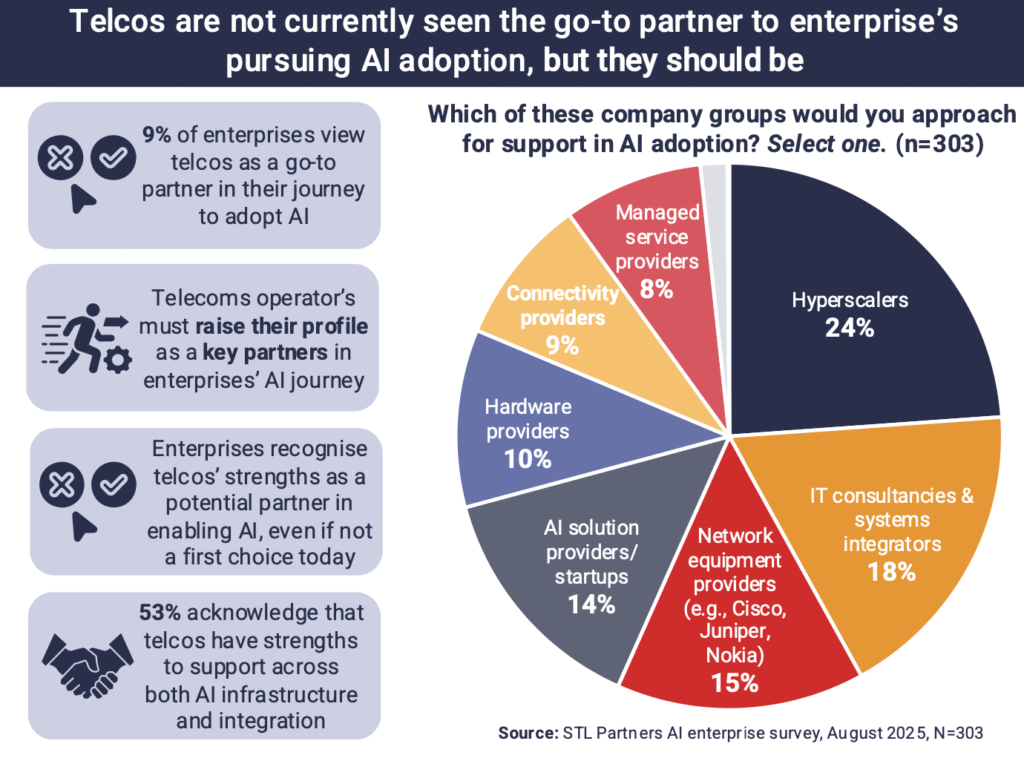
STL Partners conducted research on behalf of Cisco, aiming to understand how AI is reshaping the telecoms industry and identify where the strongest monetisation opportunities lie for telecom operators. To achieve this, STL gathered insights from across both enterprise and industry stakeholders via in-depth interviews and a global enterprise survey. STL also produced a bottom-up impact model that quantifies the impact of AI workloads on telco networks. These inputs enabled STL and Cisco to articulate both the scale of AI’s influence on the telecoms industry and identify the concrete opportunities operators can pursue. 

To share these insights, STL delivered a suite of marketing assets that are tailored for Cisco’s telecoms audience: two whitepapers, three infographics, two animated videos, an industry article, a webinar, and a series of bespoke workshops for major global operators. 


Key findings

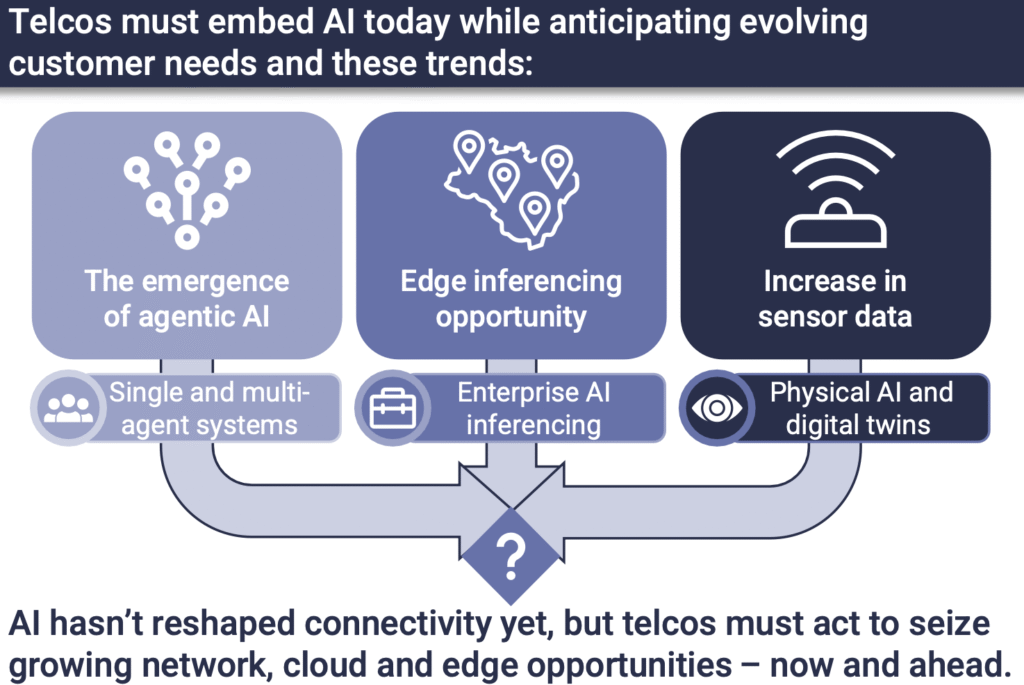
  • While AI won’t significantly raise total access network volumes, it will have a profound targeted impact: boosting demand for data centre interconnect and high-performance enterprise connectivity in certain segments, with new expectations around security, reliability and flexibility 
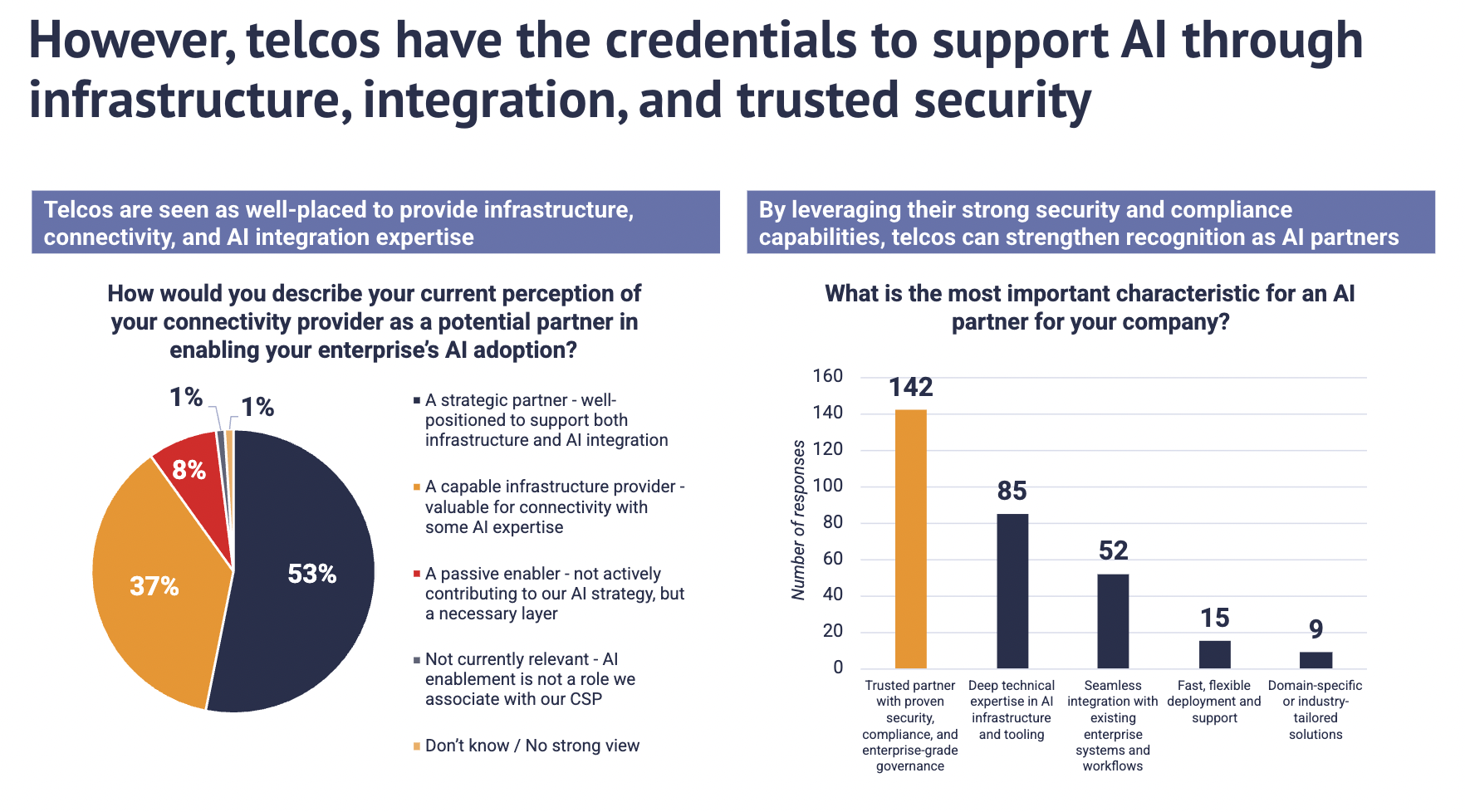
  • Operators risk being overlooked as AI partners unless they lead with strengths around security, sovereignty and resilient infrastructure—not just connectivity. 
  • The biggest monetisation opportunities sit in two places: 
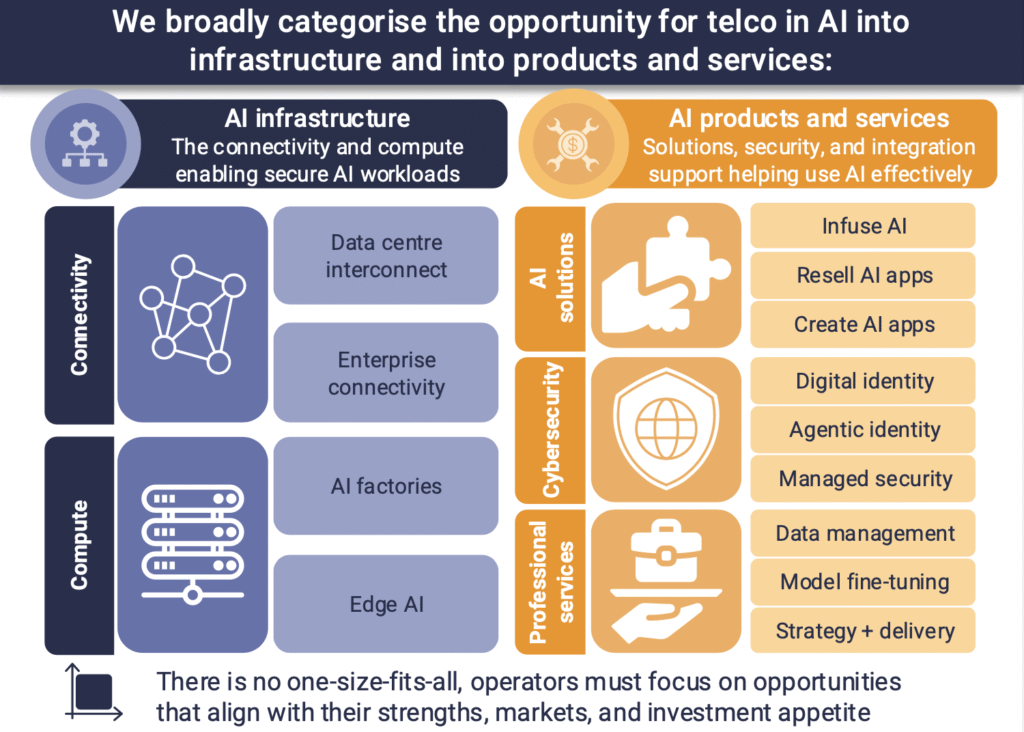
    • AI infrastructure (secure, scalable compute and connectivity for enterprise AI workloads) 
    • AI products & services (cybersecurity, integration, vertical solutions) that help enterprises adopt AI effectively. 
  • Interestingly, enterprise demand is shifting faster than many operators expect—our global survey showed strong appetite for telcos that can support early-stage AI planning and deployment. 

What was the approach? 

STL applied a robust, multi-method research approach combining qualitative, quantitative and modelling-based analysis: 

Expert interviews: 

Fourteen in-depth interviews with senior leaders across telecom operators, wholesale connectivity providers and data centre operators to understand how AI is influencing network strategy, investment priorities and customer expectations. 

Global enterprise survey: 

Targeted survey of 303 enterprise AI decision-makers (August 2025), focusing on organisations with over 1,000 employees across North America, Europe, the Middle East and Central Asia, spanning verticals such as retail, financial services, manufacturing, professional services and healthcare. 

AI traffic impact model: 

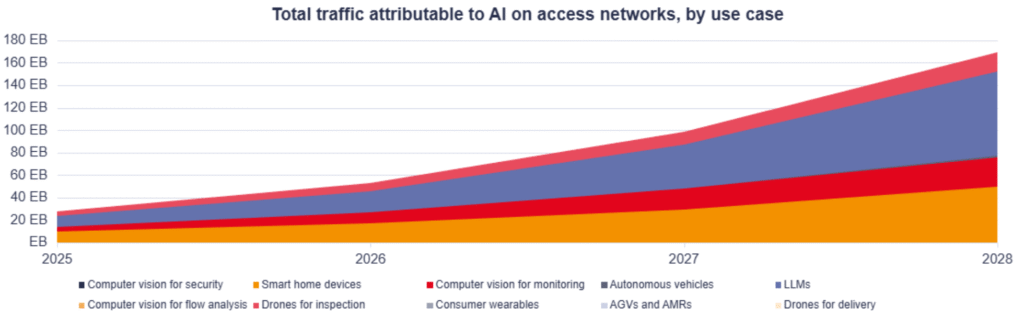
Bespoke bottom-up model that quantifies incremental access-network traffic generated by emerging AI use cases between 2026 and 2028. 

  • Identified ten high-intensity AI applications (e.g., computer vision for monitoring and flow analysis, autonomous vehicles, large language models), using STL proprietary datasets to estimate endpoint growth, workload distribution across edge and cloud, and associated bandwidth requirements. 
  • Calculated traffic by combining endpoint volumes, workload execution location and annual uplink/downlink demand for each use case. 
  • Segmented outputs to highlight how AI-driven traffic varies across consumer vs enterprise usage, fixed vs mobile access, and video vs non-video workloads—providing Cisco with granular insight into where AI will most reshape operator networks. 

This evidence base was then synthesised into clear, engaging marketing deliverables that help Cisco educate and influence telecoms stakeholders on the true commercial opportunities created by AI. 


Deliverables from the project 

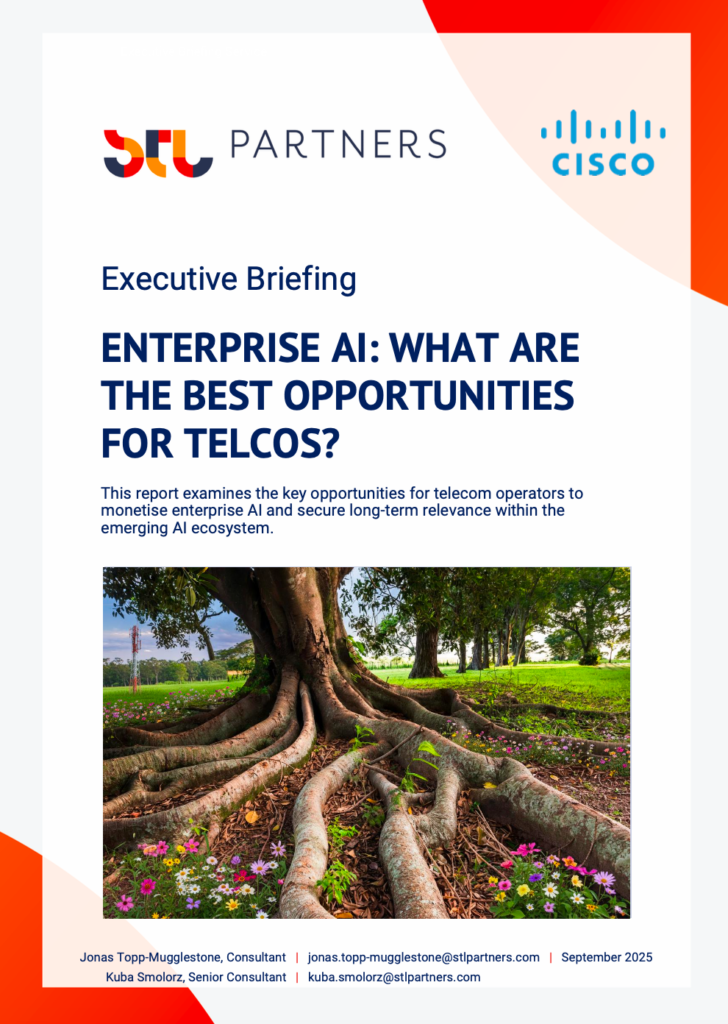
Whitepaper 1 – Enterprise AI: What are the best opportunities for telcos?

This report examines the most promising opportunities for telecom operators to monetise enterprise AI and secure long-term relevance within the evolving AI ecosystem. 

Whitepaper 2 (WIP) – How can telcos turn opportunity into impact in enterprise AI? 

This follow-on report outlines how telcos can translate the prioritised enterprise AI opportunities into tangible impact. It focuses on the practical requirements to execute effectively, differentiate in a crowded market, and deliver measurable value. 

Infographic 1 – How can telcos become more relevant enablers of AI?  

Highlights how AI is reshaping infrastructure requirements and enterprise demand—and identifies where telcos can play a central role in enabling secure, scalable AI deployment. 

Infographic 2 – How can telcos become go-to partners in enterprise AI. 

Shows that operators must focus on the domains where they hold the strongest right to play, across both AI infrastructure and AI products and services. 

Infographic 3 – What are the best opportunities for telcos to enable and monetise enterprise AI?  

Illustrates the two-fold telco opportunity: 

  • AI infrastructure: Connectivity and compute supporting secure AI workloads 
  • AI products and services: Solutions, integration and cybersecurity helping enterprises adopt AI effectively

Video 1 – How can telcos raise their profile as go-to partners for AI?  

Explores why telcos are often overlooked today and outlines how they can elevate their position as trusted AI partners by leading with security, sovereignty and resilient infrastructure – not just connectivity. 

Video 2 – What are the best opportunities for telcos to enable and monetise enterprise AI?  

Focuses on the enterprise AI opportunity, emphasising that strong internal AI adoption is a critical first step that equips operators with the capabilities and credibility needed to support customers’ AI journeys. This video has resonated strongly with the industry, generating over 10,000 views. 

Industry article – How can telcos become more relevant enablers of AI? 

Discusses how service providers can better understand and address long-term enterprise needs by engaging early in customers’ AI planning and decision-making. 

Webinar – The opportunity for telcos to enable and monetise enterprise AI 

Explores how telcos can build credibility to move beyond connectivity and become trusted AI infrastructure partners. The session attracted significant interest, with 162 live attendees and 592 registrants. Topics included the key enterprise AI opportunities, as well as practical steps for operators to reposition, execute and scale effectively. 

Operator workshops 

Delivered tailored workshops for three Tier-1 operators – two in the Middle East and one in Europe. Each session shared the core findings from the research programme, with recommendations customised to the operator’s market context, maturity and strategic priorities. 

The state of telco AI and what operators should do next​

Case study overview

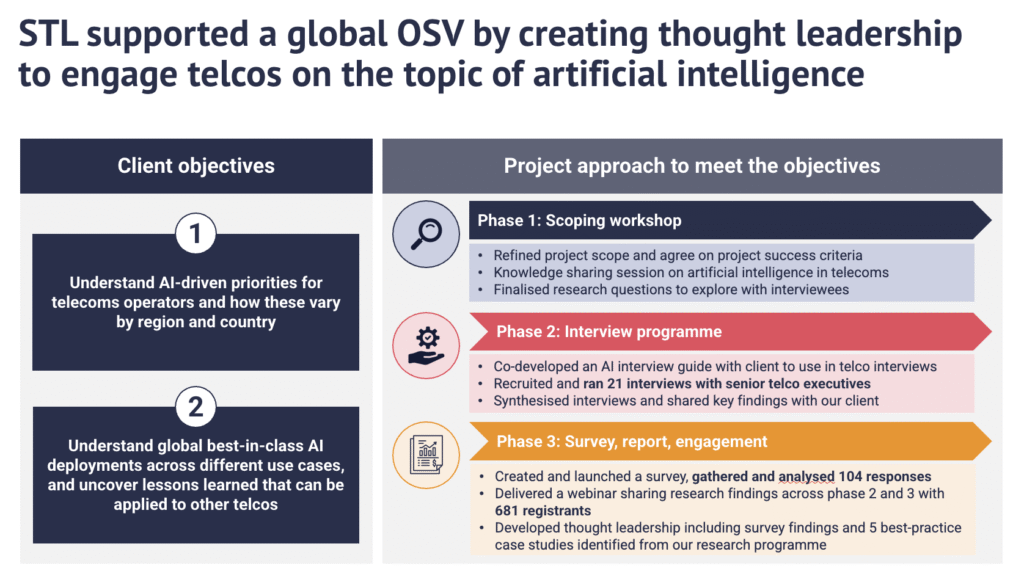
STL worked with a global OSV to engage telecom operators globally on the topic of AI, identifying the priorities, pain points and practical lessons shaping operators’ AI strategies.

AI is a strategic focus across the telecoms industry, with major advancements raising the expectations for telcos to capitalise on the opportunity and accelerate AI adoption across their operations. ​

Despite the hype, there is a lack of consensus around best-in-class development, deployment and governance of AI use cases.​

RedHat engaged STL Partners to explore how AI is shaping the telco landscape, from the use cases delivering real value, to the internal capabilities’ telcos must develop for successful adoption. ​

Based on primary research with senior telco executives, STL identified operators’ AI priorities, use cases and deployment best practices, producing a thought-leadership report and supporting marketing collateral with clear recommendations on how telcos can accelerate their AI progress.


What was the approach?

STL undertook an extensive research programme with telcos across the globe, engaging commercial, technical, and strategy executives, along with AI leads, through in depth interviews and a survey. These insights identified:​

  1. AI priorities for telecoms operators, including regional nuances ​
  2. Best-in-class telco AI deployments, including specific use cases​
  3. Key success factors learned from operator deployments​

Following this, we synthesised our research findings to gather a real-time view of the AI landscape –covering telco priorities, progress and pain points.​

We consolidated these findings into a thought-leadership report and accompanying infographic that highlighted the current state of AI maturity and set out strategic recommendations for operators to capture additional cost efficiencies and revenue opportunities.​

STL Partners then promoted the insights across multiple channels — including a webinar series, in-person workshops, and virtual roundtable sessions — to spark industry dialogue and engagement with senior telco executives.


Key results from the project

  • Interviewed 21 global Tier-1 and Tier-2 telco operators ​
  • Surveyed 104 strategy, technical, and commercial AI leads​
  • Identified 4 best-in-class operator case studies​
  • Developed a thought leadership report to promote research findings​
  • Hosted 2 successful webinars with 200+ live attendees and generating 680+ leads​
  • Produced a marketing-style infographic to highlight key research findings​
  • Conducted an in-person workshop with EMEA-based technology leaders and strategists​
  • Co-presented a virtual roundtable with leading North-American telco executives

Mapping the Gen AI skill development roadmap for a hyperscaler​

Case study overview

STL partnered with a leading hyperscaler to develop a strategic framework that prioritises GenAI skill development based on the organisation’s specific implementation needs.

The topic of generative AI gained significant momentum in 2023 and remains front of mind for many CSP decision-makers, given its potential to create significant value across the telecommunications industry. However, CSPs encounter significant challenges when implementing and deploying Gen AI across internal operations as well as in customer-facing products and services, impacting their ability to extract value from their efforts.​

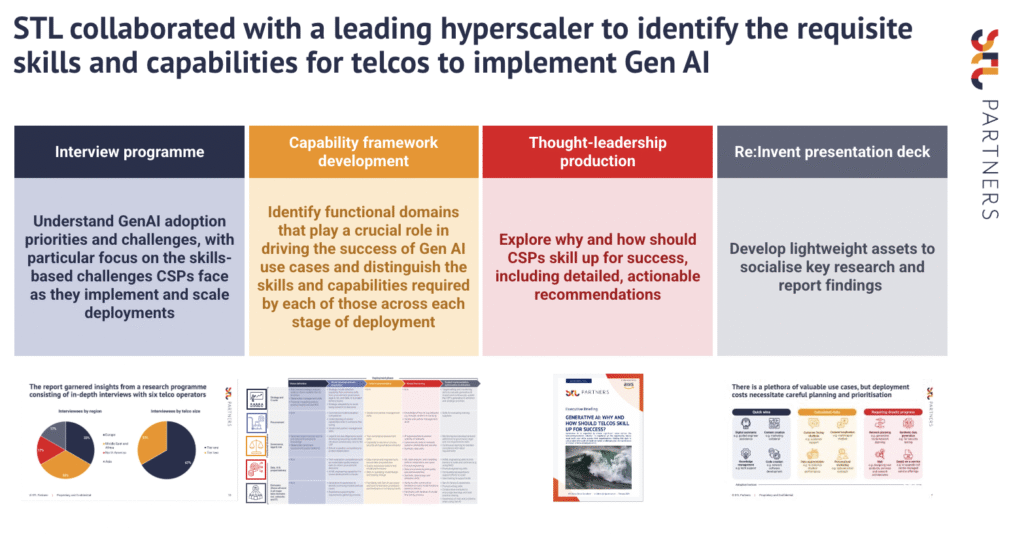
AWS approached STL Partners to explore the challenges that CSPs face as they adopt Gen AI, particularly those pertaining to internal skills and capabilities.​

Our client asked STL Partners to develop a piece of thought leadership that explores the challenges CSPs face in building the necessary capabilities – and how AWS can position itself as a strategic partner in addressing these challenges.


What was the approach?

Following a series of in-depth interviews with senior telco stakeholders and decision-makers focused on Gen AI deployment, STL developed a comprehensive framework that categorises the skills and capabilities required for success in Gen AI implementation. The framework highlights the different skills required across various organisational domains. ​

We then developed detailed assets based on insights from primary research, highlighting why and how telcos should upskill up for success and maximise the value of GenAI. These included a thought leadership report and a presentation deck to support our client socialise key research findings internally.


Key results from the project

  • Interviewed 6 global operators, including both Tier-1 and Tier-2 CSPs​
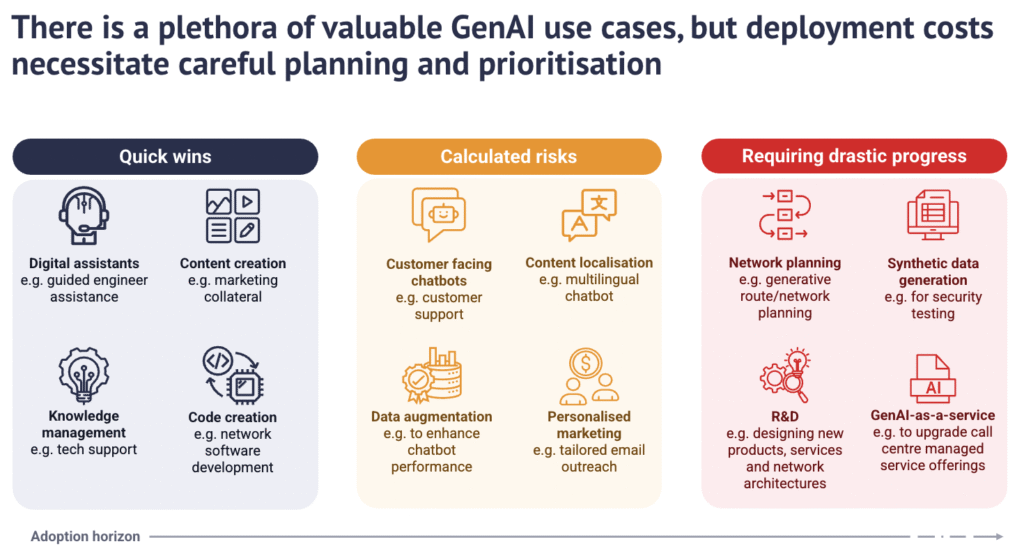
  • Identified 12 key internal and external Gen AI use cases (e.g. digital assistants, personalised marketing, network planning), mapped by adoption maturity​
  • Defined the critical skills and capabilities required across 5 core functional domains -strategy, procurement, governance, legal and risk, data and AI, and end users – aligned to deployment phases from vision definition to scaled implementation​
  • Shared findings at AWS Re:Invent

Shaping the edge data centre go-to-market strategy for a US-based cooling vendor

Case study overview

STL Partners was engaged by a US-based provider of cooling systems for data centres, looking to capture a share of the growing edge opportunity by tailoring its solutions for emerging infrastructure needs.

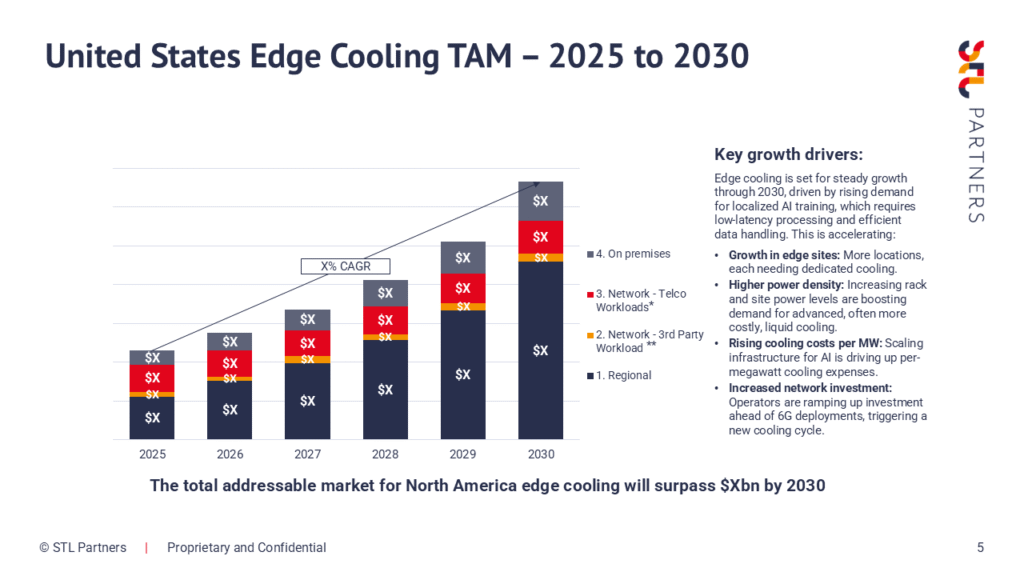
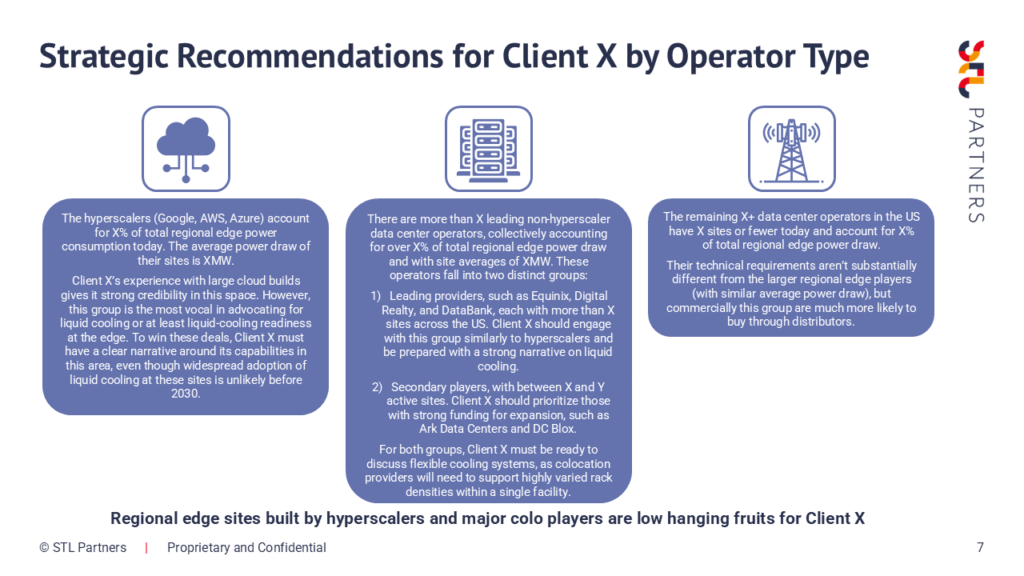
To support this, the client needed a clearer view of where demand is emerging across the edge data centre landscape, which cooling solutions are best suited to different environments, and how to shape a go-to-market strategy that aligns with the needs of prospective customers. STL undertook voice of the market research, produced a revenue forecast (TAM, SAM, SOM) and produced strategic recommendations to guide prioritisation and positioning.


Example deliverables

What was the approach?

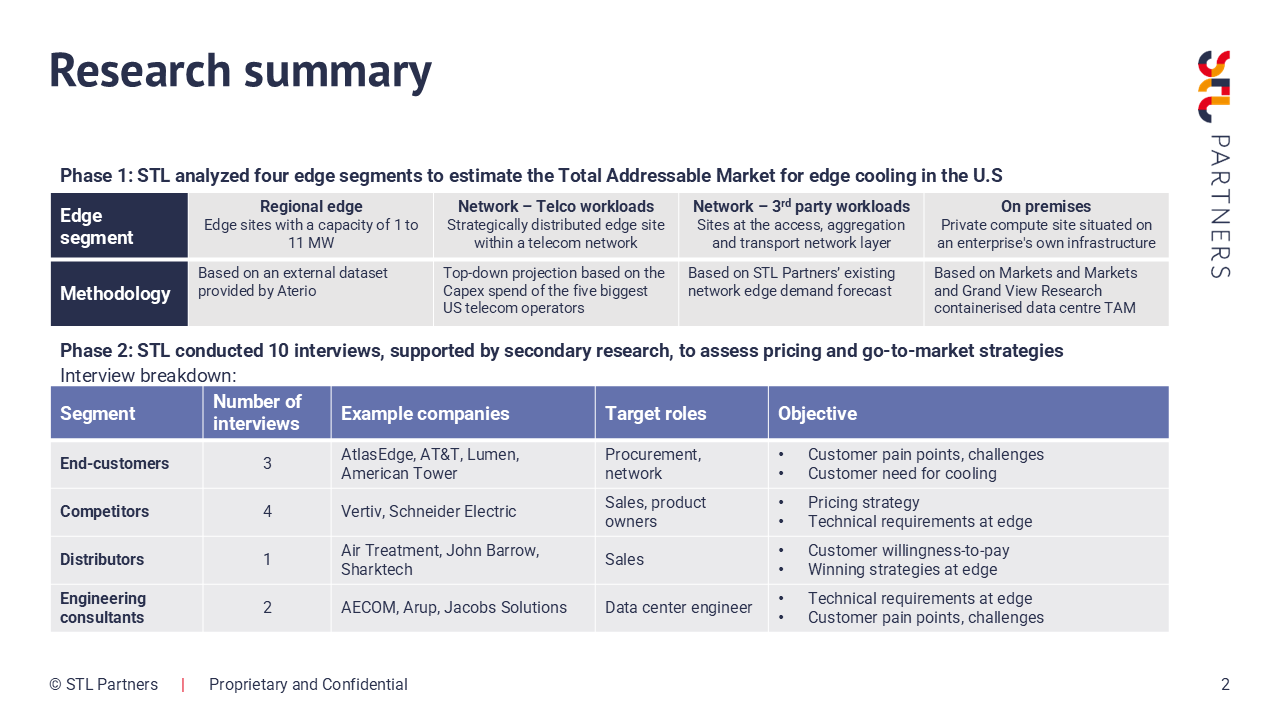
STL sized the total addressable market for edge cooling in the US by analysing four edge segments:

  • Regional edge (1–11MW sites)
  • Network – telco workloads (operator-owned edge nodes)
  • Network – third-party workloads (access, aggregation, and transport layers)
  • On-premises (enterprise-owned compute at the edge)

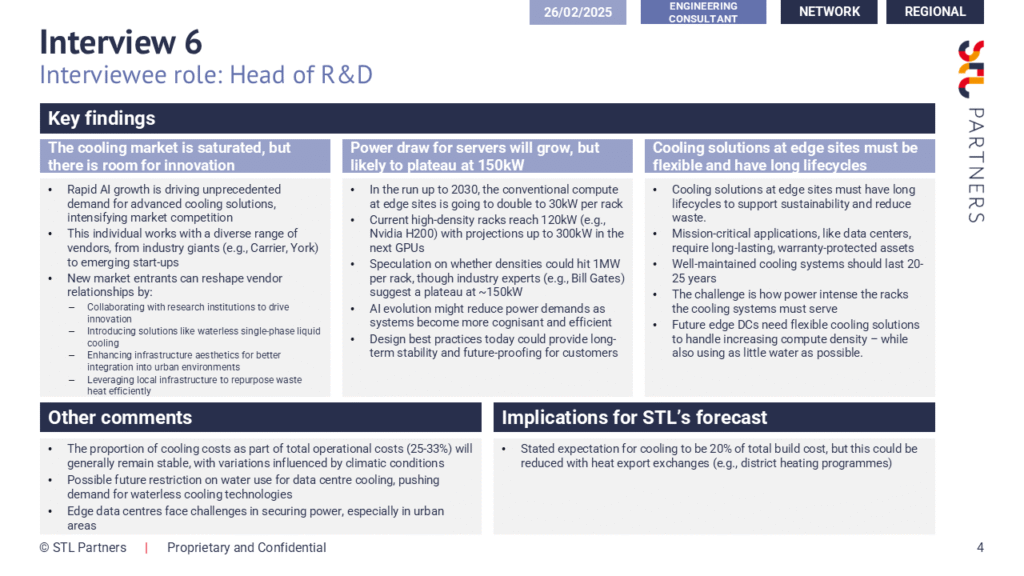
e team also conducted interviews with 10 stakeholders across the edge cooling ecosystem, spanning end-customers, competitors, distributors, and engineering consultants, to gather insights on demand drivers, customer pain points, technical requirements, and pricing strategies.


Key results from the project

Edge cooling market model:

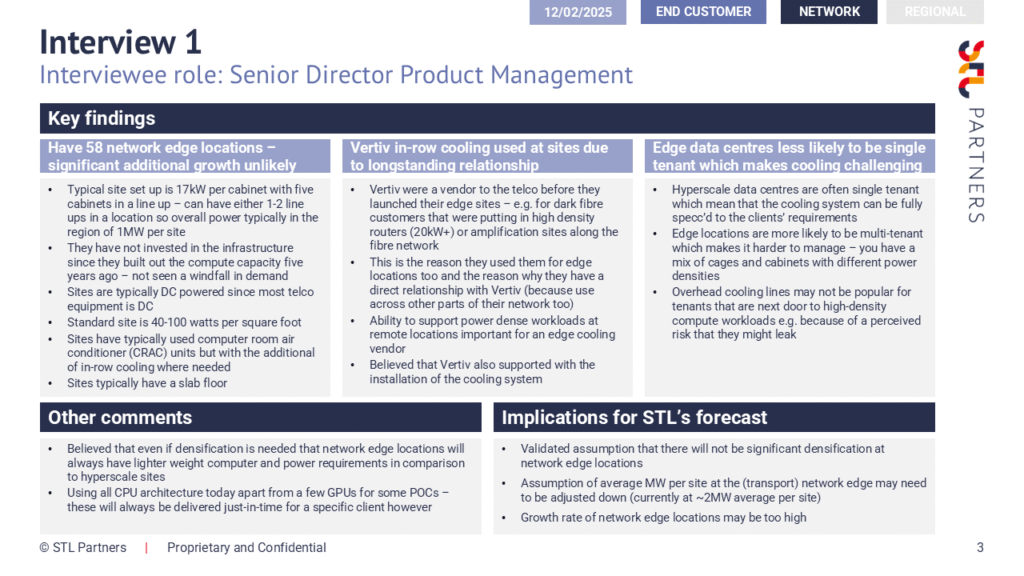
  • STL estimated the total and serviceable addressable market for cooling equipment across the four edge data centre segments, projecting revenue potential to 2030 and identifying the share addressable by the client.

Product-level analysis:

  • STL tested key cooling system types and feature sets in the voice of the market research, understanding which was most prevalent in the edge sector today (monobloc cabinet cooler, in-row DX, CRAH, CRAC and chiller and different types of liquid cooling).

Go-to-market strategy:

  • TL identified the market segments with the greatest commercial potential for the client and outlined how to approach target customers. Recommendations included segment prioritisation, messaging, and how to differentiate based on the client’s existing and upcoming capabilities.

Example deliverables

Building ROI tool and accelerating sales for mobile private networks in manufacturing

Case study overview

Our client, a leading network equipment provider (NEP), was one of the first to launch a mobile private networks offering in the market and had set ambitious revenue targets it needed to meet. It had secured a global Tier-1 telecoms operator as its go-to-market partner and wanted to ensure take-up from enterprises to meet these targets.

However, mobile private networks was new at the time and there were risks to meeting revenues. It was difficult for enterprises to understand what the technology was, how it could benefit their business and what advantages it could provide versus alternatives, such as Wi-Fi and industrial network technologies. At the time, the cost of implementing such a solution were not well understood either, particularly in terms of the integration and other services that would be required to operate it in an industrial environment and the level of CAPEX and OPEX investments.

Our client needed to quickly help its telecoms operator partner upskill its sales team to move from selling fixed network products to taking a consultative approach selling a mobile technology solution.


Example deliverables

What was the approach?

  • Identify 16 manufacturing use cases and prioritise to form the basis of the ROI tool
  • Interview 13 companies and used survey with 200 manufacturing professionals to identify benchmarks on the benefits on OEE from the mobile private network use cases
  • Work with the NEP to build a cost model of the mobile private network solution, including how radio equipment and services costs changed depending on use cases chosen, throughput required and site size
  • Work with telecom operator to build in pricing models and mark-up mechanism to help sales team use tool to understand potential size of deal
  • Develop an interactive ROI tool for the manufacturing sector
  • Test the tool with both the NEP, telecoms operator client and a friendly enterprise customer
  • Build training materials and run training sessions to hand over the tool to the client
  • Developed materials for sales playbook – including target personas

Key results from the project

  • Sustained success of partnership – NEP extended the partnership to other countries, including the U.S., and has maintained it for over 4 years
  • Quantified the benefits of 4 use cases across a 5-year period for 3 different site sizes, over 10 countries and assessing 3 different commercial models
  • Demonstrated benefits of private mobile networks, e.g. USD 26 million revenue benefit for a 70 square km factory over 5 years (from a total investment of USD 5 million)

Example deliverables


Selecting go-to-market partners for a global technology vendor in private networks

Case study overview

A global technology vendor decided to enter the private networks market. However, as the solution only makes up a small part of a private networks offering, the client decided to look for a partner who could lead the go-to-market.

– They were looking to identify a shortlist of priority partners who aligned both with the client’s strategy and with their proposed value proposition in private networks

– The client wished to understand the current proposition and strategy of proposed partners in private networks, what their joint value proposition in private networks would be, and develop a pitch to secure partnership

– The client asked STL Partners to develop and execute a prioritisation process to identify a shortlist of priority partners to go-to-market in private networks, before compiling deep dives on each priority partner

Digital infrastructure: M&A opportunities Insights Pack

  • 4 key areas driving digital infrastructure demand
  • 9 TMT sectors dominating deal activity
  • 5 potential opportunities for investors to look out


Example deliverables

What was the approach?

STL carried out a 4-phase project to achieve the client’s objective:

1. Scoping: Internal client interviews to understand their product, strategy and value proposition in private networks, as well as identifying key partner parameters and objectives for subsequent phases. Initial longlist of 120 potential partners identified.

2. Voice of Partner (VoP) research: Extensive primary research phase interviewing 20 private network providers including MNOs, SI, and specialist private network vendors.

3. Partner prioritisation: Prioritisation process consisting of 4 rounds carried out to narrow 120 partners to 8 – 10 priority partners.

4. Partnership pitch creation: Deep dives compiled on each priority partner outlining their current offering and strategy in private networks, the proposed joint value proposition in private networks, and the client’s pitch for partnership


Key results from the project

20 interviews conducted with private network providers; 120 potential partners identified; 10 priority go-to-market partners selected; 10 partner deep dives created to outline the client’s partnership proposition and the joint value proposition in private networks.


Example deliverables


Defining the edge and private 5G go-to-market strategy for a leading European operator

Case study overview

STL was engaged by a client who had a mature public 5G offering, but wanted to understand the opportunity around private 5G and edge computing in depth. This meant evaluating the opportunity for each technology individually as well as part of a joint private 5G and edge campus offering. STL devised an approach that would support the client based on our understanding of their situation which was:

  • Strategy, product and marketing teams required greater insight from the customers in their markets to understand the drivers for demand, prioritise industries and use cases, evaluate the business opportunity, and tailor products, services and messaging
  • They also needed greater visibility of the supply-side market dynamics to understand who they could partner with to develop solutions and/or to sell through, including insights on how to pitch themselves as an attractive partner
  • The client asked STL Partners to size the market for private networks and edge, identify the key opportunities and outline the go-to-market strategy for private 5G and edge services, including key channel and solution partners

Consulting services overview

Get in touch to find out how we can help you:

  • Analyse market trends and dynamics
  • Conduct market sizing and forecasting
  • Prioritise initiatives for new growth

“STL did a great job in identifying the market opportunity for Edge Computing and Private 5G across our market. The STL team used a very professional and structured approach (planning, deliverables, etc.) that really helped us to gain a clear view of the market and ecosystem.”

Business & Proposition Lead, Multicloud & Edge

Tier 1 European Telecoms Operator

What was the approach?

  • STL undertook voice of the market analysis through interviews and surveys with local market enterprises, application providers, edge and private networks platform and solution providers
  • Synthesised the findings from the research to size the market, identify key use cases, verticals, solution and channel partners
  • Developed go-to-market strategy proposal for client
  • Delivered strategy workshop with multi-disciplinary representation from client teams

Key results from the project

  • Sized the market for edge and private networks across four industry verticals
  • 15 priority use cases identified across private networks and edge
  • 4 key use cases for the private 5G and edge campus proposition
  • 14 strategic recommendations informing the client’s G2M strategy
  • 100+ channel and solution partners identified


Example deliverables

Target identification case study

Identifying targets to support a tier-1 telco operator in APAC in pursuing 5G partnerships

Case study overview

STL Partners engages with clients to recognise prospective partners and facilitate fruitful conversations where there is opportunity. We help clients to evaluate, contract, qualify, and conduct discussions with new companies where there are synergies for collaboration. 

Below we outline how STL supported a Tier-1 operator in APAC to support 5G innovation: 

  • Identify the appropriate technology players/divisions and map to opportunity domains  
  • Prioritising and engaging candidates 
  • Facilitating discussions and devising clear next steps

Digital infrastructure: M&A opportunities Insights Pack

  • 4 key areas driving digital infrastructure demand
  • 9 TMT sectors dominating deal activity
  • 5 potential opportunities for investors to look out

Identify players and map opportunity domains  

STL Partners conceptualised and prioritised partners based on key criteria developed with the client. The targeted partners were ‘unusual suspects’ comprising of up-and-coming tech firms that the client had not previously spoken to. The process followed the below steps: 

  • Review and clarify 4-5 domains defined by the client (e.g. AR/VR, Network optimised products, clean-tech etc.)  
  • Build a long-list of 60 potential partners

Example deliverables


Example deliverables

Prioritising and engaging candidates 

STL Partners developed 20 detailed partner profiles for prioritised candidates with attributes for scoring. 

This was followed by conducting a prioritisation workshop to identify the top 10 candidates for taking to the next stage. Without revealing the identity of the client, STL selected both companies and individuals to engage with. These partners were briefed by STL on the scope, perspective, and expectation of the opportunity with the client before confirming their participation.  

Facilitating discussions and devising clear next steps  

STL facilitated discussions with 5-8 of these companies. STL also devised clear next steps, including supporting the development of a potential collaboration roadmap. 

Developing a healthcare proposition for on-premise edge computing

Case study overview

We undertake primary research programmes that deliver the insight needed to build tailored customer propositions, highlighting where and how our clients can create value for their customers. We develop channel strategies with our clients covering both online and offline direct channels, as well as partnering.

See how STL Partners supported a Tier 1 European operator:

  • Develop compelling propositions across key healthcare stakeholders
  • Map the value chain to identify partners, competitors, and the client’s role in the digital health ecosystem
  • Detail the viable go-to-market strategies for healthcare customers and next steps for launch

Consulting services overview

Find out how we can help you:

  • Develop and test customer propositions
  • Detail viable go-to-market strategies
  • Scout, engage, and facilitate partnerships
  • Develop tools to empower the salesforce

STL Partners worked closely with us to accelerate the process of building compelling value propositions, including specific use cases and propositions for the healthcare sector.

Senior Strategy Manager
Tier 1 European operator

Develop compelling propositions across key healthcare stakeholders

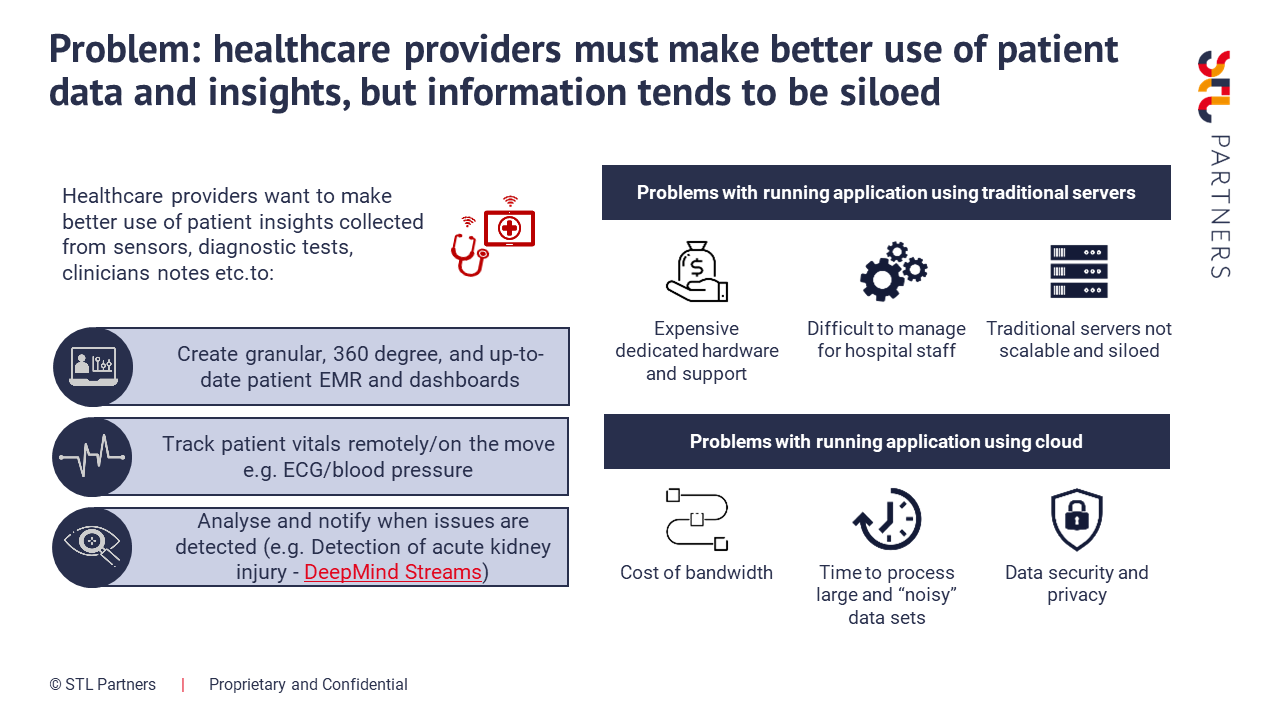
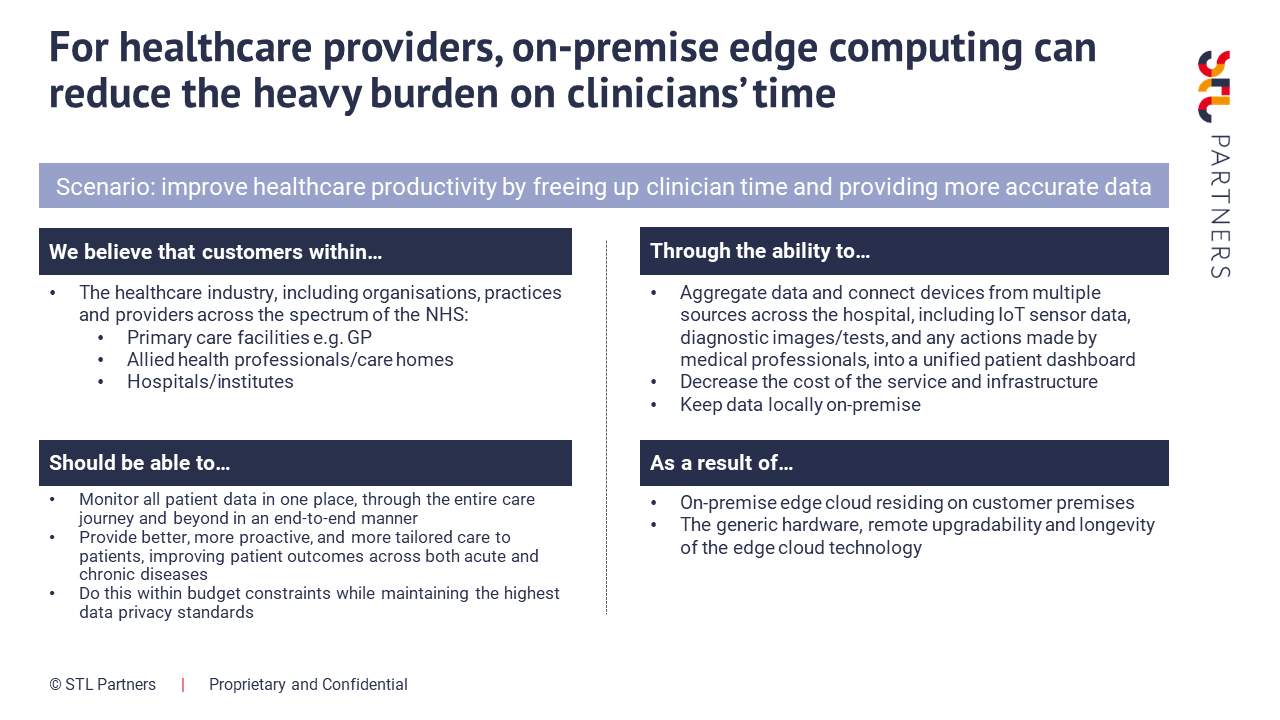
STL Partners undertook a 4-month strategy project with the client to help identify and prioritise key opportunities within on-premise edge computing. We prioritised the healthcare vertical and associated use cases, and subsequently developed the client’s go-to-market strategy and proposition to key healthcare stakeholders.

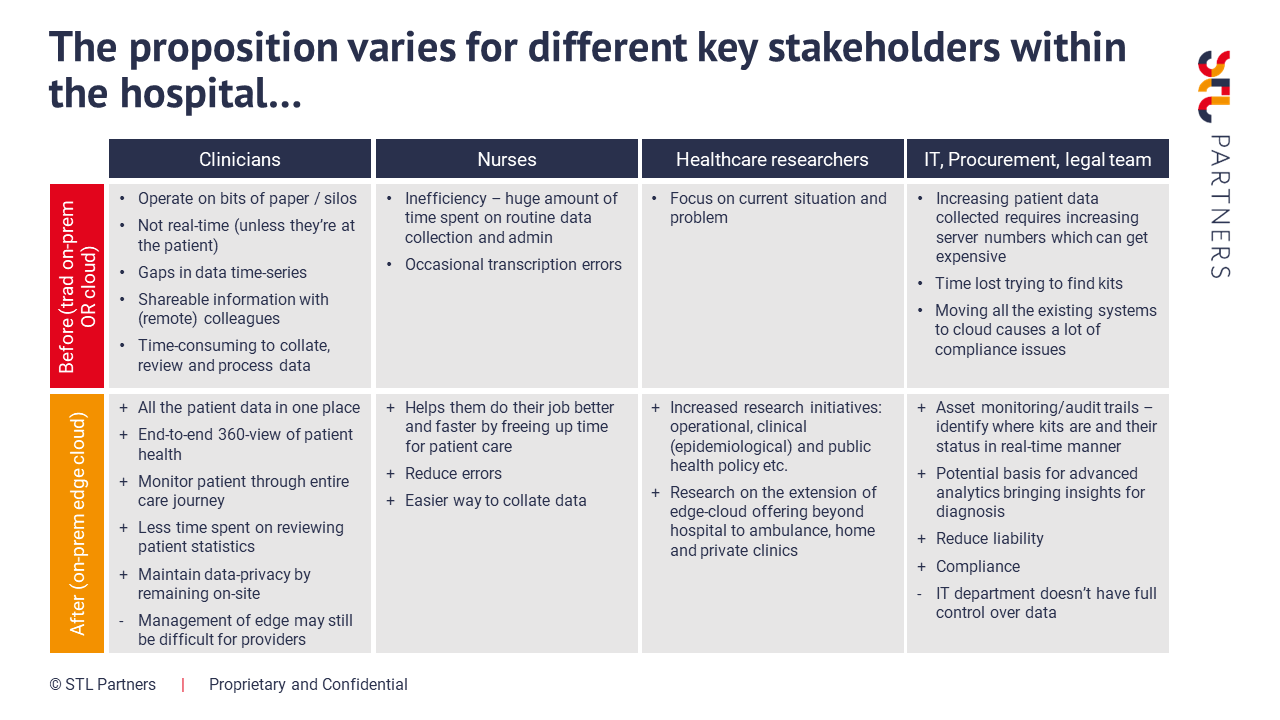
In order to complete this project, STL Partners leveraged an interview programme with potential customers, partners, and solutions providers in the digital health space to validate the use cases for edge, as well as their relevance to the client. From these insights, we generated a detailed value proposition and gaddi pitches for the use case to highlight key drivers for edge in healthcare and the challenges with existing solutions. STL Partners further developed propositions for the client across different stakeholder groups (e.g. the end user, IT teams, partners) to identify and highlight key pain points, benefits, and client messaging.

Example deliverables

Map the value chain to identify partners, competitors, and the client’s role in the digital health ecosystem

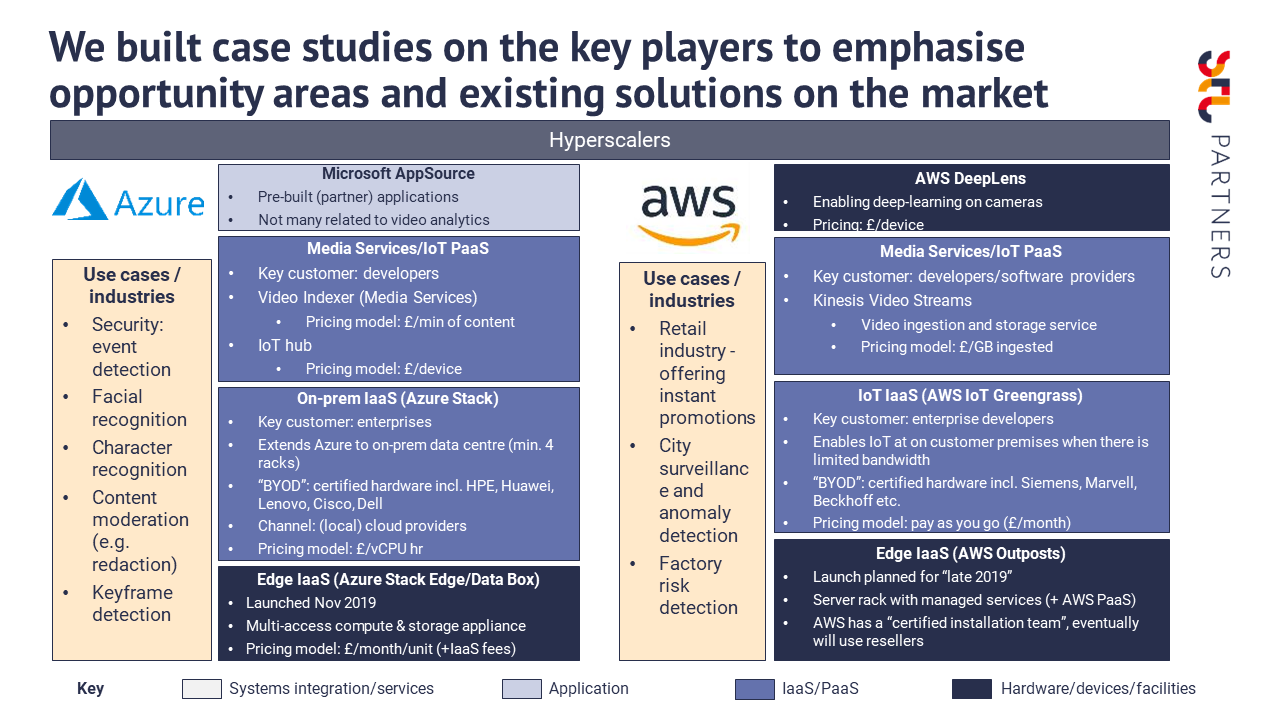
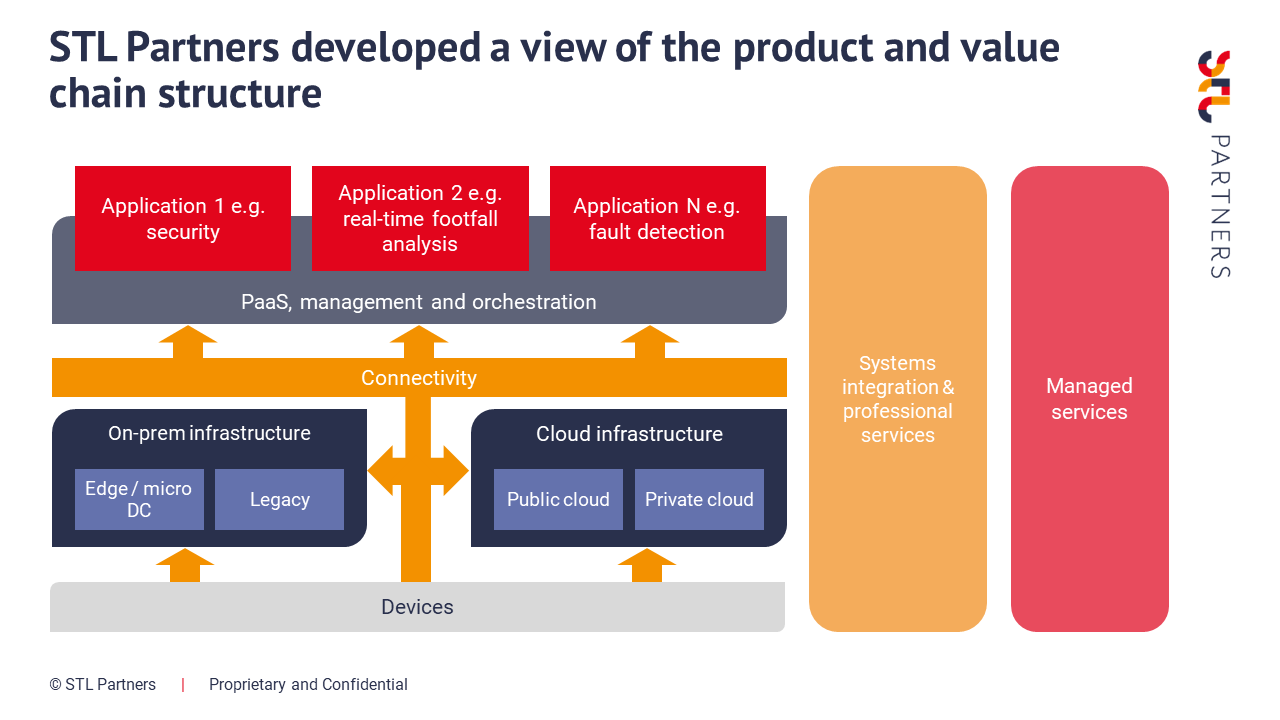
Through the interview programme and extensive desk research, STL Partners mapped out the healthcare ecosystem for our prioritised use cases. We developed the value chain segments and identified key players in each segment that were relevant for the client (either as competitors or potential partners).

Then, through a series of workshops with a wide stakeholder group within the client, STL Partners conducted an analysis of the client’s existing capabilities within digital health. We were then able to map competitor and partner capabilities against those of our client to identify opportunities and threats, as well as potential partner profiles.

Finally, we developed an activity map across the value chain to highlight how the use case would be delivered and the necessary activities for launch. From the analysis of the client’s capabilities, STL Partners highlighted where the service could be delivered solely by the client, and where the client should partner to deliver the service to healthcare providers. This fed into development of the viable business and partnership models for our client to pursue and identified the client’s role in the ecosystem.

Detail the viable go-to-market strategies and next steps for launch

The final stage of the project was to detail the viable go-to-market strategies for the client and present a clear recommendation of immediate next steps for launch.

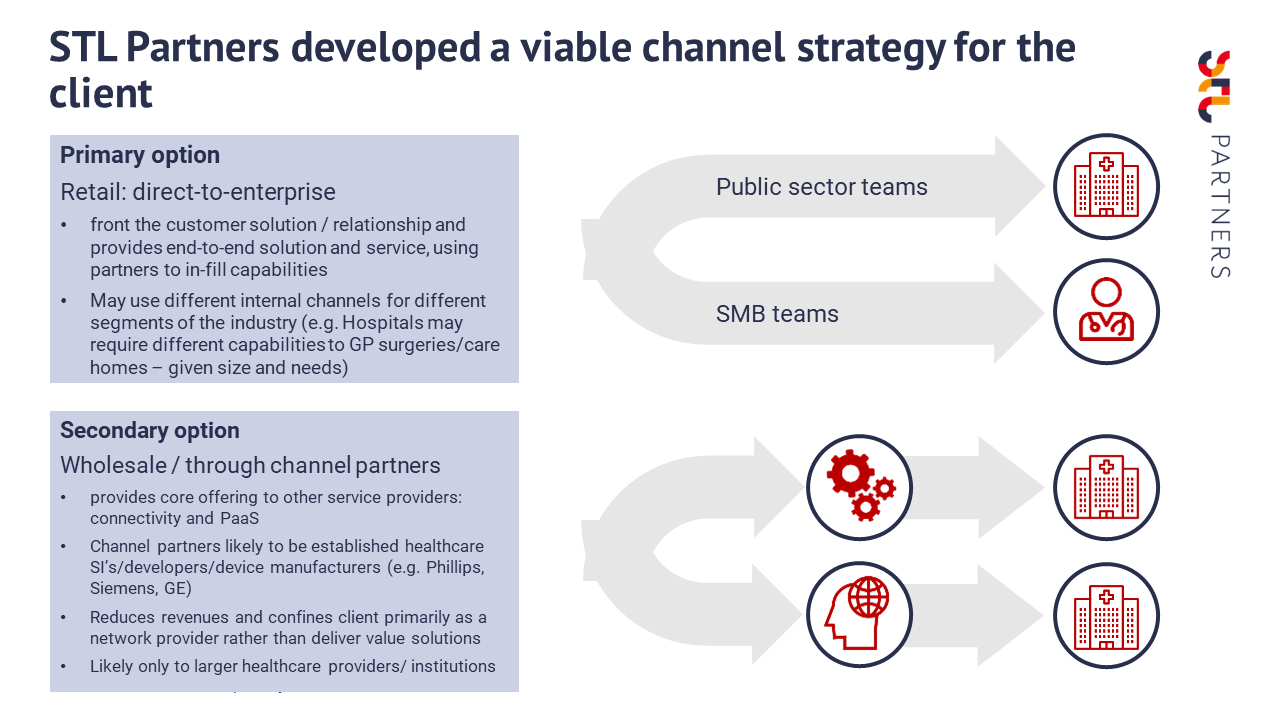
STL Partners identified the different channel strategies the client could use to sell into the customer and highlighted the process, benefits, and challenges with the approach.

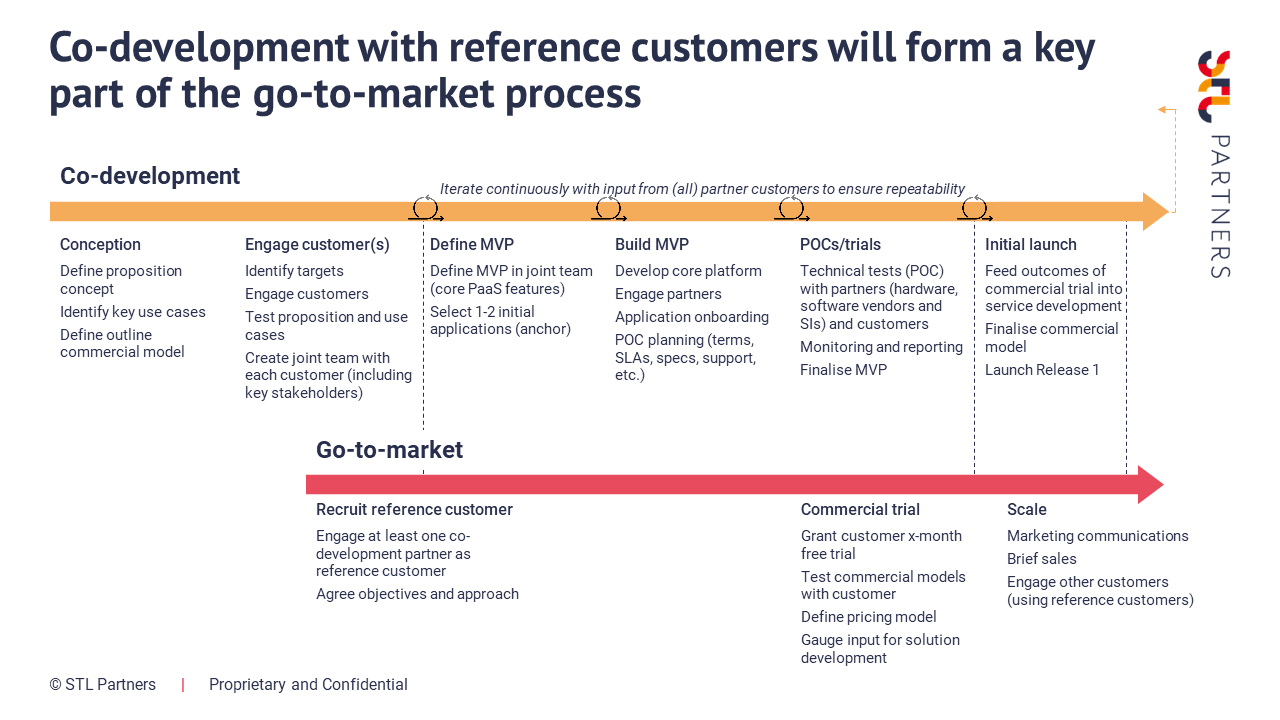
Alongside the channel strategy development, STL Partners supported the client define a product development roadmap. We highlighted the product structure and requirements from the healthcare industry for the use case, and subsequently mapped a co-development timeline which would work in tandem with the go-to-market strategy. This would enable the client to build technical and commercial PoCs, iterate the product in an agile way, and build an initial customer base to later scale. This highlighted the clear next steps for the client in terms of product launch.

Example deliverables

Identifying and evaluating viable NFV partnerships

Case study overview

Our partnering strategy approach and methodology helps clients to evaluate potential partners and narrow down the list in a systematic way. STL Partners brings innovative ‘out of the box’ thinking and objectivity in identifying and evaluating potential partners. This methodology can and has been adapted in different ways for different clients looking into partnerships across various specific domains.

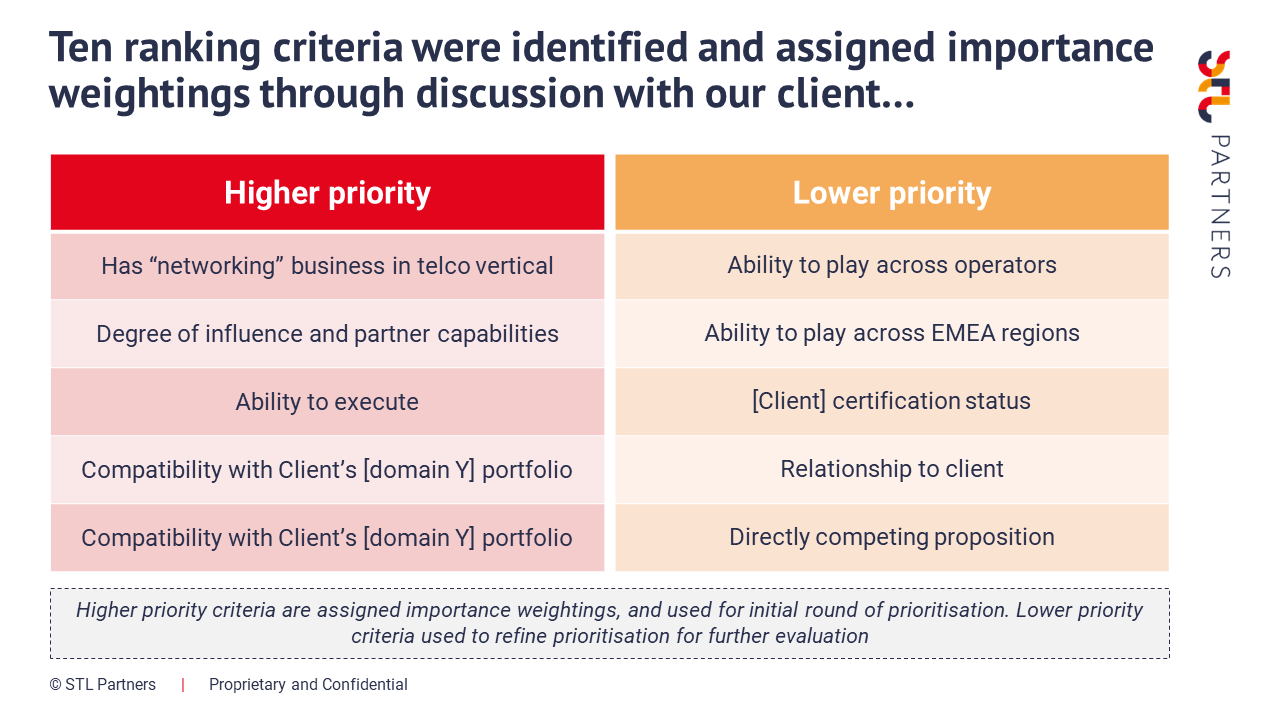
STL Partners works closely with clients to undergo an iterative and staged evaluation process to identify and assess different types of evaluation criteria (e.g. deal-breakers to exclude, high, medium, low) with which potential partners are assessed on.

See how STL Partners supported a virtualisation software provider in:

  • Building a long list of potential partners;
  • Prioritising based on exclusion and evaluation criteria;
  • Profiling shortlisted candidates and evaluating potential partnership models.

Consulting services overview

Get in touch to find out how we can help you:

  • Develop and test customer propositions
  • Detail viable go-to-market strategies
  • Scout, engage, and facilitate partnerships
  • Develop tools to empower the salesforce

STL provided customised, detailed analysis that addressed our specific needs …. not fixed generic templates we get from others.

Director, Field and Partner Development
Global virtualisation software provider

Building a long list of potential partners

Our key objective for this engagement was to identify “big bets” partnership opportunities that our client could make to help scale and accelerate traction in telco cloud, to help drive stronger engagement with CSPs. As a result, we supported our client in building out a long list of approximately 110 potential partners across a range of different categories, ranging from:

  • managed service providers;
  • technology consultants;
  • general and telecoms industry-specific systems integrators;
  • incumbent and challenger network equipment providers;
  • …and beyond.
Example deliverables

Prioritising based on exclusion and evaluation criteria

Through a series of workshops, we worked closely with our client to identify different “deal breaker” criteria to take into consideration their key objectives for the partnerships. This included:

  • identifying the criteria and defining the key questions that needed to be considered within each criterion
  • defining how the factor would be measured and on what scale
  • determining the timeframe considered for the factors

For example, one key criterion was focused on the potential partner’s commercial abilities, whether it has strong commercial relationships with and is trusted by CSPs, which needed to be considered on an immediate short-term basis.

Profiling shortlisted candidates and evaluating potential partnership models

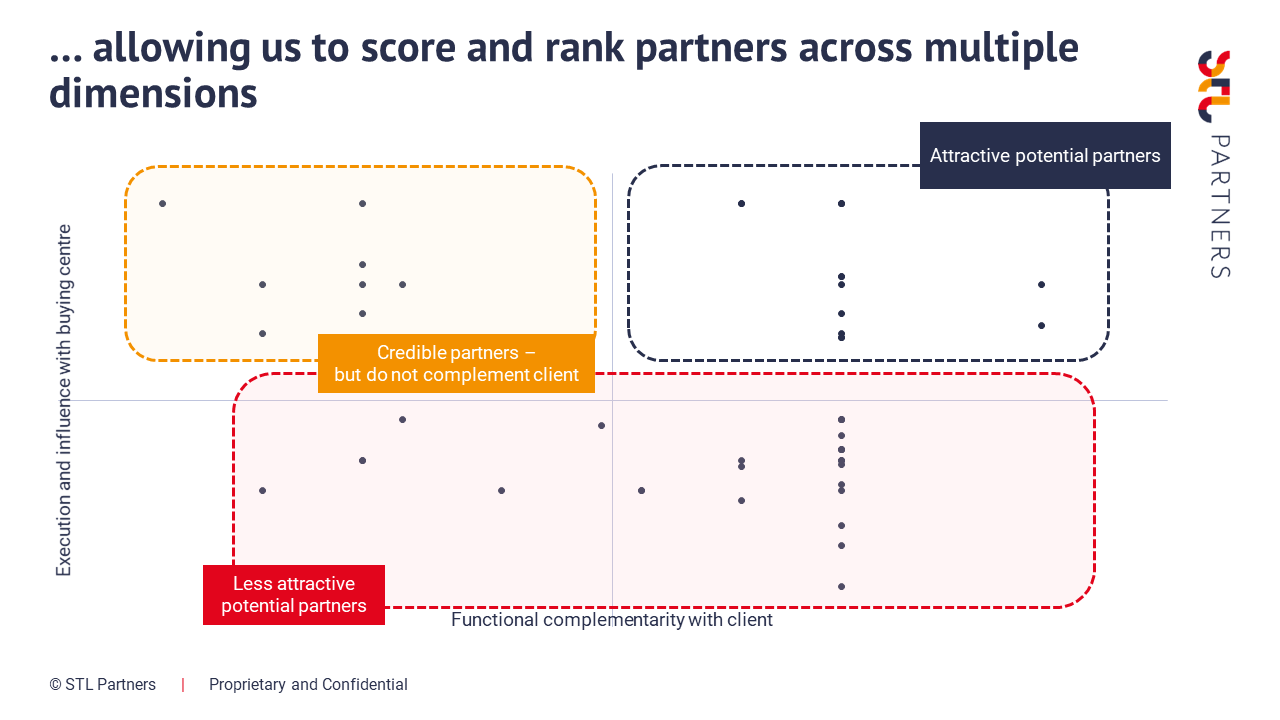
Once we completed and refined the prioritisation exercise, we reached a shortlist of 6 potential partners for our client, which we took forwards to the next stage. This next stage involved building in-depth profiles and analyses to provide the following:

  • An overview of the company, including product and service portfolio, markets covered
  • An assessment of each shortlisted company’s capabilities and overall partnership value chain capabilities to understand the combined capabilities
  • Suggested scope of the partnership, including the potential partnership model and approach, role of each partner, joint value proposition etc.
  • Key decision makers and influencers within the company to engage with
Example deliverables

Addressing the private cellular opportunity

Case study overview

We not only work closely with our clients to identify key opportunities within various domains, we also help them develop compelling propositions and go-to-market plans. We also help to equip their customer engagement teams with tools to empower them when engaging with prospective customers.

See how STL Partners supported a leading software and engineering group in:

  • Understanding the private cellular landscape;
  • Identifying, evaluating and prioritising opportunities in the industrial sectors;
  • Producing detailed briefing packs and pitch packs for each opportunity.

Consulting services overview

Find out how we can help you:

  • Develop and test customer propositions
  • Detail viable go-to-market strategies
  • Scout, engage, and facilitate partnerships
  • Develop tools to empower the salesforce

Understanding the private cellular landscape

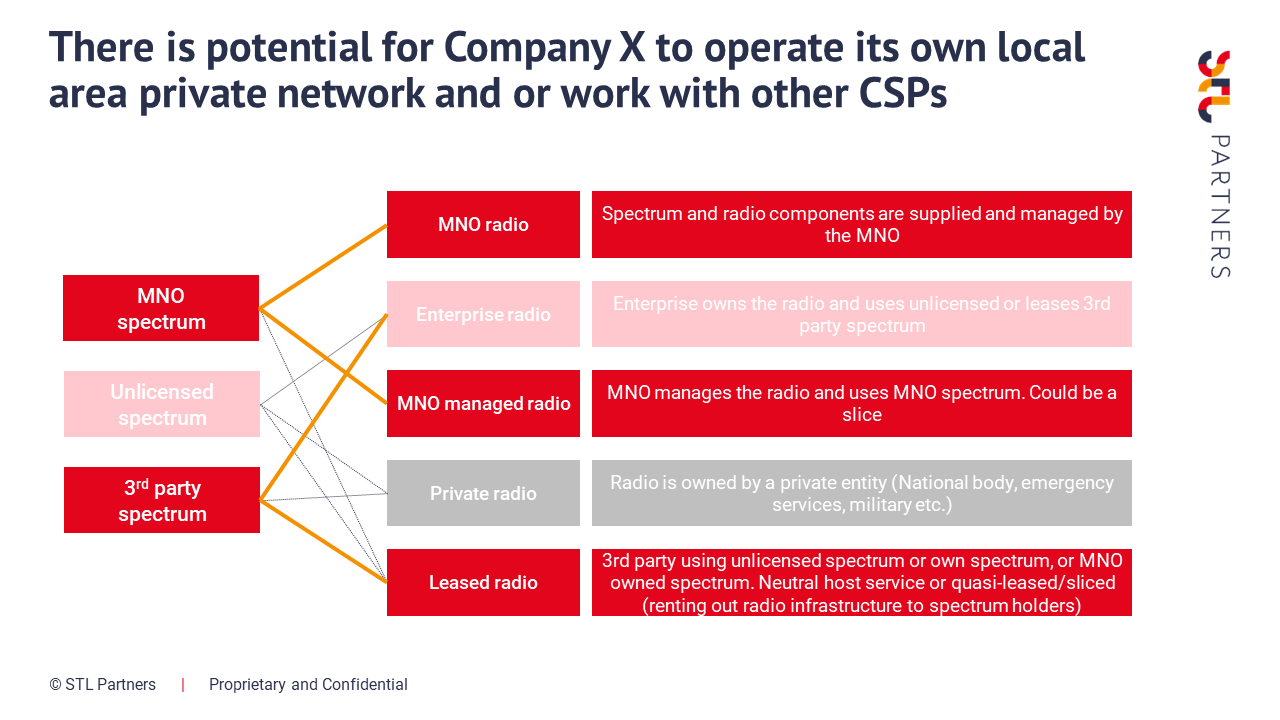
In order to identify key customer opportunities for our client in supporting 3GPP private cellular deployments, we undertook in-depth research to build an overview of the private LTE/5G opportunity in Europe with a particular focus on the industrial sectors, the potential need and business opportunity for private cellular networks and key use cases. This included clear definitions, taxonomies of private cellular delivery models and case studies to bring this to life.

Through a series of interactive workshops, we worked with key client stakeholders to assess, validate and augment our client’s exiting approach. This included a detailed exercise to evaluate our client’s right to play, their existing capabilities and potential commercial models.

Example deliverables

Identifying private networking opportunities in the industrial sectors

Using our research on the private cellular landscape to refine our search, we identified a long list of enterprise opportunities, which consisted of industrial enterprises in Europe that have a high potential in leveraging private cellular networks. This list included some firms that have publicly shared intentions in private cellular networks and others who don’t but may have pain points and/or use cases that can be addressed. We produced high-level profiles for each of these enterprise opportunities which included:

  • an overview of the company, including financial performance, operations, key products and services;
  • basis of interest in private cellular networks, including the business opportunity/pain point, supported applications and use cases, as well as potential sites and coverage requirements;
  • presumed level of existing maturity in planning for private cellular networks.

We then defined key criteria, objectives and scoring methodology with the client, and used this to evaluate the long list of opportunities, narrowing down to a final list of 6 opportunities.

Producing tools to equip our client’s customer engagement teams

To help empower the client’s customer sales and engagement teams, we produced an opportunity briefing pack and proposition pitch pack for each of the 6 shortlisted opportunities.

Each opportunity briefing pack included a deep dive into the prospect profiles, including evidence of the company’s maturity, basis of interest in private cellular etc., to outline the hypothesis implementation model and the client’s services

Example deliverables

Developing the proposition for on-premise edge

Case study overview

We undertake primary research programmes that deliver the insight needed to build tailored customer propositions, highlighting where and how our clients can create value for their customers. We develop channel strategies with our clients covering both online and offline direct channels, as well as partnering.

See how STL Partners supported a Tier 1 European operator:

  • Develop compelling stakeholder propositions for an on-premise edge product
  • Map the value chain to identify partners, competitors, and the client’s role
  • Detail the viable go-to-market strategies and next steps for launch

Consulting services overview

Find out how we can help you:

  • Develop and test customer propositions
  • Detail viable go-to-market strategies
  • Scout, engage, and facilitate partnerships
  • Develop tools to empower the salesforce

STL Partners worked closely with us to accelerate the process of building a commercial strategy for edge cloud, working closely across all parts of the team to develop our plans. We selected STL for their Edge expertise and collaborative approach, which proved to be the right decision. STL’s approach was refreshing and differed from most other consultants in the way we have been able to engage cross functional teams and create a comprehensive value proposition.

Director of Enterprise Strategy
Tier 1 European operator

Develop compelling stakeholder propositions

STL Partners undertook a 4-month strategy project with the client to help identify and prioritise key opportunities within on-premise edge computing, and subsequently develop the client’s got-to-market strategy and proposition to key stakeholders.

In order to complete this project, STL Partners leveraged an interview programme with potential customers, partners, and solutions providers for the identified opportunity areas to validate the use cases for edge, as well as their relevance to the client. From these insights, we generated a detailed value proposition and gaddi pitches for the use case to highlight key drivers for edge and the challenges with existing solutions. STL Partners further developed propositions for the client across different stakeholder groups (e.g. the end user, IT teams, partners) to identify and highlight key pain points, benefits, and client messaging.

Example deliverables

Map the value chain to identify partners, competitors, and the client’s role

Through the interview programme and extensive desk research, STL Partners mapped out the ecosystem for identified opportunity areas and use cases. We developed the value chain segments and identified key players in each segment that were relevant for the client (either as competitors or potential partners).

Then, through a series of workshops with a wide stakeholder group within the client, STL Partners conducted an analysis of the client’s existing capabilities. We were then able to map competitor and partner capabilities against those of our client to identify opportunities and threats, as well as potential partner profiles.

Finally, we developed an activity map across the value chain to highlight how the use case would be delivered and the necessary activities for launch. From the analysis of the client’s capabilities, STL Partners highlighted where the service could be delivered solely by the client, and where the client should partner to deliver the service. This fed into development of the viable business and partnership models for our client to pursue and identified the client’s role in the ecosystem.
Detail the viable go-to-market strategies and next steps for launch

The final stage of the project was to detail the viable go-to-market strategies for the client and present a clear recommendation of immediate next steps for launch.

STL Partners identified the different channel strategies the client could use to sell into the customer and highlighted the process, benefits, and challenges with the approach.

Alongside the channel strategy development, STL Partners supported the client define a product development roadmap. We highlighted the product structure and requirements from the industry for the use case, and subsequently mapped a co-development timeline which would work in tandem with the go-to-market strategy. This would enable the client to build technical and commercial PoCs, iterate the product in an agile way, and build an initial customer base to later scale. This highlighted the clear next steps for the client in terms of product launch.

Example deliverables

Identifying opportunities for growth in digital health
Case study overview

STL Partners helps our clients to identify, define and prioritise strategic opportunities to grow their revenues. We work collaboratively with key stakeholders to formulate new growth ideas and evaluate them based on our clients’ core objectives and capabilities. This approach brought together key decision makers within the organisation and created alignment.​t.

See how we supported a Tier 1 operator to:

  • Assess key trends in the healthcare market and in digital health;
  • Evaluate key lessons from other operators’ healthcare strategies;
  • Identify and prioritise strategic initiatives and develop a roadmap for growth.

Consulting services overview

Get in touch to find out how we can help you:

  • Analyse market trends and dynamics
  • Conduct market sizing and forecasting
  • Prioritise initiatives for new growth

STL Partners’ deep insight and knowledge of the market support used in shaping our healthcare strategy, and their approach drove collaboration across our team. Overall, STL over-delivered.

Manager, Strategy & Participations 
Tier-1 operator

Assessing key trends in digital health

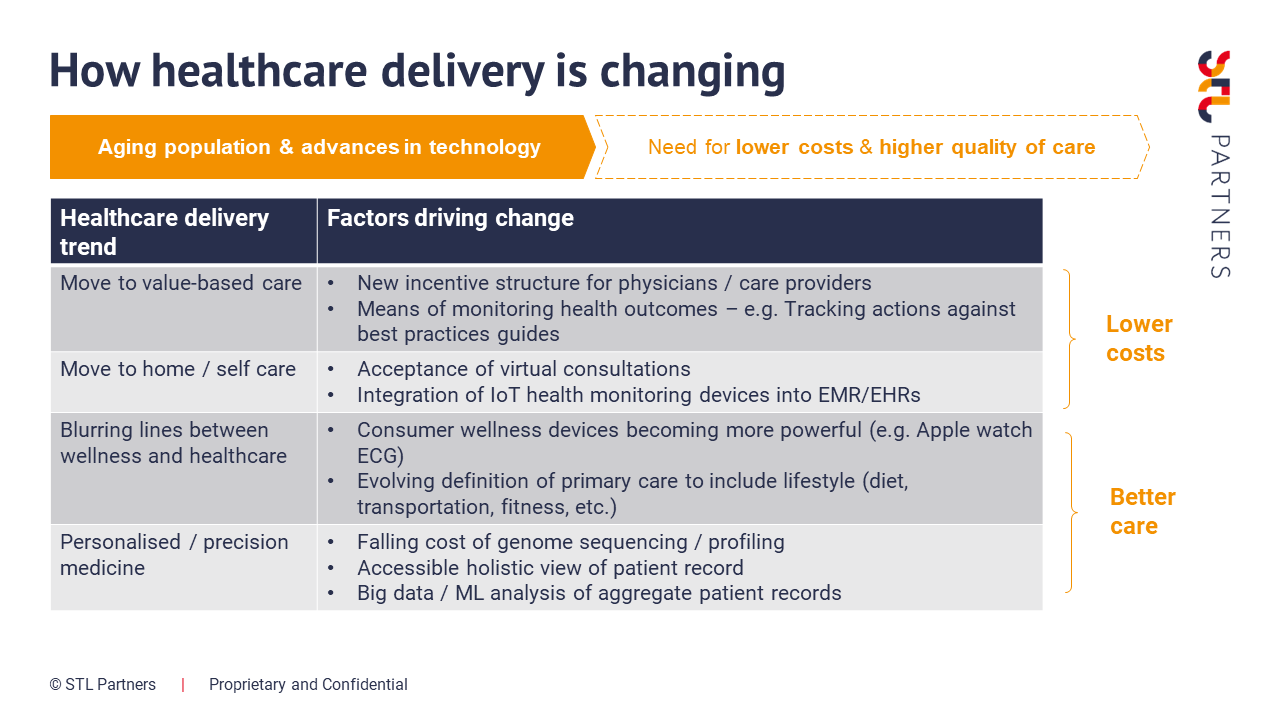
STL Partners researched the wider trends in society and in the healthcare market, particularly focusing on the role of technology and the increased adoption of digital health solutions. Our analysis explored:

  • How the delivery of healthcare services is changing and the key factors driving that change;
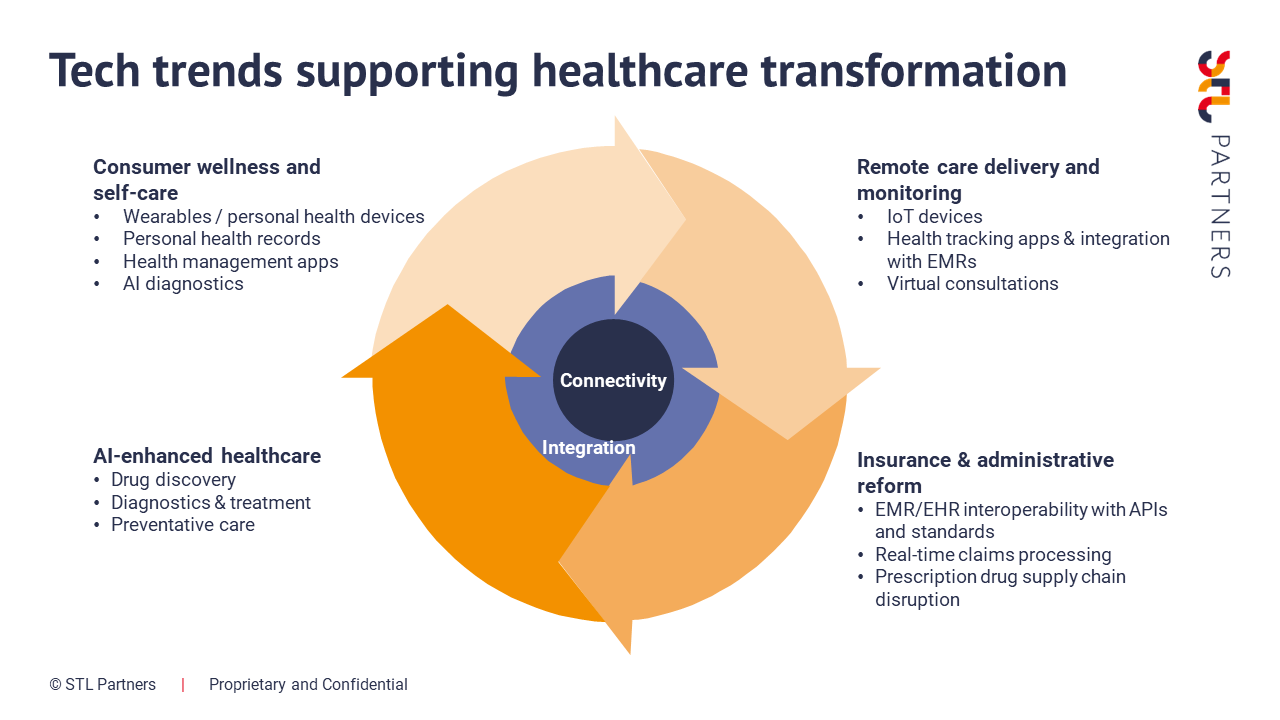
  • Key technology trends that are transforming the healthcare market;
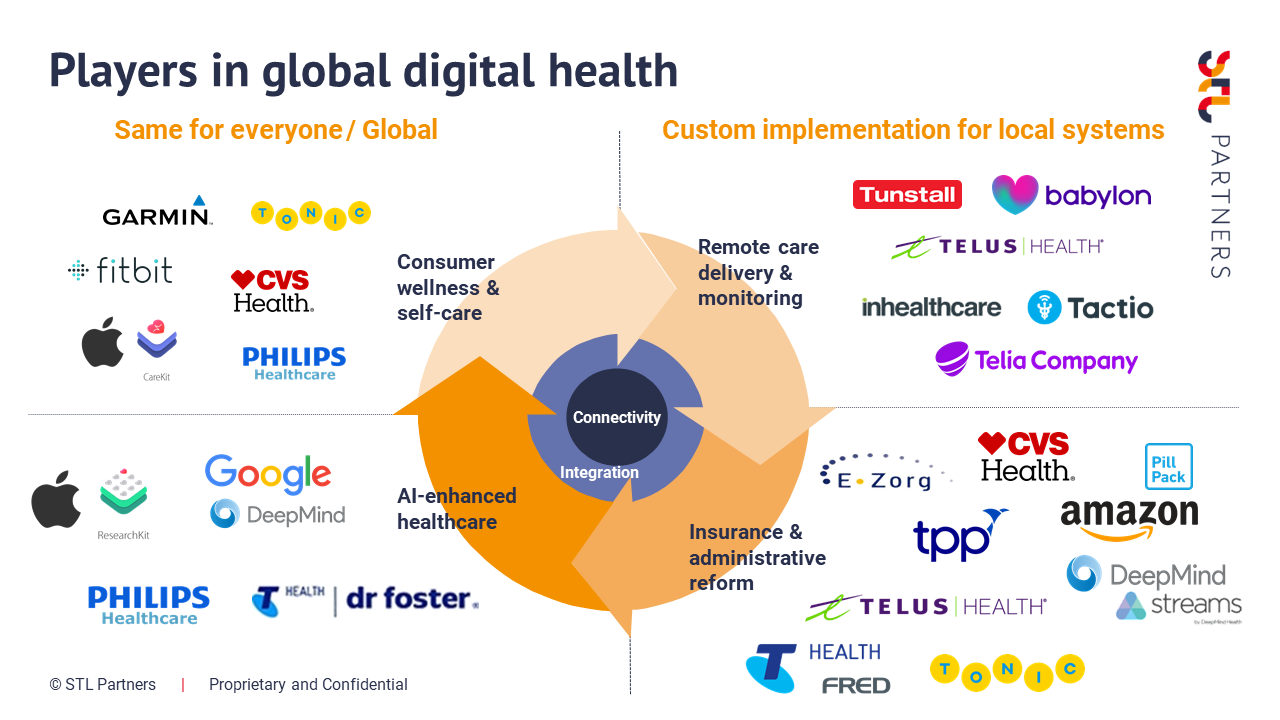
  • Different types of players in the global digital health ecosystem and the roles they play.
Example deliverables

Evaluating key lessons from other operators

​STL Partners produced nine different operator healthcare case studies using both primary and secondary research.

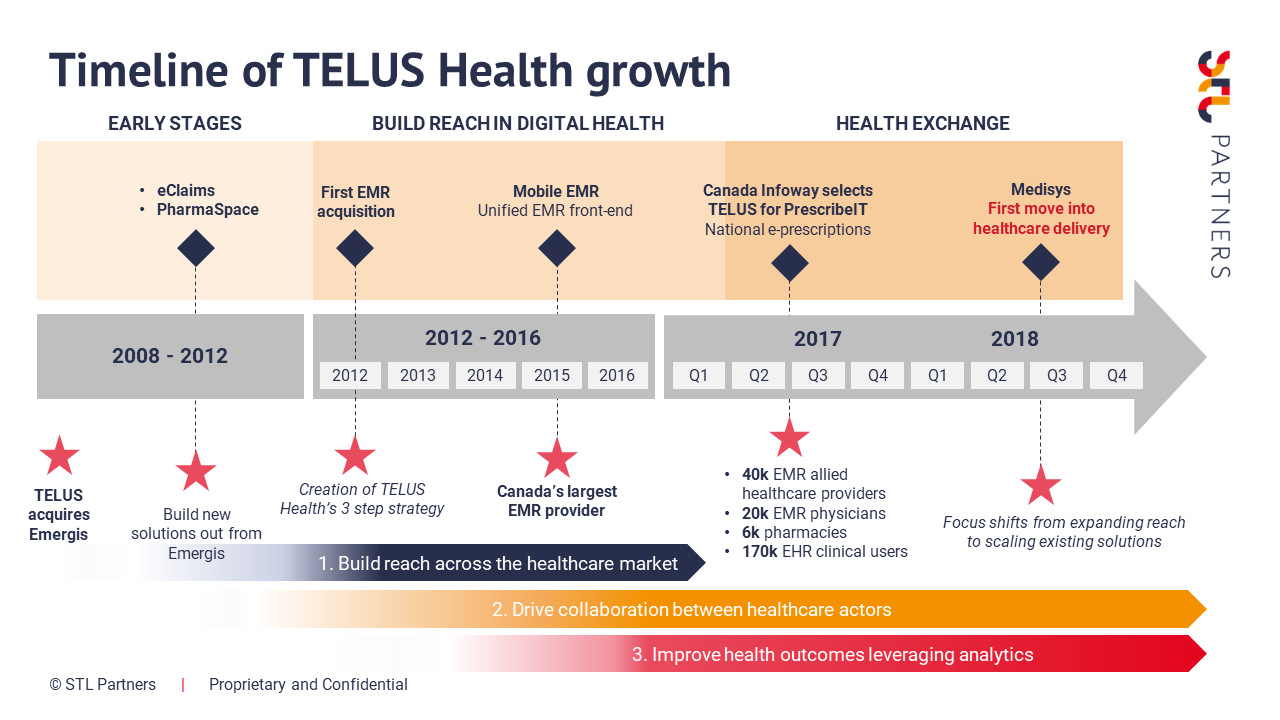
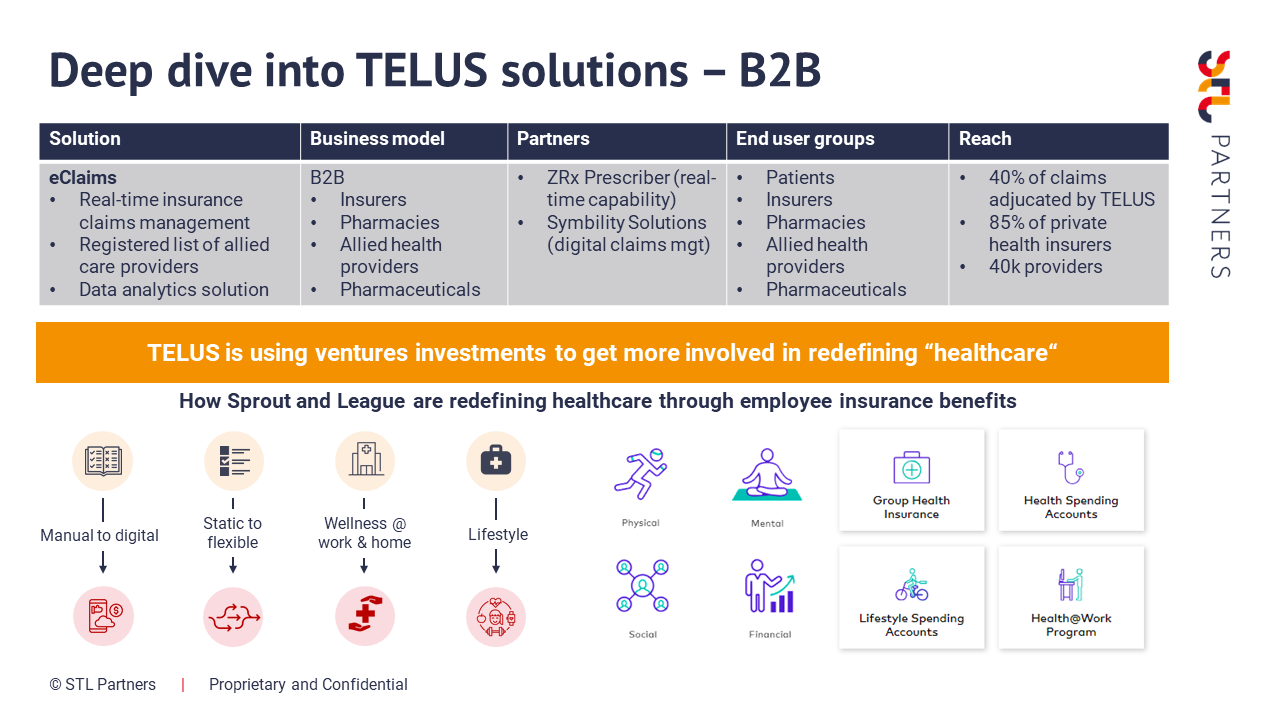
This included an in-depth analysis of two operators who have both made significant long-term commitments: TELUS Health and Telstra Health. Each case study evaluated the strategy, key challenges they faced, implementation approach, and level of success they achieved.

Our client leveraged these lessons when developing their own healthcare strategy.

Identifying and prioritising strategic initiatives

STL Partners led a three-day highly strategy formulation and alignment workshop at the client’s offices with key stakeholders within the organisation. This included:

  • Presenting an overview of the key current trends in digital health and key learnings from other operators’ experiences;
  • Conducting a SWOT analysis to identify the client’s strengths and weaknesses as context for evaluating strategic approaches;
  • Identifying and defining a wide range of potential initiatives;
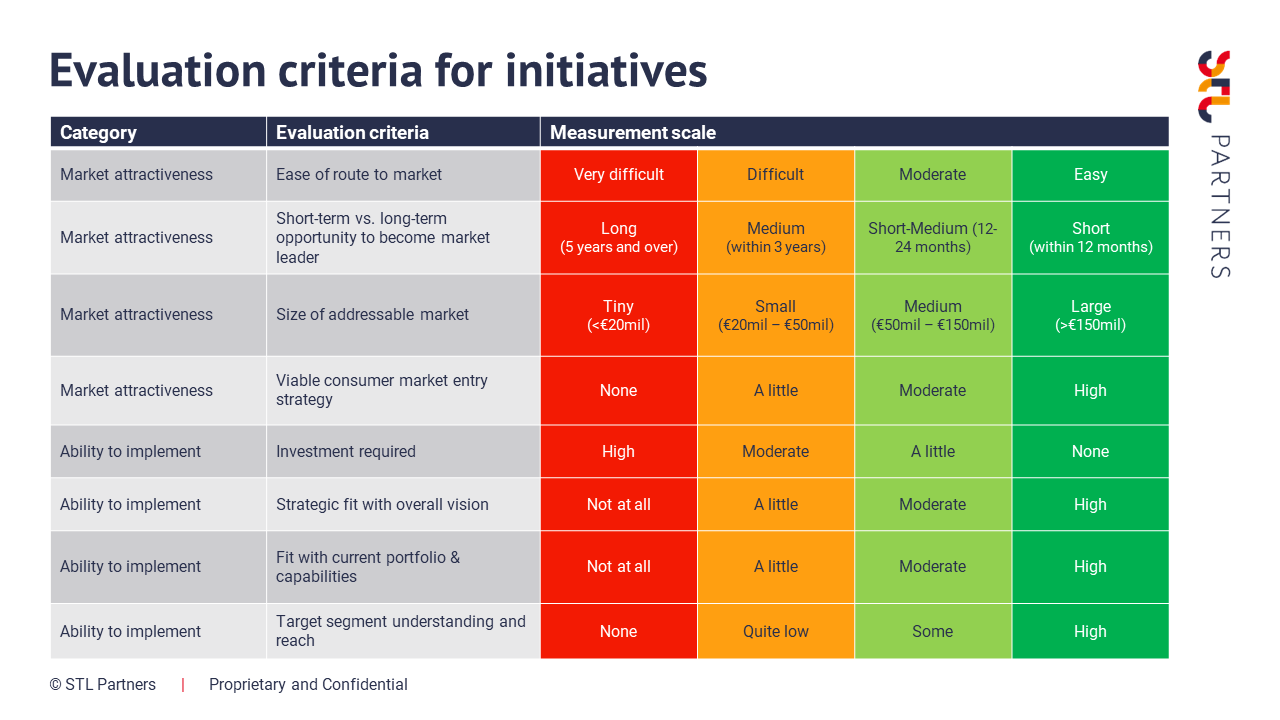
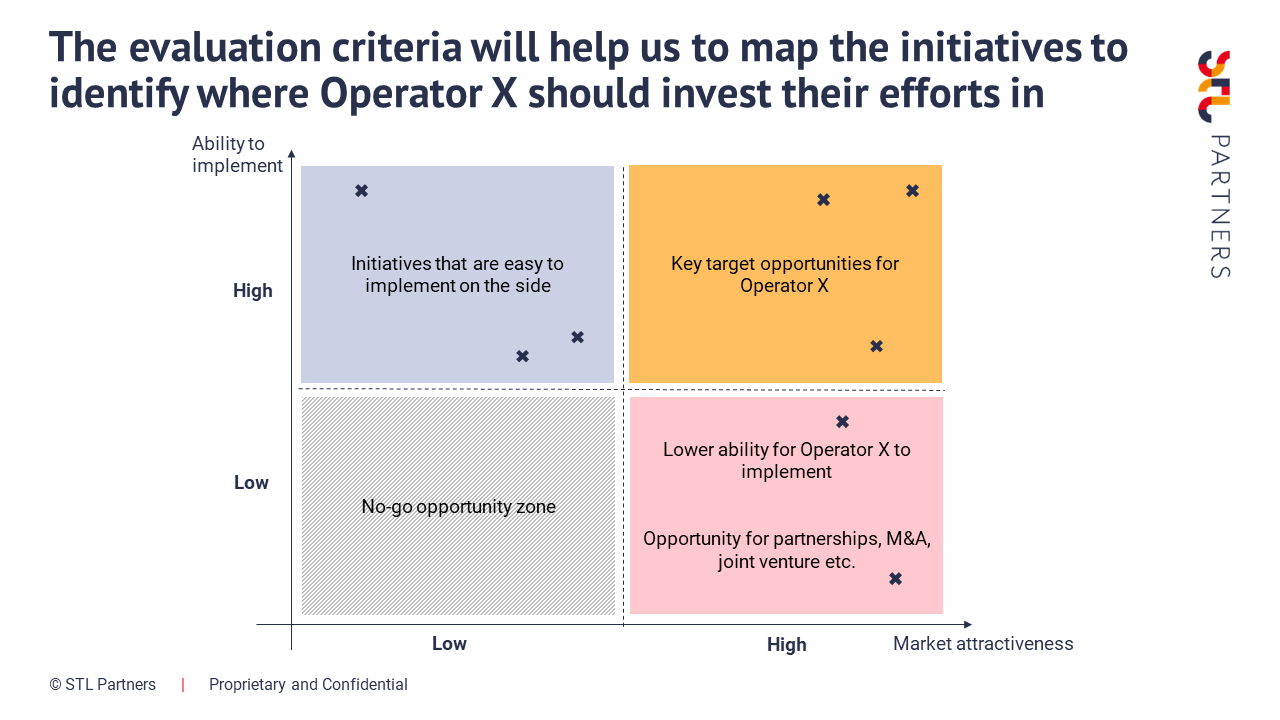
  • Prioritising initiatives based on market attractiveness and the client’s ability to implement solutions;
  • Defining a roadmap, success metrics and next steps based on the agreed prioritised initiatives.
Example deliverables