Case study overview
STL helped a major NEP evaluate how service providers can achieve higher network autonomy, leveraging our unique financial model to quantify the financial benefits of Level 4 and 5 autonomy.
CSPs are facing rising network complexity and growing pressures to deliver new servicesprofitably.
To address this, they must move towards greater network autonomy, but many encounter significant challenges when adopting advanced automation and intelligence.
A major network equipment provider asked STL Partners to identify the fundamental challenges service providers face in achieving greater network autonomy and recommend practical efforts for overcoming these.
Our client asked STL to develop a thought-leadership report outlining how CSPs can navigate these challenges and implement the fundamental enablers needed to accelerate their journey to higher levels of network autonomy, unlocking the full financial promise of automation and intelligence.
What was the approach?
To address the key problem statement, STL conducted targeted interviews with service providers to evaluate their current progress, approach, and key challenges in achieving greater network autonomy, gathering direct insights from industry experts and senior executives. Combined with STL’s existing research on the financial benefits of greater network autonomy, the insights delivered fresh perspectives and practical insights.
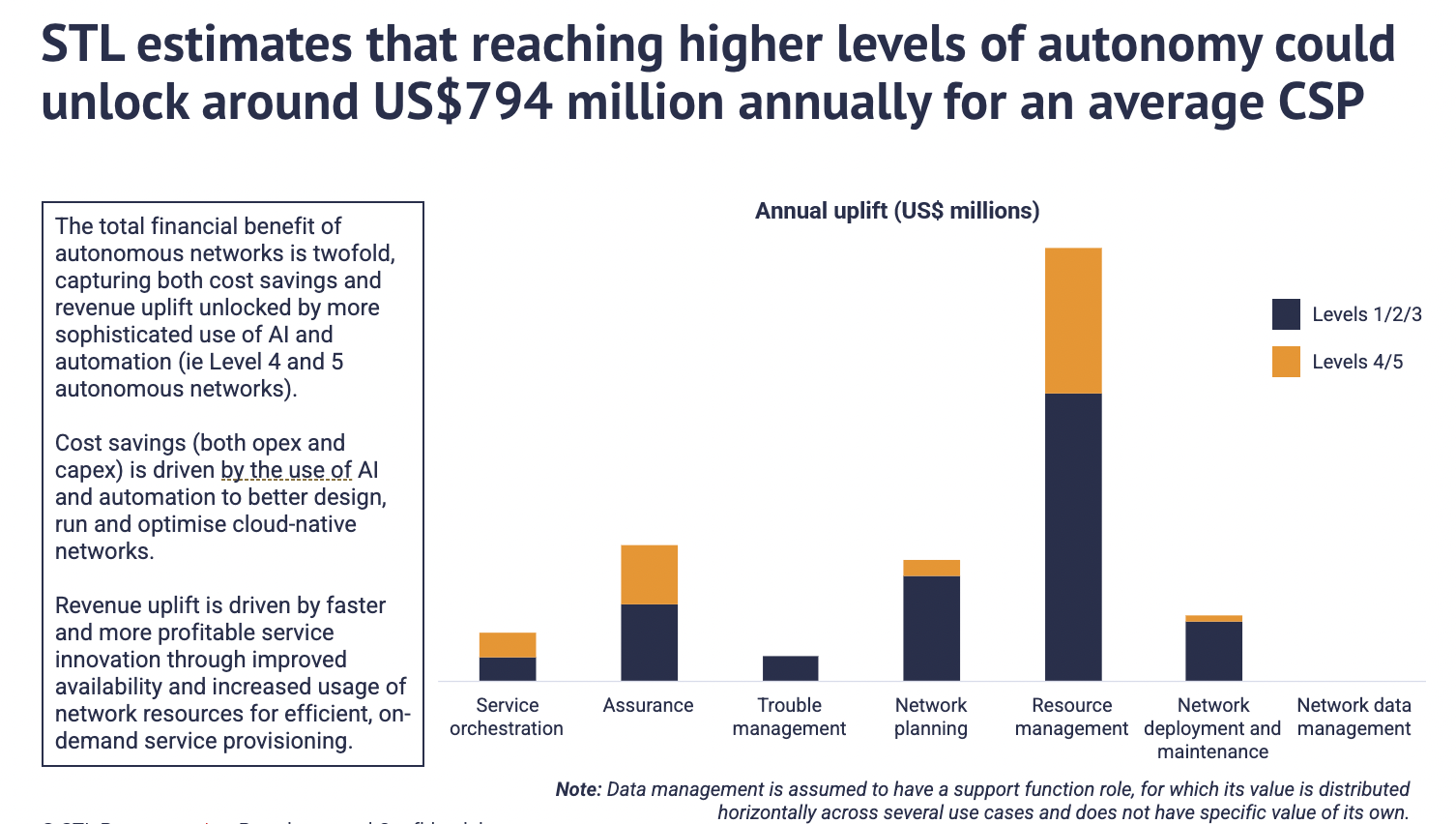
To complement this analysis, STL tested and iterated its financial model that explores the impact of AI, automation and analytics (A3) on networks, and explored the financial benefits for telcos that move from Level 1/2/3 to Level 4/5 network autonomy (as defined by the TMForum).

Key results from the project
- Interviewed 4 global operators, including both Tier-1 and Tier-2 CSPs
- Evaluated the 5 key challenges service providers face in moving beyond Level 1 to 3 network autonomy
- Identified AI and automation capabilities to achieve Level 4/5 autonomy
- Highlighted 6 operators case studies on their progress to maturing network autonomy
- Defined 5 actionable recommendations for service providers to overcome key challenges
- The research has been cited by leading industry forums across creditable public domains, including Forbes and the TM Forum.