Login to access
Want to subscribe?
This article is part of: Executive Briefing Service
To find out more about how to join or access this report please contact us
The generative AI boom has accelerated the shift in financial market value away from telcos and towards leaders in AI. We identify four goals for telecom companies to adapt to their rapidly changing competitive environment.
Generative AI (GenAI), underpinned by traditional AI, is impacting businesses across all sectors. The technology is improving day-to-day operations across sales, marketing, customer contact, resource planning and optimisation. Collectively, this is enabling faster, more widespread and ambitious organisational and skills change.
At the same time, rapid AI adoption changes requirements at the infrastructure level: data centre, cloud and connectivity must be upgraded and optimised to deliver AI workloads securely, reliably and as energy-efficiently as possible. As a result, financial market value is shifting away from telcos and towards companies driving R&D in AI tech and infrastructure.
If you are not a subscriber, enter your details below to download an extract of the report
Financial market value is shifting away from telcos and towards companies driving R&D in AI tech and infrastructure
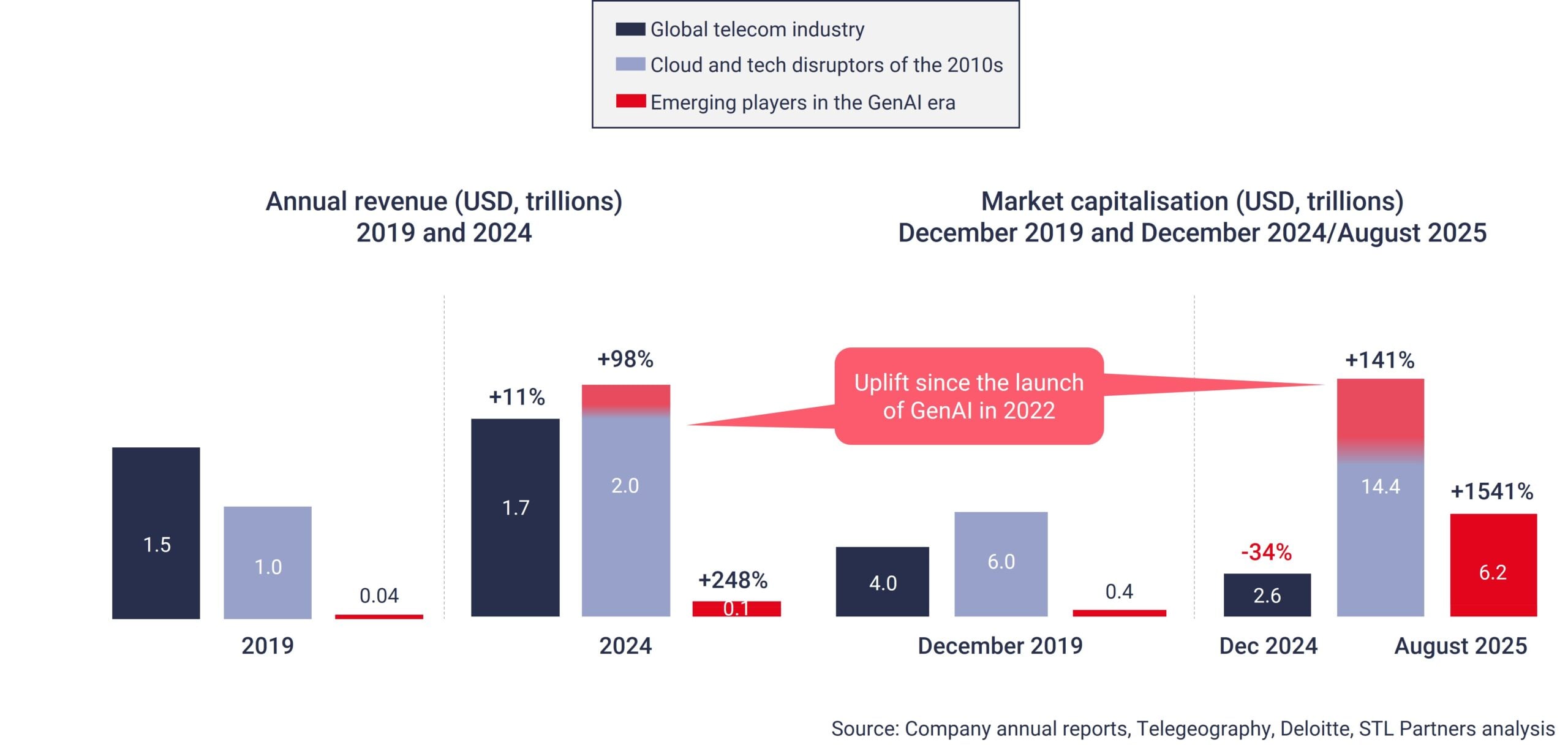
This is an update to our previous Telco 2030 analysis, in which we introduced three possible business models for the telco at the end of the decade: servco, infraco and techco.
In our latest research, we outline the infraco model as the likely outcome for most telcos, but many will fail to adapt to the AI era. A few might achieve accelerated growth.
Three scenarios for telco revenue trajectory to 2035
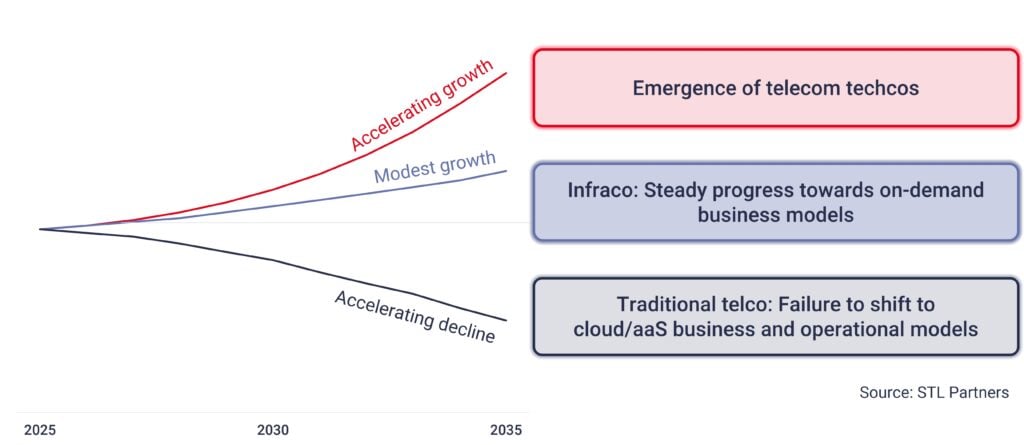
Telecom techco description:
- Provision of integrated distributed compute and connectivity, optimised in real time to meet specialised needs of applications
- All connectivity and compute adhere to strict SLAs on coverage, compliance, security and reliability
- Innovation of unique tech and services leveraging distributed infrastructure
Infraco description:
- Level 4+ autonomous networks
- Network exposure and programmability services offset commoditisation of traditional connectivity services
- Seamless integration between mobile, fixed, non-terrestrial networks (NTN) and other networks delivers ubiquitous coverage (rural areas, indoors, etc.)
Traditional telco description:
- Slow progress towards autonomous networks
- Limited network exposure and programmability
- Persistent coverage and reliability challenges
- Traditional telcos will have a longer life in markets where no players shift towards an infraco model, resulting in a less competitive environment
Related research
- Telco generative AI adoption tracker
- Sovereign AI: A strategic playbook
- Enterprise AI: What are the best opportunities for telcos?
- Not all telcos need to build their own AI factories