Login to access
Want to subscribe?
This article is part of: Network Innovation
To find out more about how to join or access this report please contact us
RAN autonomy will not deliver impact unless technical progress and value creation advance in parallel. Our dual-axis framework will help operators to assess where they are today, identify constraints across the lifecycle and the investments most likely to scale.
RAN autonomy needs a more holistic approach
Telcos are operating in an environment of prolonged revenue stagnation, increasing commoditisation of connectivity and intensifying competitive pressure. As traditional connectivity revenues become harder to defend, operators are also facing rising cost and complexity in running large-scale mobile networks. This tension is most visible in the RAN, which has historically accounted for around 60% of network total cost of ownership. Although RAN costs have begun to decline in recent years, driven by approaches such as open RAN, it remains the largest and most expensive network asset, driving both capex intensity and ongoing operational complexity.
Against this backdrop, most operators now recognise that automation – and ultimately autonomy – is not optional. Accelerating automation across the network and particularly across the RAN, is widely seen as essential to protecting profitability, managing complexity and creating the headroom needed to pursue new growth opportunities. As a result, many operators have adopted the TM Forum Autonomous Networks framework, set explicit autonomy targets and aligned their organisations around the ambition to reach higher levels of network autonomy within defined timeframes.
This is a positive step. The TM Forum framework has helped establish a shared industry language, define common maturity levels and move autonomy from an abstract ambition to a more operational agenda, enabling clearer direction for network teams and more consistent benchmarking across the ecosystem.
However, progress against technical autonomy targets has not consistently delivered faster value creation, commercial differentiation or strategic momentum. This underlines that RAN autonomy is not just a technical challenge, but also a question of value realisation and organisational alignment. In practice, the way TM Forum autonomy framework is commonly applied leaves two important gaps:
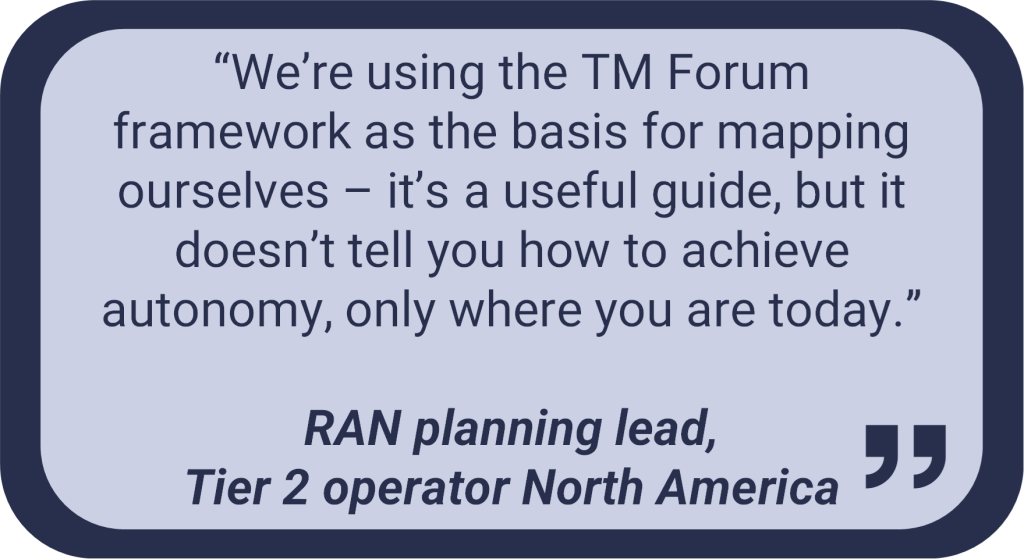
1. Limited linkage between autonomy initiatives and commercial outcomes. While autonomy frameworks define levels of technical capability, they typically provide generic guidance on how initiatives might be prioritised and sequenced. In practice, this can make it difficult to consistently link individual automation efforts to specific commercial KPIs, particularly where benefits are indirect, cumulative or realised over longer time horizons (e.g., net promoter score , churn or average revenue per unit [ARPU]).
2. A concentration of autonomy within network operations rather than across the full lifecycle. Autonomy efforts often focus most strongly within network operations. This is where use cases are more tangible and technically bounded, resulting in less consistent evolution across the full RAN lifecycle, including planning, design, deployment and ongoing optimisation.
As a result, many operators advance unevenly, developing sophisticated automation in isolated domains while struggling to align initiatives end-to-end, manage cross-team dependencies and justify scaled investment beyond incremental efficiency gains. Automating individual elements of a workflow rarely delivers meaningful impact in isolation, limiting the translation of technical progress into material business outcomes.
This creates the need to extend existing models with a more comprehensive approach that captures both lifecycle-wide technical autonomy and the commercial value. Without this alignment, operators risk either stalling at fragmented autonomy that cannot be scaled across the organisation or achieving higher technical maturity without materially shifting business outcomes – reinforcing efficiency gains but leaving the operator’s strategic position largely unchanged.
If you are not a subscriber, enter your details below to download a free copy of the report
Table of contents
- Executive Summary
- RAN autonomy needs a more holistic approach
- Execution gap in RAN autonomy programmes
- Hidden risk of a purely tech-led autonomy journey
- Equal and opposite risk: Commercial ambition without technical alignment
- Existing autonomy frameworks need to be extended, not replaced
- A more effective way forward: Combining technical maturity and value creation
- Mapping the landscape: Nine states of RAN autonomy
- How the framework should be used
- RAN autonomy technical maturity axis: How responsibility shifts across the RAN lifecycle
- RAN commercial value maturity axis: How the role of the RAN changes
- The diagonal path to sustainable autonomy
- Operator archetypes: Where autonomy journeys tend to stabilise
- Why some operators keep moving faster: Markers of diagonal progress
- Recommendations: How operators accelerate autonomy and avoid being “RAN-cuffed”
- Lower-hanging fruit: Unlock near-term value
- Higher-impact moves: Scale autonomy for sustained value
Related research
- Digital twins: Accelerating progress towards autonomous networks
- Autonomous networks: The role of multi-agent systems
- The journey to a self-healing network: Intelligence, agents and complexity
- Agentic AI: Making operator data AI ready
