Login to access
Want to subscribe?
This article is part of: Executive Briefing Service
To find out more about how to join or access this report please contact us
How telcos can employ artificial intelligence to enrich their interactions with customers, while protecting their brands and reputations.
Introduction
Across the economy, an AI arms race is well under way. Like other businesses, telcos are under pressure from investors to show that they are effectively harnessing AI and generating substantial business benefits as a result.
AI promises to help telcos deliver better, or more cost-effective, customer interactions. This report explores how telcos are using AI to support both reactive communications (such as customer support) and proactive communications (generally marketing and advertising) with customers. In the latter case, there is some overlap with the use of AI to enhance products – for example, a telco’s video-on-demand service may use AI to make personalised recommendations, which is a form of marketing/advertising for its content.
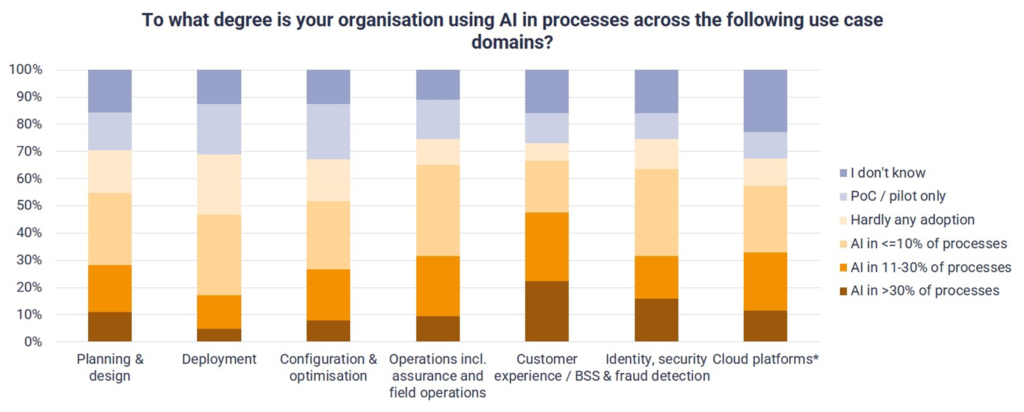
Some telcos regard these use cases as low hanging fruit. As shown below, a recent STL Partners’ survey of telcos (April 2026) found that processes in the customer experience domain are more likely to have been enhanced by AI than those in other domains.
Customer experience is an early focus area for AI in telecoms
Source: STL Partners
While many telcos are looking at using AI to improve their customer-facing apps and chatbots, the technology can also be integrated directly into networks, as T-Mobile US and Deutsche Telekom are doing. That means telcos can potentially use AI to enhance interactions with consumers regardless of the device they are using or the apps they are running.
This report begins by examining how telcos view the potential of AI, before considering how consumers regard AI and the rise of AI intermediaries. It then outlines how several major telcos are trying to use AI to streamline and/or enhance interactions with their customers, as well as detailing how some leading Asian telcos are developing their own AI tools to enhance their own interactions with customers and to sell to enterprises.
Finally, to help identify good practice, it describes how T-Mobile US is using advanced digital tools to field incoming requests from customers and Spotify is using AI to provide customers with highly personalised recommendations. This report concludes by considering the future of customer interactions and making recommendations for telcos, which are also summarised in tables in the Executive summary.
If you are not a subscriber, enter your details below to download an extract of the report
Table of contents
- Introduction
- Telcos are under pressure to implement AI
- Consumers’ attitudes to AI
- Consumers’ growing use of intermediaries
- Will AI agents disintermediate telcos?
- How telcos are using AI to interact with customers
- Vodafone’s long-running AI journey
- Deutsche Telekom pushes forward on three fronts
- Orange pursues hyper-personalisation
- Developing AI customer interaction tools in-house
- NTT offers a large action model
- China Mobile offers emotional companionship
- Case studies in good practice
- A step-by-step approach – T-Mobile US
- The art and science of personalisation – Spotify
- Conclusions and recommendations
- What is next?
Related research
- Finding value from AI, analytics and automation in the telco: Part 2
- AI for consumers: Telcos’ efforts to monetise AI
- The future of (really) useful smartphone personal assistants