Login to access
Want to subscribe?
This article is part of: Edge Insights
To find out more about how to join or access this report please contact us
This report presents the main findings of our latest quantitative research on global demand for edge computing services through to 2030. In this forecast, we analyse demand for on-premises, network and regional edge infrastructure across 21 use cases and 16 industry verticals. This edition also examines key adoption trends emerging from real-world deployments and highlights pricing dynamics observed across the vendor ecosystem.
This is the fifth iteration of STL Partners’ revenue forecast for the edge computing market
The edge computing market continues to invite different types of players including server OEMs, hyperscalers, telcos, data centre operators and more. The varying requirements across verticals, business sizes and use cases create an opportunity that can accommodate all these different players. However, it is important for any edge provider to understand how to position its service in the space and what areas of the market to pursue vertically and horizontally.
Through quantitative analysis, this report aims to help players participating, or planning to participate, in the edge computing market to identify where opportunities lie. This report presents the key findings of STL Partners’ demand forecast model for edge computing services. Its purpose is to:
- Assess the demand from 21 use cases which currently rely on edge or will require edge to fully mature;
- Identify the total revenue across the value chain: device, connectivity, application, edge platform, edge infrastructure (on-premise, network and regional), and integration and services;
- Output a full set of results for 74 countries over the 2024–2030 period per use case and per vertical.
This report is accompanied by a dashboard which presents a summary of our model output and the associated graphics for the world’s regions and for 20 major markets. The dashboard also presents the full revenue output for the 74 countries.
If you are not a subscriber, enter your details below to download an extract of the report
Our edge market sizing forecast models the total addressable market for 21 leading edge computing use cases

STL Partners projects addressable revenue from edge computing use cases to reach USD274 billion by 2030
- Through our bottom-up modelling of 21 key edge computing use cases, we identify a total addressable market for edge computing that stood at USD51 billion in 2024, growing to USD274 billion in 2030.
- Although edge computing has long been discussed as a major opportunity and has been targeted with varying degrees of success by players including telcos, hyperscalers and server OEMs, STL Partners strongly believes the next five years will prove critical to the technology becoming pervasive. The catalyst will be the inferencing era of AI. Edge computing environments will provide one key location where inferencing takes place: when compute cost, scalability and redundancy constraints preclude on-device deployment, and latency, data privacy and network-cost considerations preclude cloud deployment. With much of the USD700 billion-plus capex this year from five US hyperscalers directed towards model training, there is an immediate need for inferencing to deliver ROI – some of this will be realised at the edge.
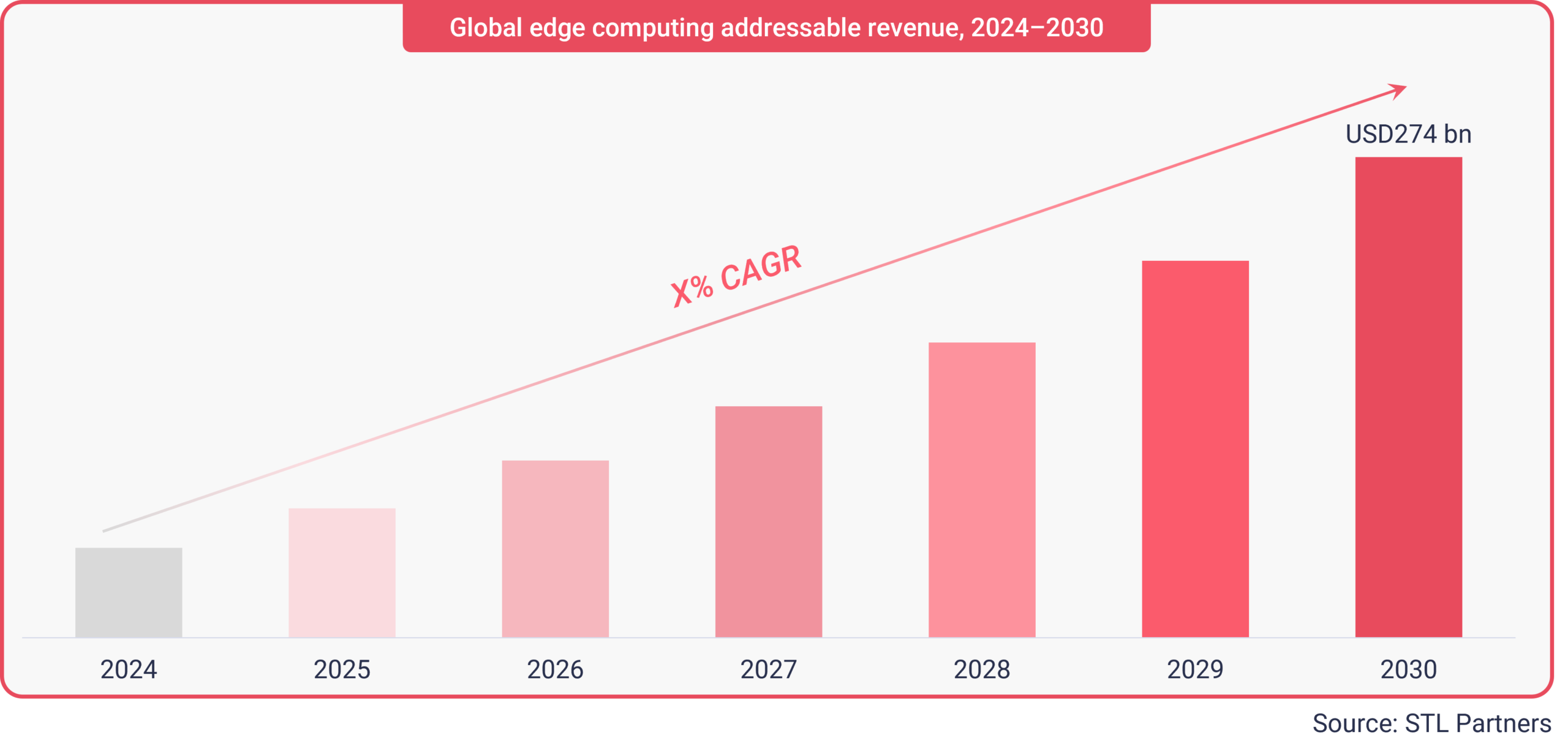
Table of contents:
- Preface
- Executive summary
- Introduction
- Vendor case study
- Pricing benchmarks
- Forecasting analysis
- Revenue by value chain component
- Revenue by use case
- Revenue by vertical
- Revenue by region
- Methodology
Related research
- Edge computing use case directory
- Edge Computing Ecosystem Tool
- Telco AI data centre forecast
- What is the role of edge computing in an AI world?