
hero-banner

Tag Archives: T-Mobile

MobiNEX: The Mobile Network Experience Index, Q4 2015

For the first time, STL Partners quantifies the customer ‘app experience’ on twenty-seven mobile networks in seven countries. MobiNEX – The Mobile Network Experience Index – benchmarks mobile operators’ network speed and reliability by measuring download speed; average latency; error rate and latency consistency. It’s based on billions of real customer data points provided by our partners Apteligent. Congratulations to the top three performers – Bouygues, Free and Orange (all in France).


Problem: Telecoms technology inhibits operator business model change (Part 1)

The last few years have seen attempts by many leading telecoms operators to refresh their business model and generate new sources of growth and value. Now many digital initiatives are being scaled back. Telefonica and Telenor, two companies in the vanguard of the ‘drive to digital’ have both disbanded their digital organisations. In the first of two reports, STL Partners explores why efforts to yoke platform and product innovation businesses to a traditional infrastructure business have proved so difficult. The financial and operational constraints associated with traditional telecoms – particularly the need for long investment cycles in ‘one-function’ infrastructure – have made achieving the switch to ‘agile digital innovation’ all but impossible. But all that may be about to change and the future could be a little brighter.

Mobile app latency in Europe: French operators lead; Italian & Spanish lag

Our latest analysis shows staggering differences in ‘app-lag’ (the time it takes for an app to get a response over the Internet) across France, Germany, Italy, Spain and the UK, and twenty mobile operators. This has significant consequences for customer data experiences, and potentially operator market performance too. Operators in France, particularly Bouygues and Free, are delivering a superior customer app experience while 3 in Italy and Movistar in Spain are European laggards. (October 2015, Foundation 2.0, Executive Briefing Service.)

Self-Disruption: How Sprint Blew It

Self-Disruption: How Sprint Blew It

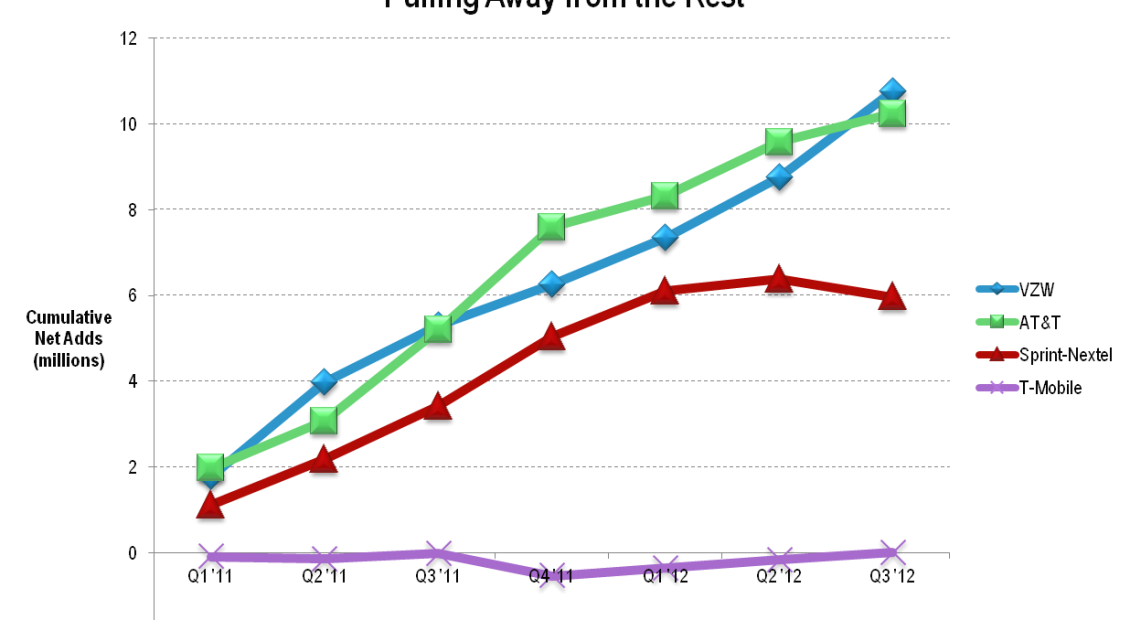
How Sprint’s necessary shutdown of Nextel turned into a commercial disaster, losing valuable customers, reputation, and market share. Our analysis shows that amdist the drama of the Softbank deal and the complexity of a major network upgrade, SMB customer needs were neglected, and its competitors (VZW, AT&T and T-Mobile) stepped smartly in.

Sprint-Softbank: how it will disrupt the US market

The Japanese and French markets have both been disrupted through the entry of low-cost competitors offering substantial price reductions. We think that Softbank’s acquisition of Sprint is a signal that the same is to soon come in the US given Softbank’s experience as a successful disruptor in Japan. (January 2013, Executive Briefing Service).
Digital Commerce Flywheel December 2012

‘Under-The-Floor’ (UTF) Players: threat or opportunity?

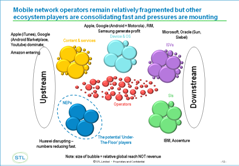
The telecoms industry often puts so-called OTT (over-the-top) players like Google and Facebook at the forefront of its concerns, as they pose new competition for services and applications. But what about encroachment of companies “underneath” the telcos, displacing them from their core asset, the network? Telco 2.0 examines the strategic threats and opportunities from wholesale providers, outsourcers and government-run broadband networks. (January 2012, Executive Briefing Service, Future of the Networks Stream).
UTF Image Jan 2012