Login to access
Want to subscribe?
This article is part of: Network Innovation
To find out more about how to join or access this report please contact us
This report explores how a more adaptive, cross-domain AI approach, leveraging the latest AI techniques such as time series foundation models, can move operators forward in their network autonomy journey and unlock significant financial value.
Telecom operators are pursuing the ‘North Star’ of network autonomy
Most telecom operators today rely on traditional, machine learning (ML)-based AI algorithms that deliver incremental efficiency gains but fall short of driving true network autonomy. The next leap forward lies in redefining AI’s role – from a tool that executes instructions to a collaborator that learns alongside humans. In this human-AI partnership, people remain in the loop to validate outputs, build confidence in AI-driven decisions and ensure accountability. Early benefits include enhanced network visibility, faster fault detection, root cause analysis and predictive remediation — all of which help reduce opex and capex by cutting manual intervention and service disruptions.
As explainability and trust mature, this collaboration can evolve towards closed-loop automation, allowing AI to act autonomously within transparent boundaries. Rather than a sudden revolution, this gradual process – grounded in iterative learning and human oversight – lays the foundation for more resilient, flexible operations. According to our analysis, operators progressing through these stages could unlock 5% uplift to overall revenues, driven by both efficiency gains and new value opportunities enabled by the next phase of human-AI collaboration.
These benefits unfold across three stages of the network lifecycle:
- Day 0 (design and planning): Traditional AI, based solely on rule-based methods, has not delivered much value to this phase. AI-driven automation using new techniques can change this.
- Day 1 (building and deployment): AI-driven automation can unlock benefits here too – beyond those relating to savings purely through headcount reduction.
- Day 2 (running operations): This is where the true value of AI-driven automation lies and where 78% of financial benefits are, making it the phase on which telcos should focus their efforts.
If you are not a subscriber, enter your details below to download an extract of the report
Historically, it has been challenging for operators to realise these benefits largely due to the complexity of their networks and fragmented data sources. Earlier methods depended on rigid, ML algorithms that rarely adapted to shifting network demands and could not scale to meet growing operational needs. While large language models (LLMs) have introduced important strengths – such as extracting value from unstructured data and automating knowledge sharing – they fall short in domain-specific reasoning and lack real-time adaptability. Although there are new technologies and a greater willingness among operators to adopt innovative approaches (see figure below), these limitations continue to slow progress towards genuine network autonomy.
New techniques accelerate telcos’ path to intent-driven network autonomy
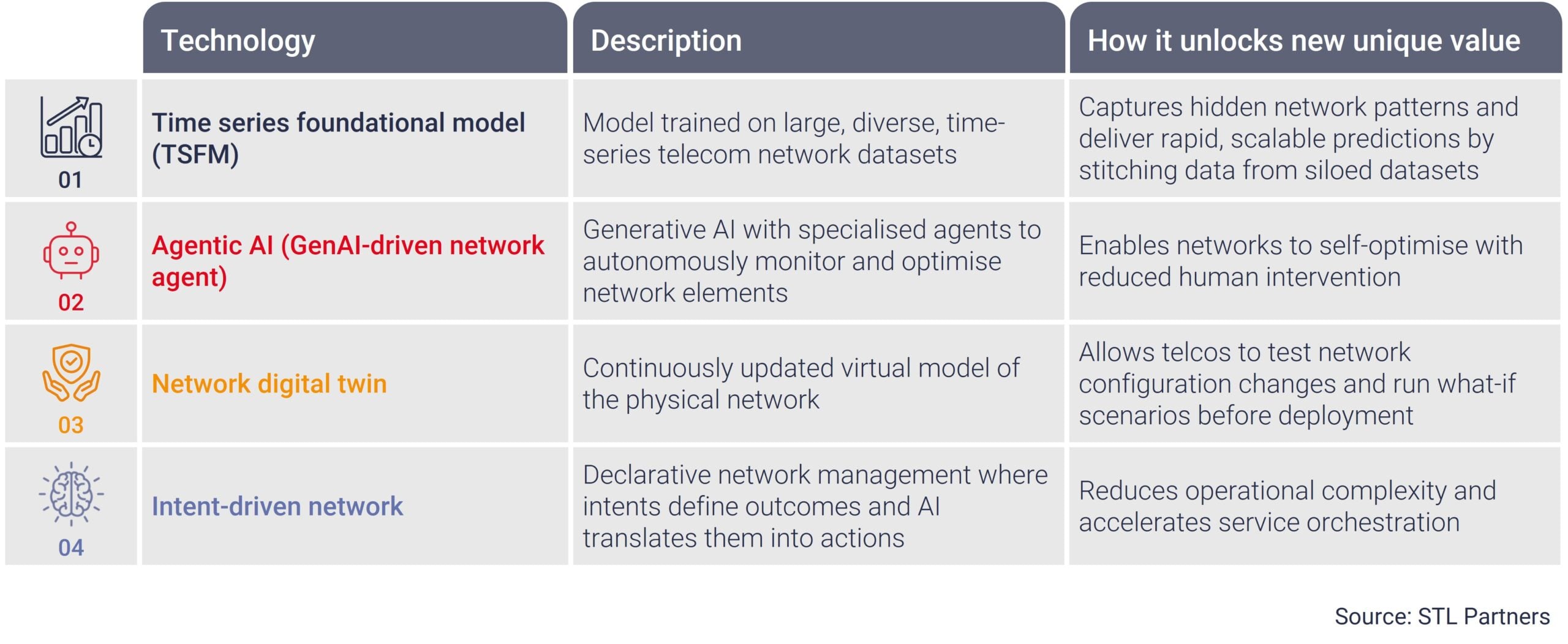
Unlocking full value requires combining precise insights with adaptive decision-making, enabling operators to overcome rigidity and silos, and shift towards AI-driven, collaborative network operations.
Table of contents
- Foreword
- Methodology
- Editorial independence
- Executive summary
- Introduction
- By moving beyond traditional AI, the average telco can unlock USD800 million value p.a.
- Dual intelligence AI unlocks value through opex and capex savings in addition to revenue gains
- Opex savings are driven by improvements in process efficiency
- Tracking USD800 million across Day 0, 1 and 2 of the network management lifecycle
- Day 0 – Intelligent planning to set the foundation
- Day 1 – Accelerating deployment with smarter AI integration
- Day 2 – Operational excellence and continuous optimisation
- Future revenue opportunities: How dual intelligence AI gains in importance
- Unlocking efficiency in data centre expansion and sovereign cloud integration
- Delivering personalised and programmable networks through private 5G and network slicing
- Recommendations
- Appendix
Related research
- AI transformation: Insights for telcos from Amdocs analyst event
- Accelerating network transformation with startup practices
- Sovereign AI: A strategic playbook
- Autonomous networks: The role of multi-agent systems