Login to access
Want to subscribe?
This article is part of: Edge Insights
To find out more about how to join or access this report please contact us
A surge in AI adoption is reviving interest in leveraging mobile base stations as an alternative avenue for deploying AI workloads. This report outlines the commercial rationale, key customer segments and potential investment strategies for telcos exploring this opportunity.
Introduction: Growing AI demand
Since 2022, there has been a significant increase in the investment and adoption of AI applications in both consumer and enterprise contexts. Globally, 78% of organisations are now using AI in at least one business function, up sharply from 55% just one year earlier. In the UK, the AI ecosystem has expanded to more than 5,800 AI companies, an 85% increase over the past two years.
Enterprises are increasingly adopting AI across their organisations
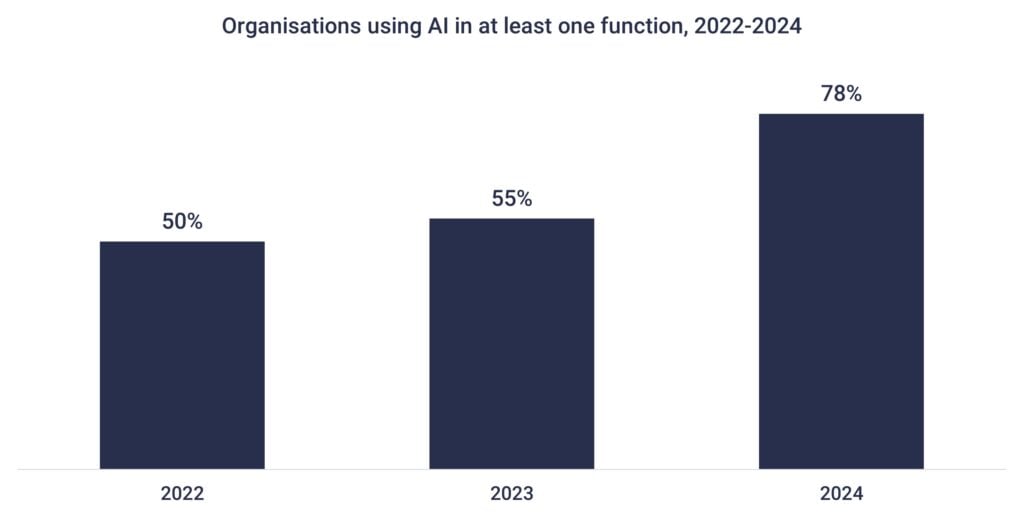
Source: Stanford AI Index Report
If you are not a subscriber, enter your details below to download a free copy of the report
Challenges persist in scaling data centre capacity
There has been much discussion around what needs to be done to ensure that AI growth can continue. Policymakers are moving to provide clearer operating guardrails, universities and corporates are focused on continuing to develop the skills and talent required. One other critical constraint is making sure there is enough compute capacity for AI applications to run on. Global colocation data centre capacity is estimated at 55GW yet demand from compute-intensive AI applications continues to outstrip supply.
Although hyperscale cloud providers and private enterprises are expanding capacity beyond the 55GW, much of it is likely to be reserved for training proprietary models. This concentrates power demand in a few hands and externalises environmental costs onto the wider public without delivering local returns once operations become business-as-usual. It also raises barriers to entry: by securing large grid allocations, hyperscalers can pre-empt capacity in certain geographies, hindering innovation and making it difficult for new, local organisations to gain a foothold.
A further challenge is the length of time it takes from conception to an operational data centre. Depending on the country and region, it can take up to two years to obtain planning permission, five to seven years to secure a national grid connection and up to two further years to construct the data centre itself. Friction is also rising as data centre demand grows and collides with other national priorities such as boosting grid capacity, meeting new housing targets and as local impacts become clearer. Water use is a particular concern: large facilities can consume up to five million gallons per day, roughly the daily usage of a town of 10,000 to 50,000 people.
Lead times (months) for electricity and data centre builds in Germany vs. Ireland
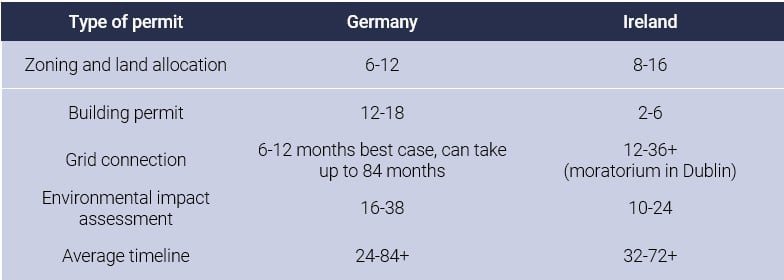
Source: STL Partners
Subsequently, the ecosystem is looking for solutions for this problem. One resolution is to start to repurpose existing infrastructure and convert them into data centres, reducing the time-to-operation. In this paper, we will explore the opportunity of developing small AI-ready data centres at mobile base stations that can work both standalone or as a collective across a country or region.
Table of contents
- Executive Summary
- Introduction: Growing AI demand
- Challenges persist in scaling data centre capacity
- Why does it make commercial sense to use base stations to host AI workloads?
- Who are the likely customers?
- B2B2C applications requiring real-time inference
- Enterprise or government workloads with data privacy, sensitivity, or resilience requirements
- Organisations lacking access to dedicated compute or affordable capacity in FLAPD regions
- How can telcos and towercos make the investment case?
- Recommendations
- Operating model
- Commercial model
- Investment model
Related research
- AI-RAN: Navigating the path from hype to commercial reality
- STL Partners’ annual edge computing industry survey
- Edge AI market forecast: The USD157 billion opportunity