
Skywatch constellation: Satellite operator profiles
Skywatch constellation offers an in-depth analysis of major satellite operators, including their constellation, business model and strategic posture toward telcos.

Skywatch constellation offers an in-depth analysis of major satellite operators, including their constellation, business model and strategic posture toward telcos.

Skywatch tracker monitors public announcements of collaborations between telcos and satellite/non-terrestrial networks (NTN) players publicly announced since 1 January 2024. It also highlights where satellite operators are collaborating and competing with telcos.

Skywatch telescope offers deep-dive coverage of telcos’ live satellite services, offering insights into how telcos are commercialising these offerings.

Many have tried to capture the elusive opportunities in the super apps domain, but very few are succeeding. This playbook examines the different approaches to super apps and offers valuable recommendations to telcos that aim to pursue opportunities in this area.

With iPhone sales apparently peaking, Apple is looking to double its revenue from services over the next four years to approximately US$50 billion, taking it deeper into adjacent markets, such as entertainment, financial services and communications. However, Apple trails behind Google in developing artificial intelligence and needs to extend the reach of its services to capture more behavioural data. If Apple decides to decouple more of its key services from its hardware, that would have major ramifications for Google, Amazon, Facebook and many of the world’s leading telcos.

VoLTE solves the complex problem of providing voice services over a 4G mobile data network. Although it may allow 2G and 3G networks to be turned off, and their spectrum re-farmed to other networks, declining call revenues (and in some cases declining volumes) are dampening appetite to invest in VoLTE. However, with voice beyond telephony on the rise, for example through AI-powered voice assistants and video calling, can telcos use VoLTE as an opportunity to develop new IP-based voice and messaging communications offerings?

The rapid growth of Facebook, WhatsApp, WeChat and other Internet-based services has prompted some commentators to write off telcos in the consumer communications market. But many mobile operators retain surprisingly large voice and messaging businesses and still have several strategic options. Indeed, there is much telcos can learn from the leading Internet players’ evolving communications propositions and their attempts to integrate them into broad commerce and content platforms. In this report we examine what opportunities still exist for telcos in this strategically important sector.
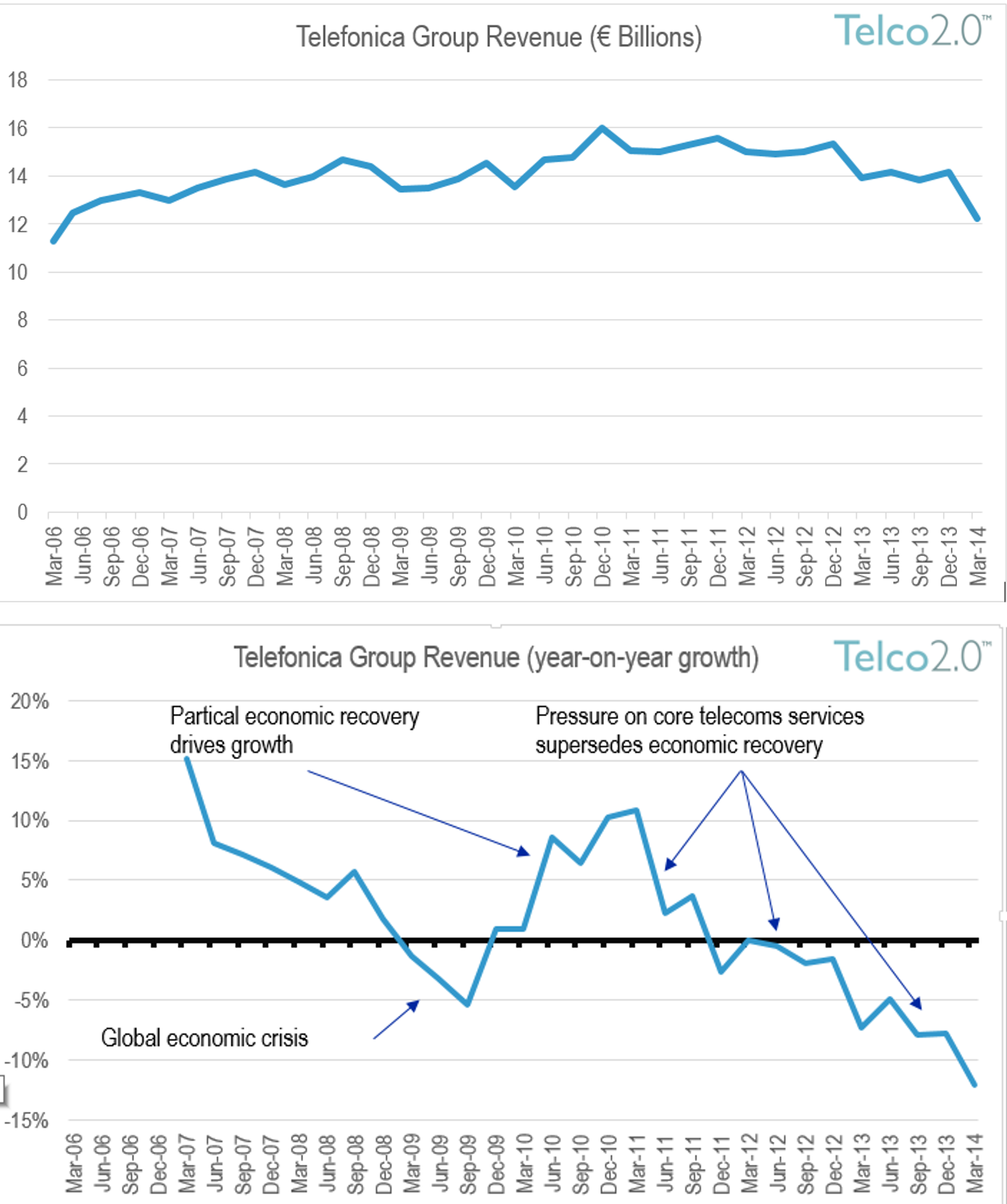
The latest results for Telefonica are grim, showing a 12% y-o-y revenue decline, following Orange and Deutsche Telekom’s 4% drops. This signals unequivocally that transformation is now a necessity not a luxury for European operators – and the rest of the world is not far behind. Longer term recovery is possible but not a certainty – what are the key steps? (May 2014, Foundation 2.0, Executive Briefing Service, Telco 2.0 Transformation Stream.)
Enterprise Mobility Framework December 2013

So Facebook is buying the mobile IM app WhatsApp for $19bn including $4bn in cash, and WhatsApp is launching a voice service. Why, and what are the consequences and lessons for telcos and others?

Disruption is taking place across the voice and messaging space – not just with telcos. Established vendors and de facto technology standards are also being challenged. For example, Cisco, the market leader in enterprise telephony, finds itself being disrupted in key markets by other vendors offering more horizontally integrated solutions. This report provides an overview and insight into a number of vendors and technologies in the voice and messaging markets, including telco platforms and services, and LTE, RCSe, and WebRTC. Three telco case studies (Vodafone, Telefonica and AT&T) are also provided, examining their activities, products and results.

Our new research shows how telcos can slow the decline of voice and messaging revenues and build new communications services to maximise revenues and relevance with both consumer and enterprise customers. It includes detailed forecasts for 9 markets, in which the total decline is forecast between -25% and -46% on a $375bn base between 2012 and 2018, giving telcos an $80bn opportunity to fight for. It also shows impacts and implications for other technology players including vendors and partners, and general lessons for competing with disruptive players in all markets. It looks at the impact of so-called OTT competition, market trends and drivers, bundling strategies, operators developing their own Telco-OTT apps, advanced Enterprise Communications services, and the opportunities to exploit new standards such as RCS, WebRTC and VoLTE. (November 2013, Executive Briefing Service). Future Value of Voice and Messaging Cover Small
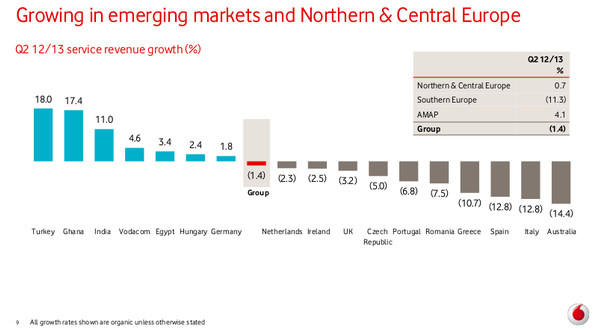
In our recent briefing European Mobile: The Future’s Not Bright, It’s Brutal, we predicted that European operators faced a grim future. New figures from Vodafone and Telefonica suggest that, unfortunately, the grim future is arriving fast. (November 2012, Executive Briefing Service, Transformation Stream.)
Vodafone results Nov 2012

New analysis by the Telco 2.0 team shows that the mobile industry’s combined revenues from voice, messaging and data services in the EU5 economies (UK, France, Germany, Spain and Italy) will drop by nearly 20Bn Euros, or 4% per year, in the next five years, and by 30Bn Euros by 2020. (October 2012, Executive Briefing Service)
Euro Voice Brutal Future October 2012

An extract from our 284 page, 124 chart, strategy report that analyses the business models, markets, objectives, strategies and modus operandi of the major adjacent players, and their current and future impact on the telecoms industry. The report identifies the areas and options for competition and co-operation, and outlines potential strategies for interacting with each player. It also draws the combined activities of the digital empires – telcos, so called ‘OTT players’ and others – into the context of the new ‘Great Game’, the battle for power and value in the emerging digital economy. (Page updated February 2012, report published November 2011, Dealing with Disruption stream) Google Apple Facebook Microsoft Skype Amazon Telco 2.0 Disruptor Report Cover

M2M 2.0: Event Summary Analysis: A summary of the findings of the M2M 2.0 session, 10th November 2011, held in the Guoman Hotel, London
M2M 2.0: Event Summary Analysis Presentation
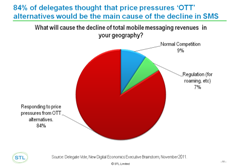
In four years’ time, Telco SMS revenue will decline on average by around 40% across Europe and the Middle East according to the senior execs at this month’s Telco 2.0 brainstorm in London. The main cause is competitive pressure from ‘OTT’ alternatives (Facebook, Skype, Google, BBM, etc). Mobile voice isn’t that far behind, with a 20% decline foreseen. What can be done and what is the role of RCS-e? (November 2011, Executive Briefing Service, Dealing with Disruption Stream).
EMEA Messaging Decline reasons Nov 2011