Login to access
Want to subscribe?
This article is part of: Network Innovation
To find out more about how to join or access this report please contact us
The RAN is evolving towards greater openness and disaggregation, but the path is hybrid and incremental. This report explores the challenges operators face, early lessons from deployments, and why embedding openness and flexibility early is critical to long-term competitiveness.
The RAN is moving towards open, disaggregated architectures
The future of the RAN is defined by greater openness and disaggregation. Operators globally are committed to this principle when considering future networks, as it will reduce dependence on single vendors and create room for faster innovation. Industry momentum is now firmly behind this vision, supported by global initiatives such as the O-RAN Alliance and growing ecosystems of vendors, integrators and hyperscalers.
Over the past few years, significant progress has been made in moving towards this vision. The industry has advanced beyond the initial concept stage, with growing vendor ecosystems and learnings from early trials and deployments. The challenge now lies less in ‘if’ networks will adopt greater openness and disaggregation, and more in ‘how’ and ‘when’ operators can make the transition at scale while retaining enough flexibility to evolve as architectures and technologies mature.
If you are not a subscriber, enter your details below to download an extract of the report
What has become clear is that adoption will be more hybrid and incremental than originally anticipated. Many deployments today are of partially disaggregated cloud RAN rather than fully open architectures: they combine elements of the full O-RAN vision adopted step by step, often through vendor-integrated virtualised RAN and mixes of public and private cloud environments. The fully open, disaggregated, multi-vendor blueprint— spanning radio unit (RU), distributed unit (DU), centralised unit (CU) and orchestration — remains aspirational for large-scale rollouts, given the complexity of achieving full interoperability. Not all operators will aim for this as their end state of RAN evolution; instead, many are prioritising partial openness such as Open Fronthaul, while continuing to rely on lead vendors to ensure integration and performance.
The hybrid evolution towards open, disaggregated architectures
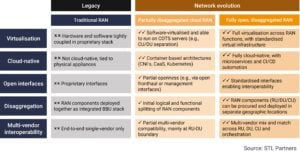
This report explores the current state of RAN evolution and the growing momentum across the ecosystem. Whilst there remain several challenges which operators must navigate, there is a shift in the industry, as early deployments are beginning to demonstrate how these issues can be addressed in practice. As operators evolve on their hybrid path, they must embed openness and flexibility early to ensure long-term competitiveness and control.
Table of contents
- Executive summary
- The RAN is moving towards open, disaggregated architectures
- Early deployments are beginning to address initial challenges
- Concerns over technical, operational and commercial issues remain
- Real-world deployments are beginning to address key challenges
- Flexibility and openness are critical to avoid lock-in and enable future innovation
- Two elements are emerging as central to avoiding this outcome: cloud flexibility and open interfaces
- Key recommendations for operators
Related research
- Telco cloud deployment tracker Q1 2025: The various flavours of open RAN
- AI-RAN: Navigating the path from hype to commercial reality
- Enterprise AI: What are the best opportunities for telcos?
- Networks for AI: Segmenting the growth