
Listen
Download


This article explores how public perception is shaping the fate of data centre developments. It examines the key concerns driving delays and cancellations, from land use to water and power, and sets out strategies that operators can use to engage communities, build trust, and keep projects on track.
Why does public perception matter for data centre projects?
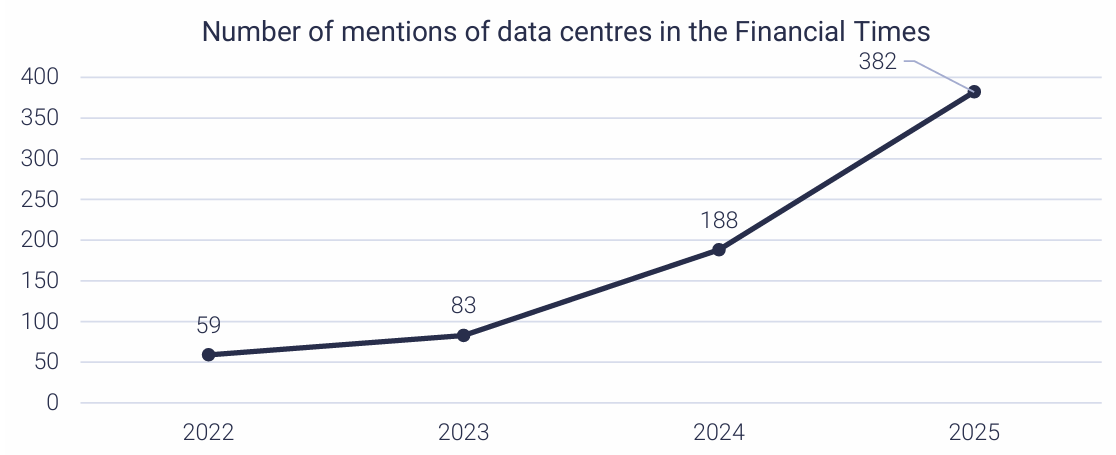
Over the past decade, the importance of decisions made around data centre site selection and permitting has increased, becoming a major risk factor that can materially delay or even derail projects. Part of the reason for this is increased public scrutiny. Data centres are no longer niche, behind-the-scenes infrastructure. Press coverage of data centres has grown exponentially, with mentions doubling year-on-year in outlets such as the Financial Times.
STL Partners analysis based on the public information about investments for projects that were then delayed or cancelled
Once an obscure topic, data centres are now firmly in the public eye. This increased attention brings scrutiny and heightened expectations for how operators engage with local communities. Not all media coverage has been favourable. Mainstream newspapers and broadcasters are increasingly publishing investigative reports on the negative externalities of data centre operations. For instance, a recent BBC article highlighted water pollution issues linked to a Meta facility in the U.S., sparking debate on the environmental costs of such projects. These stories have helped galvanise local opposition, pushing data centres into the spotlight as symbols of environmental and land-use conflicts.
This growing awareness means that public perception can no longer be dismissed as a secondary concern. Community sentiment has the potential to make or break data centre construction projects, with opposition leading to delays of months or even years. These delays drive up costs, disrupt project timelines, and can undermine the internal rate of return (IRR) for investors. In extreme cases, public pushback has led to outright cancellations.
The consequences are not merely anecdotal. STL Partners’ research shows that public concerns have already impacted data centre investments worth almost USD 120 billion across Europe and the US. This includes USD 76.75 billion of impact projects in the United States and USD 41.85 billion in Europe, encompassing both delays and cancellations. These numbers underscore how local perception has become a financial and strategic risk that operators and investors must actively manage.
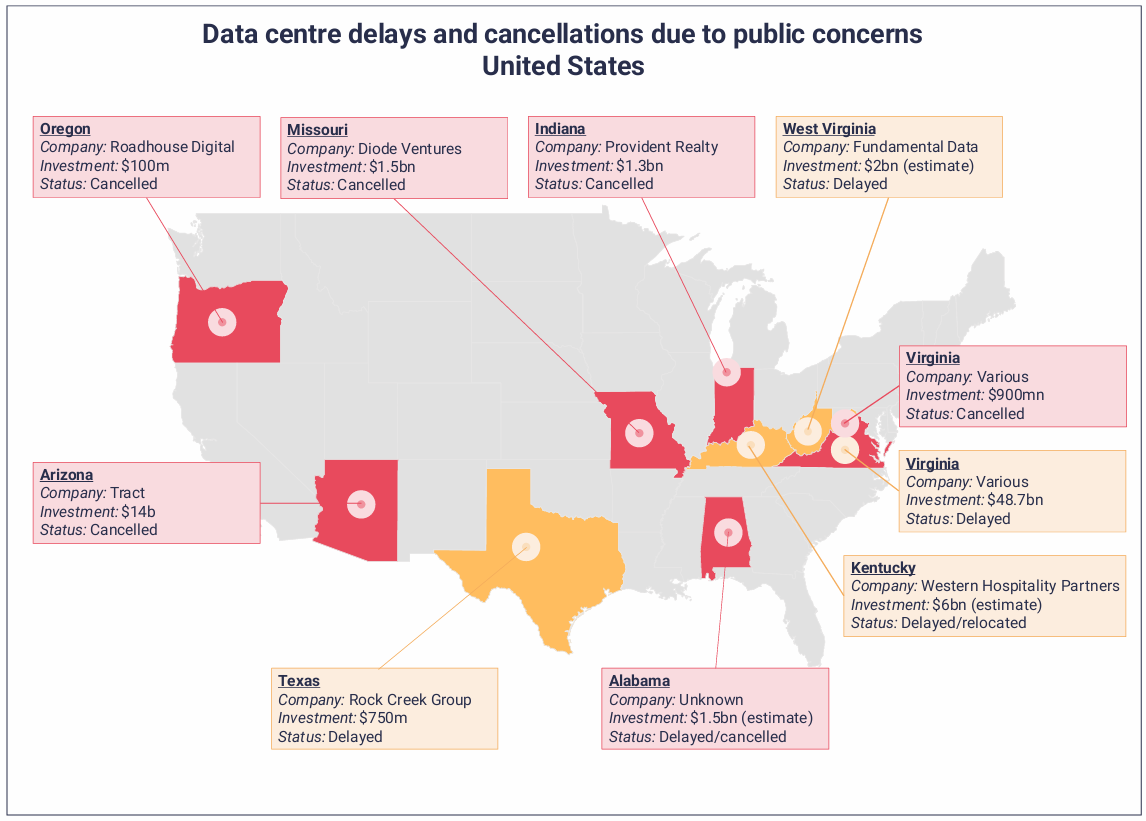

While the problem is particularly critical in saturated data centre markets (e.g. Virginia, Ireland), as the maps above indicate, delays related to public concerns are not isolated to specific regions – they are universal. To mitigate against such delays and cancellations, developers and investors must understand the root causes of opposition.
Which public issues cause delays?
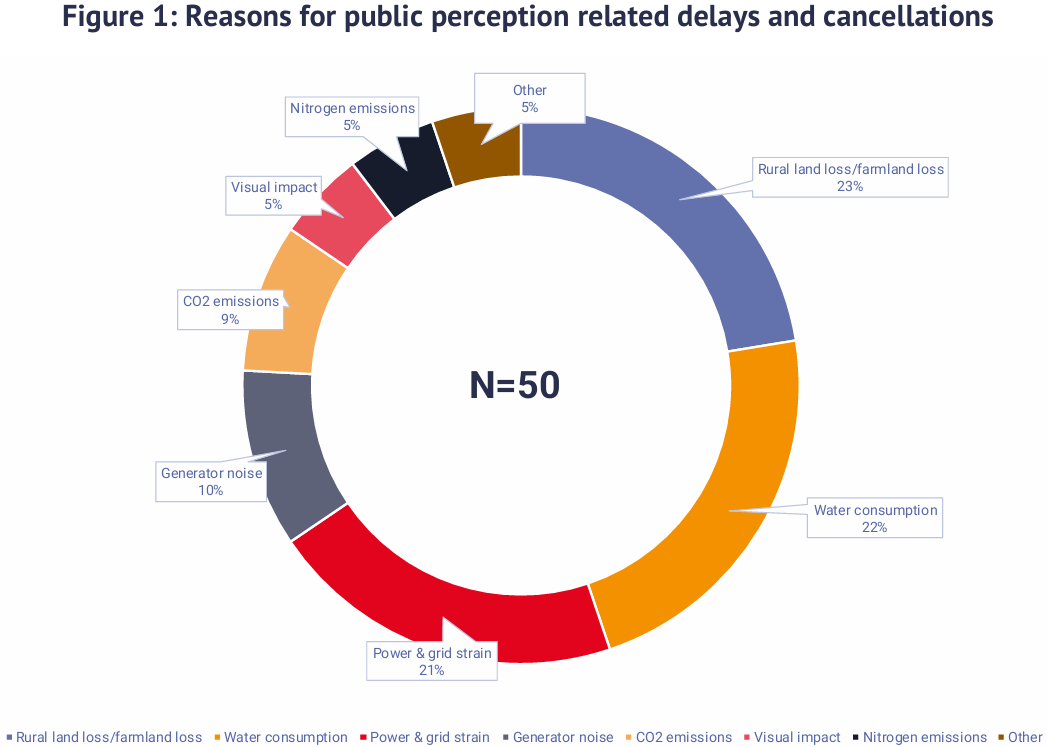
STL Partners’ research has examined the main drivers of project delays and cancellations linked to public perception challenges. Drawing on a comprehensive review of 50 case studies, the most frequently cited issues were rural land loss (22%), water consumption concerns (22%), and power and grid strain (21%). Secondary factors were less common but still notable, including generator noise (10%), CO₂ emissions (9%), visual impact (5%) and nitrogen emissions (5%). It is important to note that these issues are not mutually exclusive. In many cases, projects face multiple overlapping concerns – for example, a combination of land use, water, and power objections – which collectively build momentum in public forums and ultimately drive delays or cancellations.
Rural land loss
Rural land loss in the data-centre context refers to converting farmland, Green Belt and other open countryside into large industrial campuses with heavy utility connections. Communities push back because the trade-off feels asymmetric: thousands of square metres of sheds, perimeter plant, substations and diesel compounds for relatively few permanent jobs per hectare, plus 24/7 noise/lighting and HGV traffic. It also raises worries about food security, landscape character and heritage settings, plus biodiversity and water run-off concerns on previously permeable land. In Europe, that friction is sharpened by planning protections (e.g., Green Belt in the UK; Natura 2000 sites) and by the need for new grid infrastructure across rural corridors.
Recent cases show how “loss of countryside” arguments can delay or derail projects. In the Netherlands, Meta’s hyperscale at Zeewolde was scrapped in 2022 after a national-level backlash over building on polder farmland and the government’s ensuing clamp-down on hyperscalers. In the UK, Green Belt objections led Greystoke’s Abbots Langley campus to be refused locally in 2024 (later pushed through at a governmental level), and Digital Reef’s East Havering mega-campus has been pushed into extended consultation. Collectively, these illustrate that where rural land conversion is central to a scheme, sustained community challenge often forces delay, redesign, relocation – and sometimes outright cancellation.
Water consumption
Water consumption becomes a flashpoint when proposed data centres rely on evaporative or adiabatic cooling that draws on potable supplies, especially in drought-prone or agricultural regions. Communities worry about absolute volumes (often hundreds of thousands to hundreds of millions of litres per year), seasonal peaks, and whether withdrawals compete with households, farms, or ecosystems. Regulators then face tough trade-offs between digital infrastructure and local water security, frequently conditioning approvals on technology changes (e.g., switching to air or liquid cooling that avoids evaporation), recycled/industrial water use, or on-site storage and reuse – each of which can add time, cost, and redesign risk.
Recent cases show how water concerns alone can slow or reshape projects. In Spain, Meta’s Talavera de la Reina campus drew sustained opposition over its projected annual withdrawals from the Tagus; approval came only alongside commitments to reduce consumption, recycle, and fund local water restoration—delaying progress and tightening conditions. Also in Spain, AWS’s Aragón build-out faced farmer and NGO pushback during a regional drought. Increasingly, water consumption is figuring highly in local concerns around new data centre construction projects.
Power and grid strain
Power and grid strain is one of the most visible triggers of public pushback against new data centres. Residents and regulators worry that these facilities place disproportionate stress on local electricity systems, requiring costly grid upgrades, competing with households and businesses for capacity, and often relying on polluting backup generation when connections fall short. This fuels perceptions that data centres jeopardise local reliability and climate goals.
Recent cases highlight these concerns clearly. In Dublin, the grid operator froze new data centre connections (possibly) until 2028, and Google’s Grange Castle expansion was refused on grounds of power shortfall. In the Amsterdam region, local authorities imposed moratoria amid grid saturation, while in Brandenburg (Germany) Google abandoned a project after doubts over power availability. And in Norway’s Hamar region, TikTok’s project drew protests after it tied up scarce grid capacity, blocking a defence factory expansion. In each case, the fear that hyperscale centres would overwhelm fragile energy systems played a decisive role in slowing or cancelling projects.
Other factors
Noise & local amenity
Backup generation fleets trigger anxiety about 24/7 hum, periodic diesel tests, fumes and night-time disturbance – especially near homes or schools. In Staffanstorp, Sweden, Microsoft dropped an expansion after pushback over additional diesel generators and the way the permit had been framed. Similarly, a planned campus in Bad Vilbel, Germany drew strong objections because tall server halls and dozens of diesel generators were sited close to a playground and housing, prompting legal challenges and delay.
Visual impact, construction nuisance & traffic
Where projects transform protected landscapes or bring years of heavy HGV movements, opposition hardens. The aforementioned UK Green Belt cases – Abbots Langley (Hertfordshire) and East Havering (London) – were slowed or initially refused on visual/landscape harm and the prospect of years of construction traffic on narrow rural roads, forcing appeals, national reviews, and extended consultation.
Climate alignment (CO₂) & air pollution (nitrogen)
Communities are sceptical when projects add large fossil backup or private gas plants, or when cumulative nitrogen emissions collide with protected habitats. In Clondalkin, Dublin, an Equinix proposal dependent on a dedicated gas plant was refused (and that refusal upheld on appeal) because it conflicted with climate policy.
Strategies for overcoming public perception issues in data centre development projects
Developers who succeed in overcoming public perception challenges start by treating communities as genuine partners, not obstacles. Entering a locality without transparency or care for residents’ concerns almost guarantees pushback. Listening sessions, clear communication, and a willingness to adapt demonstrate diligence and respect. Communities expect to be engaged honestly, and developers who ignore this often find themselves facing delays, legal challenges, or reputational damage that could have been avoided with early, open dialogue.
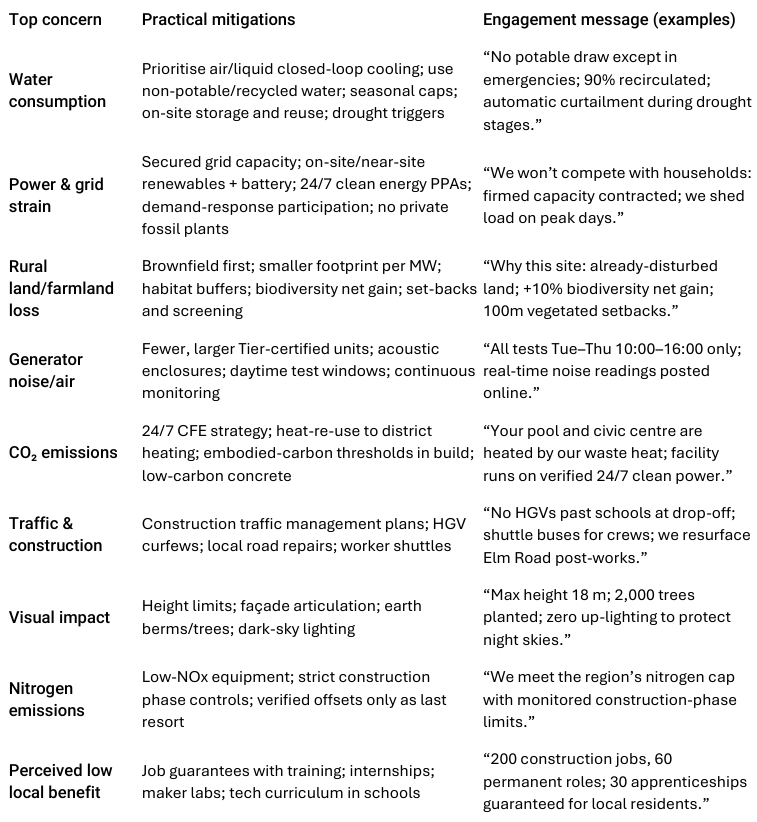
The most effective approach is to tailor responses to the issues that people actually raise. If water scarcity is the concern, host educational sessions explaining the cooling system design and how it avoids competing with household supply. Where jobs and economic contribution are in question, highlight training programmes, apprenticeships, and commitments to local hiring. In areas where emissions or energy draw are sensitive, emphasise renewable energy sourcing, efficiency measures, and backup generation limits. In other words, use issue-led engagement paired with clear engineering mitigations – then explain the “why” in plain language. This strategy not only de-risks projects by addressing concerns directly, but also helps reposition developers as trusted community partners rather than outsiders forcing change. Having a named spokesperson who can translate technical data centre information into clear messages for laypeople is likely to be important. As is being prepared to produce and publish an impact assessment report (especially for larger projects).
Data centre operators will want to use a concern-to-solution framework when discussing with the community, where each common point of resistance – water, power, land use, noise, emissions, jobs – can be matched with concrete mitigations and a narrative communities can understand.
Data centre operators should also collaborate with local and national governments to manage and mitigate community issues. In particular, local authorities can be an important ally both from a process and a reputation perspective.
Public perception has become a decisive factor in the success or failure of data centre projects. As case studies across Europe and the US show, community opposition can impose costly delays, force redesigns, or even cancel billion-dollar investments outright. Yet, these risks are not inevitable. With early engagement, transparent communication, and tailored responses to specific concerns, developers can reposition themselves from outsiders imposing infrastructure to valued partners enabling local benefits.
At STL Partners, we support operators and investors in navigating this shifting landscape. Our experience in analysing the drivers of community opposition, coupled with practical frameworks for engagement, helps ensure smoother project delivery. By proactively engaging communities and producing strategies to address public concerns – whether around land, water, energy, or local benefit – STL can help de-risk investments, shorten timelines, and build the trust needed to turn data centres into assets welcomed by the communities that host them.
Public perception & delays: FAQs
Why do data centre projects face local opposition?
Concerns usually centre on power demand, water use, noise/traffic, and visual impact/land use. Upfront engagement, published impact assessments, and community benefit plans reduce delays.
Do data centres always use lots of water?
Not always. Many modern designs minimise or eliminate water (air-cooled chillers, closed-loop systems, liquid cooling) or use non-potable/recycled sources where available.
Are data centres bad for the grid?
Large sites need substantial capacity, but they can also co-invest in new generation and grid upgrades, add onsite storage/backup, and shift non-urgent compute to off-peak windows. National policy frameworks for Sovereign AI often set the rules for siting, energy procurement and compliance.
What community benefits can operators offer?
Typical packages include local jobs & training, tax base growth, district heat reuse, biodiversity & screening, and public amenities (e.g., trails, landscaping).
Looking for advisory services in data centres? Schedule a call.
Download the data centre insights overview pack
Download the data centre insights overview pack
Get a concise, practical summary of the data centre market: the impact of AI and sovereign strategies, the differentiators that win in a crowded landscape, and proven frameworks for market entry, channel partnerships and customer acquisition—backed by case studies and sample deliverables.

Five things we learned at Datacloud Global Congress 2026
We were at Data Cloud Congress 2026 in Cannes last week to evaluate the key narratives among data centre operators, investors and vendors.

The hidden economics of liquid-cooled data centre retrofits
This article, kindly supported by Airedale, explores when liquid cooling retrofits make commercial sense, showing why the decision depends on HPC pricing, facility fill, market constraints and disciplined execution.

The EU’s AI Gigafactory Initiative: What it means for digital infrastructure?
The EU’s €20 billion AI gigafactory initiative will fund up to five large-scale AI compute facilities, each designed to support frontier model training with more than 100,000 advanced AI processors.