
Download
Listen


As data centres expand worldwide, water use is becoming a growing source of public scrutiny. Understanding how cooling systems shape water consumption is key to separating headline narratives from the technical realities.
Why water is becoming the next major data centre debate?
The global build-out of data centres is accelerating at an unprecedented pace as demand for cloud services, AI infrastructure, and digital platforms continues to surge. Governments and industry alike increasingly see digital infrastructure as foundational to economic growth, and hyperscale campuses are being announced across North America, Europe, and Asia at record scale. Yet alongside this rapid expansion, concerns about the environmental footprint of data centres are gaining prominence (see our prior article on data centres and public perception). While energy consumption has long dominated the debate, water usage is quickly emerging as a critical issue.
Data centres use water primarily to help remove the large amounts of heat generated by the computing equipment they house. As servers process data, they produce heat that must be continuously dissipated to keep systems operating safely and reliably. In many facilities, water is used as part of the cooling process because it is highly effective at absorbing and transporting heat away from the equipment. While not all data centres rely heavily on water, many cooling systems use it to improve efficiency when rejecting heat from the building. As a result, water consumption has become an important part of the discussion around the environmental footprint of large-scale digital infrastructure.
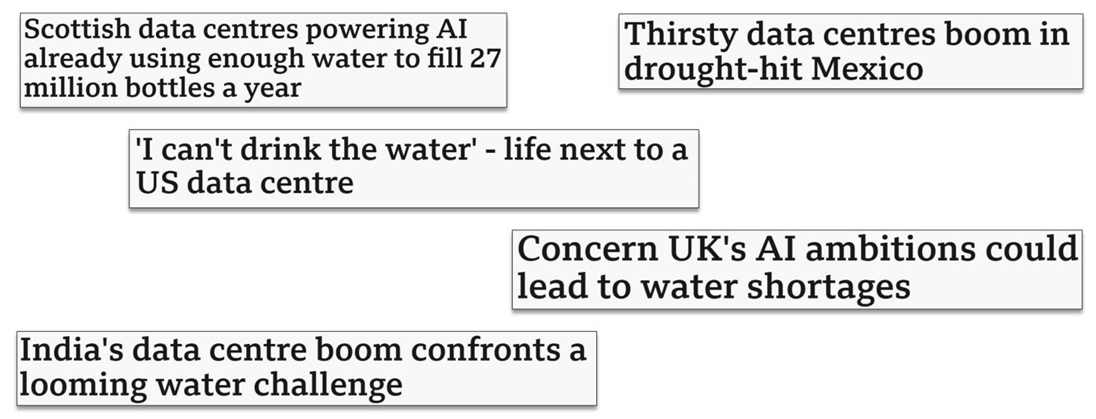
In many regions, newspaper headlines warning about the impact of data centres on local water supplies are proliferating, reflecting growing scrutiny from communities, policymakers, and environmental groups about how these facilities draw on increasingly stressed water resources.
Figure 1: Data centres are increasingly making negative headlines due to their water usage
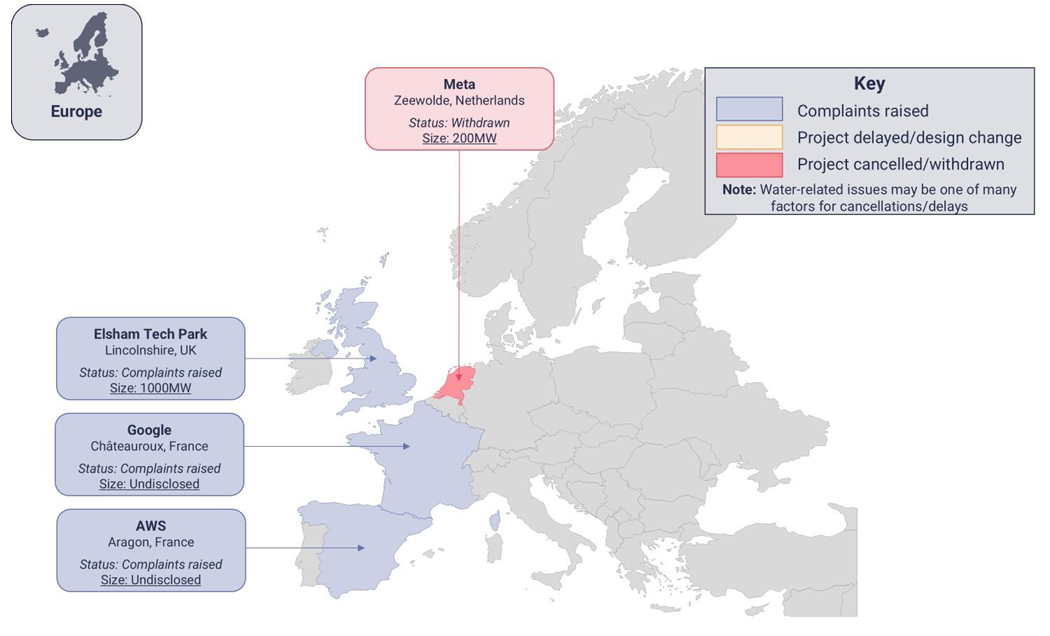
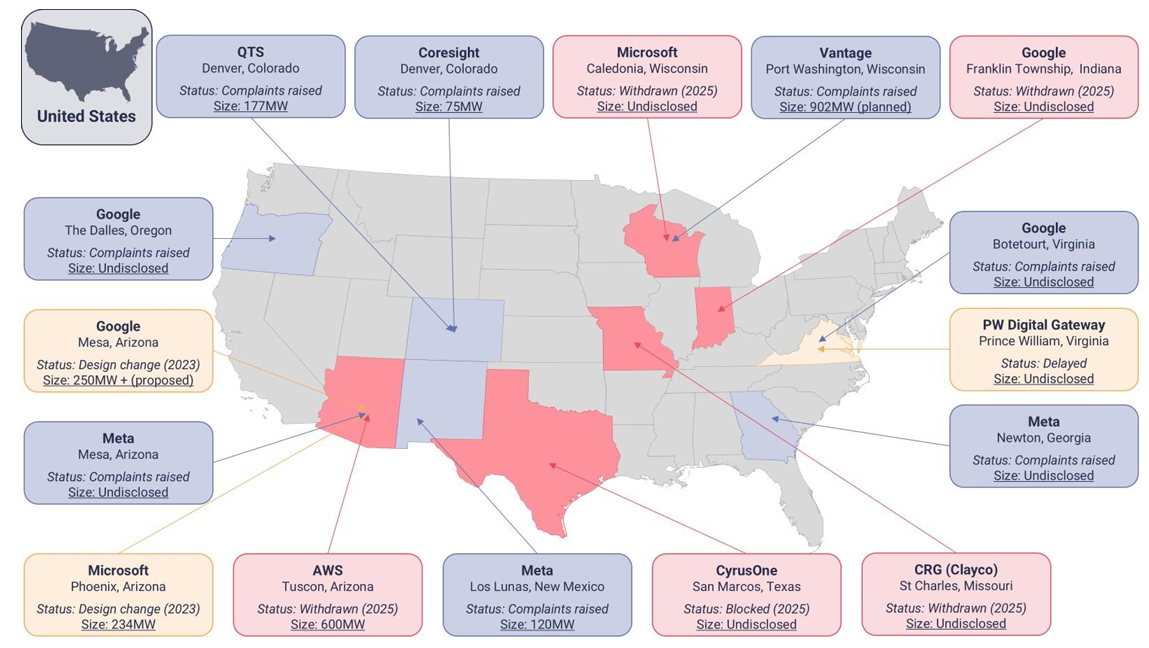
Such negative attention is not confined to newspaper headlines. In many cases, it is beginning to have tangible consequences for the development of new data centre capacity. Water use is increasingly becoming a focal point of community opposition, contributing to projects being delayed, redesigned, or in some cases cancelled entirely. Local residents, environmental groups and policymakers are raising concerns about the pressure that large facilities may place on local water supplies, particularly in regions already experiencing water stress. The map below highlights a selection of data centre projects that have been withdrawn or cancelled, subject to design changes, or drawn significant public scrutiny where water-related concerns have been a contributing factor.
Figure 2: Data centre projects impacted by concerns around water usage
For data centre developers seeking to expand their footprint, particularly into new communities where large-scale digital infrastructure may be unfamiliar, this represents an increasingly important risk factor. Perceptions around water usage can quickly become a focal point for broader local opposition, making it essential for developers to understand, communicate and manage water impacts carefully from the outset.
Examining the debate around data centres and water
Debate around data centres and water usage is often highly polarised. At one end of the spectrum are critics who characterise data centres as ‘water-guzzling’ facilities that divert scarce resources away from local communities and place additional strain on already stressed water systems. At the other end are industry defenders who argue that data centres have little or no material impact on water supplies. In reality, the picture is far more nuanced. The extent to which a data centre affects local water resources depends heavily on factors such as the cooling architecture chosen, the climatic and hydrological conditions of the location, and how thoughtfully the developer engages with and plans for the needs of the surrounding community. Widespread claims that all data centres inevitably create water problems are as unhelpful as assertions that they pose no environmental challenges at all. A more constructive discussion requires understanding the technical and geographic factors that shape water use in each case.
Understanding the critique against data centres
To understand the debate, it is important to examine in detail the primary concerns raised about data centres in relation to water. The most prominent issue is water consumption itself, specifically the perception that water is irreversibly removed from local drainage basins to support data centre cooling. When facilities are designed or located without sufficient consideration of the surrounding environment, this can indeed create real pressures on local water resources.
Figure 3: Data centres have the potential to cause stress on water supplies at times when they are most essential
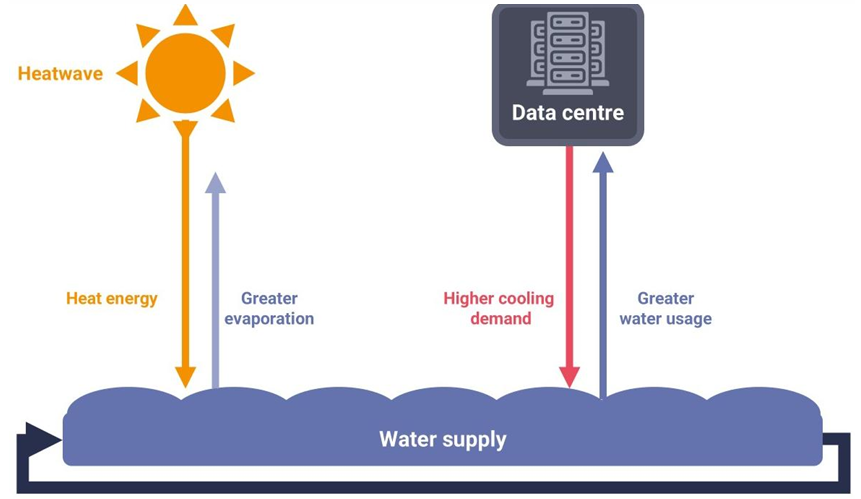
Data centres can cause greater pressure on the water supply at times when it is most in demand
In some cases, this dynamic can contribute to a problematic feedback loop. During heatwaves or prolonged periods of hot weather, particularly in already water-stressed regions,data centres require greater cooling to maintain safe operating temperatures. If cooling systems rely on evaporative processes, this can increase water withdrawals precisely when local water supplies are already under strain. In effect, the same heat that stresses regional water systems can simultaneously increase the demand for cooling, amplifying pressure on those water resources at the time they are needed most.
Other concerns extend beyond the volume of water consumed and relate to the potential degradation of water quality. Data centre cooling systems often require water treatment chemicals to prevent corrosion, biological growth, and mineral buildup within cooling infrastructure. If not properly managed, wastewater discharge from these systems can raise concerns about chemical contamination or changes to local water chemistry. There are also worries in some communities about the thermal impacts of returning warmer water to local waterways. While modern facilities typically operate under strict environmental regulations designed to manage these risks, the potential effects on water quality nonetheless remain part of the broader debate surrounding the environmental footprint of large data centre developments.
The role of cooling architecture in data centre water consumption
Broadly speaking, there are three main cooling archetypes used in modern data centres. In simple terms, the way a data centre is cooled largely determines its relationship with local water systems. The three broad categories of cooling architecture are:
1.Evaporative cooling
2.Closed-loop liquid cooling
3.Air-cooling
Evaporative cooling
Evaporative cooling is typically the most water-intensive cooling approach used in data centres because it relies on water being evaporated to carry heat away. In simple terms, heat from the IT equipment is transferred into a cooling system, and that heat is then rejected outside by using water as the “working fluid”: a portion of the water is intentionally turned into water vapour, and in doing so it removes heat from the remaining water and the wider system. This is the core dynamic shown in the graphic – heat flows from the data hall into the cooling system, and water loss occurs at the point where that heat is discharged via evaporation.
Figure 4: Indicative explanation of evaporative cooling
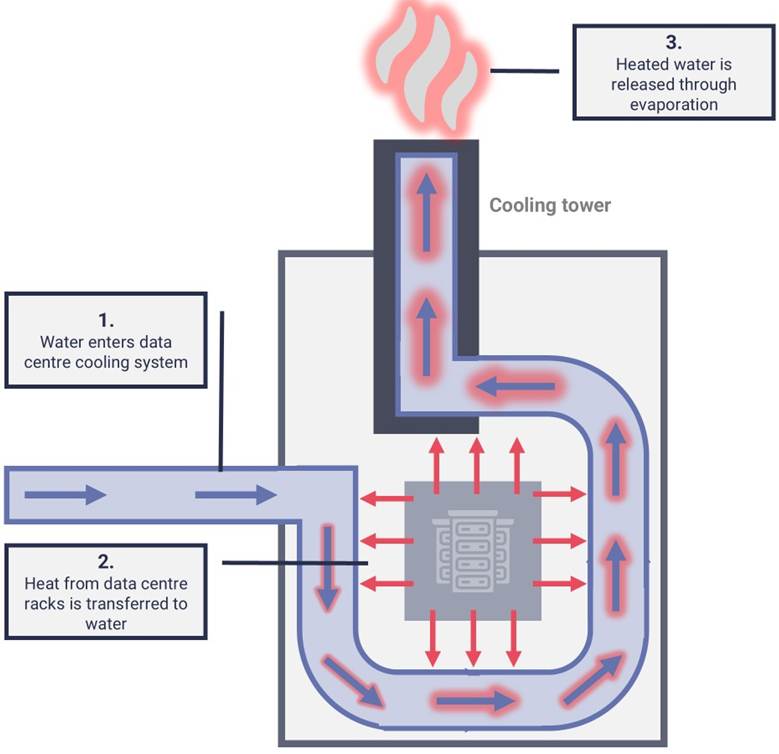
Developers still choose evaporative cooling because it can be highly effective and energy-efficient, particularly at large scale. Evaporation is a powerful way to reject heat, which often means facilities can achieve lower electricity consumption for cooling, maintain stable operating temperatures during hot weather, and avoid oversizing purely mechanical cooling equipment. In many climates, evaporative approaches also reduce the need for energy-hungry chillers, improving overall efficiency and operating costs. In short, it’s often selected because it can deliver a favourable trade-off on performance and power – but that trade-off is precisely why it becomes contentious in regions where water is scarce or politically sensitive.
Closed-loop liquid cooling
Closed-loop liquid cooling systems typically have a much lower environmental footprint on local water resources than evaporative cooling approaches. Because the cooling liquid is recirculated within a sealed system rather than intentionally evaporated, very little water is consumed during normal operation. Once the system is initially filled, the same coolant continues to circulate through the infrastructure, meaning there is minimal ongoing withdrawal from local water supplies. As a result, this architecture significantly reduces the risk that a data centre will place sustained pressure on municipal or regional water systems, making it particularly attractive in areas where water availability is a sensitive issue. However, some developers still choose evaporative cooling because it can provide very high cooling efficiency and lower electricity consumption in certain climates and operating conditions.
In closed-loop liquid cooling systems, heat generated by servers is transferred into a circulating coolant – often water or another specialised fluid – which flows through a closed piping loop. The warmed coolant is then passed through a heat exchanger or dry cooler where the heat is released to the outside air before the cooled liquid returns to the system and repeats the cycle. As illustrated in the graphic, the defining feature of this approach is the closed loop, where liquid absorbs heat, releases it externally, and is continuously reused rather than being lost through evaporation.
Figure 5: Indicative explanation of closed-loop liquid cooling

Air cooling
Air cooling typically has the lowest direct impact on local water resources, as it relies primarily on moving air rather than circulating or evaporating water to remove heat from data centre equipment. In these systems, cool air is supplied to the server racks, where it absorbs the heat generated by the computing hardware. The warmed air is then extracted from the data hall and cooled again through air-handling systems or external heat rejection units before being recirculated. As illustrated in the graphic, heat is removed through the movement and cooling of air rather than through the evaporation or circulation of water, meaning there is little to no ongoing water consumption for cooling.
Figure 6: Indicative explanation of air cooling
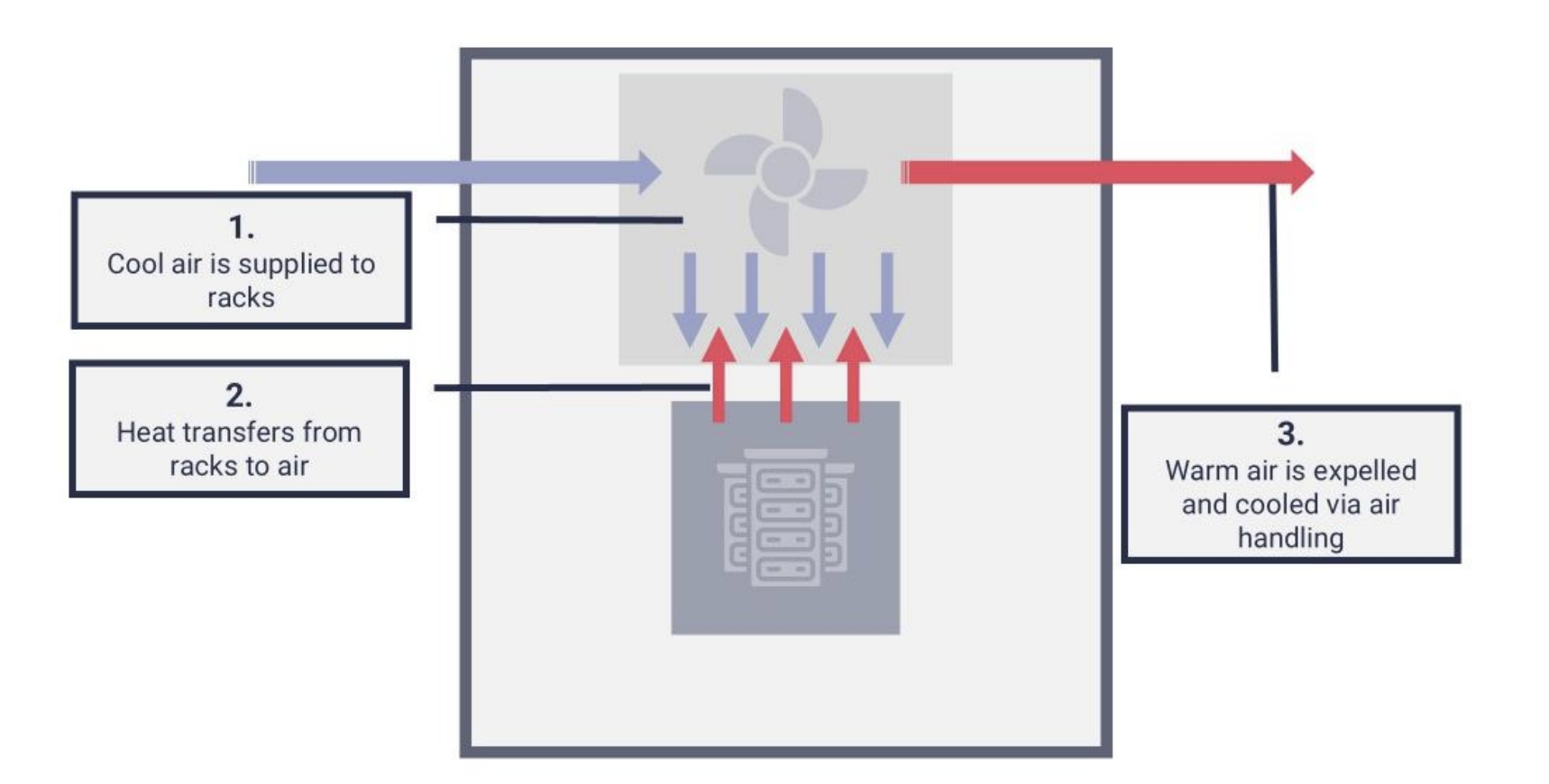
From the perspective of local water systems, this architecture therefore places minimal pressure on water supplies, making it an attractive option in regions where water scarcity is a major concern or where communities are particularly sensitive to water withdrawals. However, air cooling has its own trade-offs. Moving and cooling large volumes of air requires significant mechanical equipment – such as fans, chillers, and air-handling units – which can increase overall electricity consumption. As computing densities rise, particularly with AI workloads, air-based cooling systems can become less efficient and require even greater power draw to maintain safe operating temperatures. As a result, while air cooling minimises water use, developers must often balance this advantage against the higher energy requirements and operational costs associated with cooling large facilities using air alone.
The balancing act
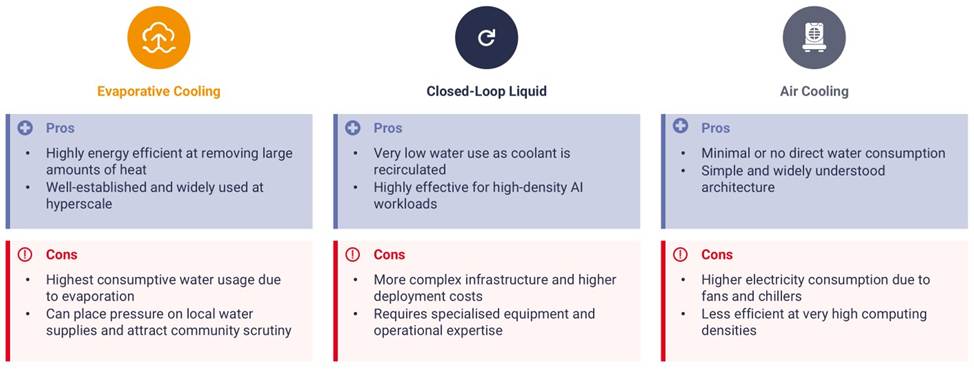
In practice, selecting a cooling architecture is rarely a simple choice between water use and energy efficiency. Data centre developers often face a balancing act between power draw and water consumption, as different cooling approaches shift the burden between these two resources. Systems that minimise electricity use –such as evaporative cooling – can require significant water withdrawals, while approaches that minimise water consumption – such as air cooling or certain closed-loop systems – may require more electricity to move and chill air or reject heat. The optimal solution therefore depends heavily on local conditions, including climate, energy availability, water scarcity and the sensitivity of surrounding communities.
Adding further nuance, modern data centres rarely rely on a single cooling technique in isolation. Many facilities employ hybrid approaches, combining multiple cooling methods that operate together or activate under different conditions. For example, a site may primarily rely on air or closed-loop cooling but switch to evaporative methods during periods of high temperature, or use liquid cooling for the highest-density equipment while the rest of the facility remains air-cooled. As a result, the real-world water and energy footprint of a data centre is shaped by a complex set of operational choices rather than a single architectural decision .
Figure 7: The three cooling approaches offer distinct trade-offs for data centre efficiency
Conclusion: Navigating the water challenge in data centre expansion
The growing debate around data centres and water use highlights an important reality: the issue is far more complex than the headlines often suggest. While some facilities can place meaningful pressure on local water systems, particularly when evaporative cooling is deployed in water stressed regions, the extent of that impact ultimately depends on a range of technical and environmental factors, from cooling architecture and facility design to climate conditions and site selection. Data centres are not inherently “water guzzlers,” but neither are they environmentally neutral by default.
This places a clear responsibility on developers and operators. Cooling architecture choices, operational practices and siting decisions all shape how a facility interacts with local water resources. Developers that fail to consider these factors carefully risk creating genuine environmental strain and, increasingly, public opposition that can delay or derail projects altogether.
The era in which data centres could expand quietly and largely out of public view has come decidedly to an end. As digital infrastructure becomes more visible and as communities become more aware of its resource demands, new projects are facing growing scrutiny. Addressing water concerns therefore requires more than technical optimisation; it requires transparent engagement with the communities in which facilities are built. That engagement must also be accessible. Discussions about water usage are often framed in abstract technical metrics that mean little to most people. Developers should instead communicate impacts in relatable terms, such as comparisons with other local water users like golf courses, factories or agricultural operations, to help demystify how facilities operate and provide context for their resource use.
Ultimately, building trust will be just as important as building infrastructure. Developers that proactively address water impacts, explain their design choices clearly and collaborate with local communities will be far better positioned to expand sustainably. Those that fail to do so may increasingly find that public scrutiny, and the resulting political and regulatory pressure, becomes one of the biggest barriers to future data centre development.
Looking for advisory services in data centres? Schedule a call.
Download the data centre insights overview pack
Download the data centre insights overview pack
Get a concise, practical summary of the data centre market: the impact of AI and sovereign strategies, the differentiators that win in a crowded landscape, and proven frameworks for market entry, channel partnerships and customer acquisition—backed by case studies and sample deliverables.

Five things we learned at Datacloud Global Congress 2026
We were at Data Cloud Congress 2026 in Cannes last week to evaluate the key narratives among data centre operators, investors and vendors.

The hidden economics of liquid-cooled data centre retrofits
This article, kindly supported by Airedale, explores when liquid cooling retrofits make commercial sense, showing why the decision depends on HPC pricing, facility fill, market constraints and disciplined execution.

Key takeaways from the launch of the Quantum Infrastructure Council
STL Partners attended the launch of QIC to explore what it will take to deploy
quantum technologies in real-world data-centre environments.
Five things we learned at Datacloud Global Congress 2026
We were at Data Cloud Congress 2026 in Cannes last week to evaluate the key narratives among data centre operators, investors and vendors.
The hidden economics of liquid-cooled data centre retrofits
This article, kindly supported by Airedale, explores when liquid cooling retrofits make commercial sense, showing why the decision depends on HPC pricing, facility fill, market constraints and disciplined execution.

Modular data centres: can prefabricated design speed up construction?
A look at whether modular data-centre design can help operators deliver capacity faster, scale more flexibly and respond to rising demand.