
Download
Listen


A look at whether modular data-centre design can help operators deliver capacity faster, scale more flexibly and respond to rising demand – and where its limitations mean traditional construction still has a role to play.
The age of ‘modular’ data centres
The surge of interest in ‘modular’ data centres is being driven by a simple mismatch: data-centre demand is accelerating, but traditional construction timelines have not kept pace. Hyperscale cloud expansion, enterprise digitalisation, and now AI workloads are all pushing operators to bring large volumes of capacity online quickly. Yet conventional data-centre builds typically follow long, sequential construction cycles . In this context, any approach that can reliably compress timelines while maintaining quality has become strategically valuable. Developers and operators that can deliver capacity faster are better positioned to capture demand, secure customers, and generate revenue earlier. In this, so-called ‘modular’ solutions to data centre construction are frequently highlighted as a means to begin to realise scale at speed.
The core tenets of modularity
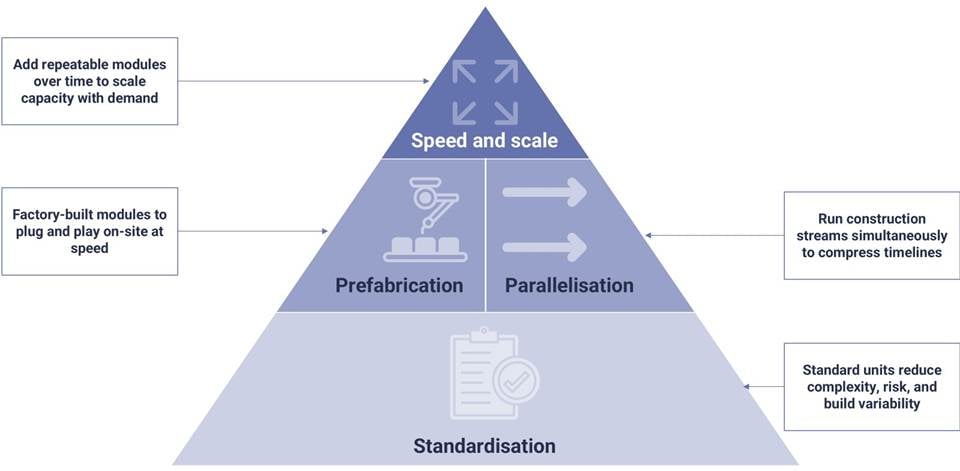
At its core, modularity is about shifting data-centre delivery from bespoke construction to repeatable assembly. Rather than designing and building every site from scratch, modular approaches rely on three reinforcing principles: standardisation, prefabrication and parallelisation.
- Standardisation creates the repeatable designs and capacity blocks that reduce complexity and make future deployments more predictable.
- Prefabrication moves key parts of the build into factory environments, where modules can be assembled and tested before arriving on site.
- Parallelisation then allows those off-site activities to happen at the same time as site preparation and civil works, compressing the overall timeline.
Together, these tenets support the central promise of modular data centres: faster deployment today, and more flexible scaling over time as capacity is added in line with demand.
Figure 1: The core tenets of modular data centre design and construction
 Source: STL Partners
What does ‘modular’ actually mean in practice?
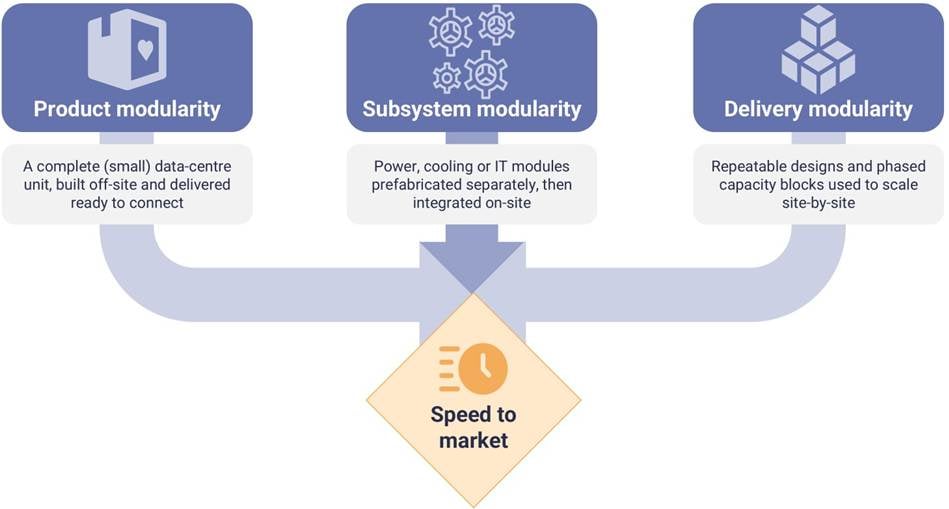
One complication in assessing modular data centres is that the term itself is used inconsistently. There are three main forms of modularity in data-centre delivery:
1. Product modularity: self-contained prefabricated units with IT, power and cooling integrated before arriving on site.
2. Subsystem modularity: key components such as power skids, cooling plants or electrical rooms are prefabricated and installed into a wider facility.
3. Delivery modularity: large sites are built around repeatable designs, standard capacity blocks and phased expansion rather than bespoke one-off builds.
Figure 2: There are three main forms of ‘modularity’
 Source: STL Partners
Product modularity
In some cases, “modular” refers to a physical product: a prefabricated, self-contained data-centre unit that arrives on site with IT space, power, cooling and controls already integrated. This is the most literal interpretation of modularity, and is often associated with edge sites, temporary capacity or smaller deployments where speed and portability are central. Vendors such as Vertiv position modular units in this way, while Microsoft’s Azure Modular Datacenter shows how the model can bring cloud capacity into remote or constrained environments.
Subsystem modularity
In other cases, modularity refers not to the whole facility, but to specific subsystems. A data centre may still be housed in a conventional building, while major components such as electrical rooms, power skids, cooling plants, UPS blocks or white-space pods are manufactured and tested off site before being installed. This form of modularity is increasingly relevant in larger facilities because it allows operators to industrialise the most complex parts of the build without necessarily changing the entire site architecture. This is where vendors such as Vertiv and Schneider Electric are especially active, positioning prefabricated power, cooling and infrastructure modules as a way to industrialise the most complex parts of the build without redesigning the entire facility.
Delivery modularity
For hyperscale and large colocation operators, the term can mean something broader again: a repeatable delivery model. The facility may not look “modular” in the containerised sense, but it is designed around standard capacity blocks, repeatable layouts, phased expansion and proven supply chains. Here, modularity is less about a box arriving on a truck and more about turning data-centre development into a replicable platform. Compass Datacenters is a good example of this approach, using off-site manufacturing, prefabricated electrical systems and standardised designs to make large-scale delivery more repeatable
Understanding the spectrum of modularity
This distinction matters because the speed claims attached to modular data centres depend heavily on which version is being discussed. A small prefabricated edge unit may be deployed in weeks; a prefabricated power room or cooling module may remove months from a larger project; a hyperscale campus based on repeatable designs may still take many months to complete, but can be delivered more predictably and expanded more easily than a bespoke build. For example, in Dublin, Vertiv helped an unnamed hyperscale cloud provider deploy 60MW of capacity within a 20-week timeframe using prefabricated modular infrastructure
So, modularity should not be understood as a single technology. It is better seen as a spectrum of approaches that move data-centre delivery away from bespoke, sequential construction and towards repeatable, industrialised assembly.
Speed to market: can modular actually deliver ?
As “modular” covers everything from edge units to prefabricated power rooms and repeatable hyperscale designs, its speed benefits vary by use case. But the underlying logic is the same: shift data-centre delivery from bespoke, sequential construction to a more industrialised model.
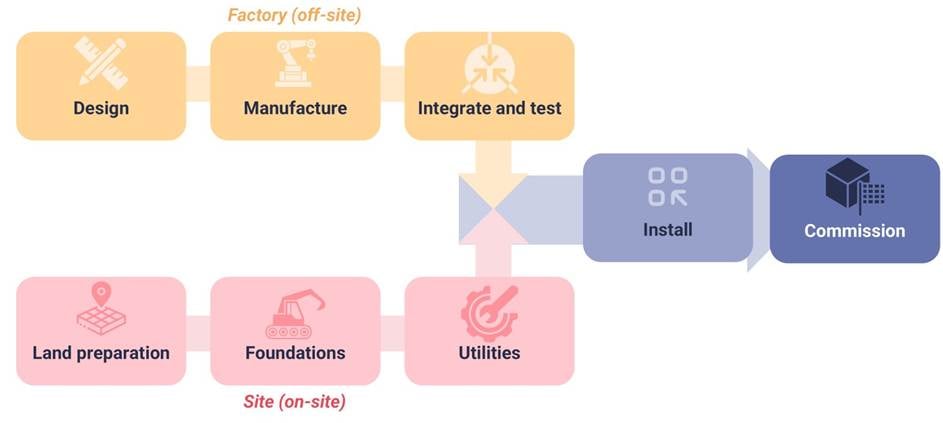
The main time saving comes from parallelisation. Instead of waiting for site works to finish before installing systems, modular approaches allow key power, cooling and IT components to be manufactured, integrated and tested off site while foundations, utilities and civil works progress in parallel. Once the site is ready, the task becomes connecting pre-built systems rather than assembling everything from scratch.
This can materially shorten delivery timelines where designs are standardised and supply chains are mature. Prefabricated power and cooling modules reduce infrastructure build time, white-space pods accelerate fit-out, and repeatable designs cut engineering, procurement and on-site decision-making.
There is also a sustainability angle. By shifting work into a factory environment, modular construction can reduce on-site waste, rework, vehicle movements and site disruption. Standardised modules can also support more efficient material use and better quality control, while phased deployment reduces the risk of building capacity before it is needed.
Figure 3: Modularity allows factory and site works to run in parallel, accelerating deployment timelines
 Source: STL Partners
The limitations: why modular isn’t universal?
Despite its appeal, modularity is not a universal answer to data-centre delivery. Its advantages are strongest where speed, repeatability and phased growth matter most. However, the same features that make modular approaches attractive can also create limitations, particularly for large, highly customised or highly optimised
1. Modular models rely on standard designs, fixed capacity blocks and pre-defined power and cooling configurations. This accelerates deployment, but limits flexibility where customers have unusual technical, resilience, site or cooling requirements.
2. At very large scale, operators often optimise every element of the design. A pre-packaged module may deploy quickly, but bespoke engineering can sometimes deliver better density, cost per MW, land use or energy performance.
3. Modular systems still need to connect into site-wide power, cooling, controls, fire, security, BMS and network infrastructure. Poorly managed interfaces can create delays during installation and commissioning.
4. Modular delivery depends on factory capacity, component availability and logistics. In a market already constrained by transformers, switchgear, generators, cooling equipment and skilled labour, prefabrication may shift bottlenecks rather than remove them.
5. Factory-built modules can cost more per unit once transport, packaging, duplicated structure and vendor margins are included. The business case depends on whether faster revenue, lower site labour, reduced risk and phased capex outweigh the premium.
Conclusion
Modularity is not a silver bullet, but it is becoming an important tool for a market under pressure to deliver capacity faster. By shifting parts of the build into factory-made, repeatable units and allowing site preparation and system fabrication to happen in parallel, modular approaches can compress timelines, reduce delivery risk and support more flexible scaling. However, modularity is not a cure-all. It cannot remove every constraint in the data-centre development process. Land acquisition, planning approval, grid connection, fibre access, long-lead electrical equipment and local labour availability can still dominate the programme. A prefabricated module is only useful if the site is ready to receive it and the surrounding infrastructure is available to support it.
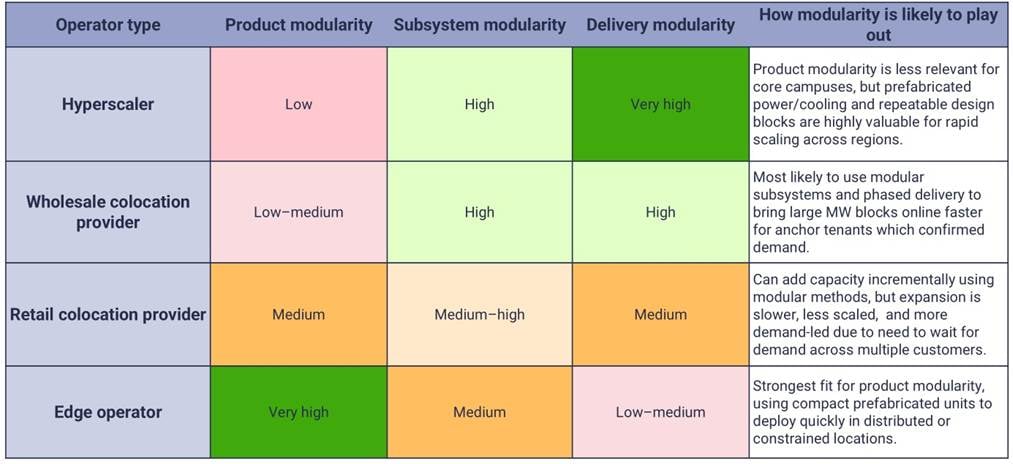
The implications vary by operator type. Hyperscalers are unlikely to depend on fully self-contained modular units for core campuses, but they can benefit from prefabricated power and cooling systems and highly repeatable campus designs. Large wholesale colocation providers may use subsystem modularity to speed up fit-out while standardising halls and capacity blocks across sites. Retail colocation players can use modular approaches to reduce complexity, though they may need more customer-specific flexibility, and tend to face less pressure to expand quickly due to needing to wait for demand signals from across multiple customers (as opposed to just one in the case of wholesale single-tenant colocation). Edge and enterprise deployments are the strongest fit for product modularity, where compact, self-contained units can bring capacity online quickly in constrained or distributed locations.
Figure 4: The relevance of modular methods varies by data centre archetype
Source: STL Partners
Looking for advisory services in data centres? Schedule a call.
Download the data centre insights overview pack
Download the data centre insights overview pack
Get a concise, practical summary of the data centre market: the impact of AI and sovereign strategies, the differentiators that win in a crowded landscape, and proven frameworks for market entry, channel partnerships and customer acquisition—backed by case studies and sample deliverables.

Key takeaways from the launch of the Quantum Infrastructure Council
STL Partners attended the launch of QIC to explore what it will take to deploy
quantum technologies in real-world data-centre environments.

The EU’s AI Gigafactory Initiative: What it means for digital infrastructure?
The EU’s €20 billion AI gigafactory initiative will fund up to five large-scale AI compute facilities, each designed to support frontier model training with more than 100,000 advanced AI processors.

AI’s hidden resilience crisis and the colocation opportunity it creates
AI’s hidden resilience crisis, and the colocation opportunity it creates

Five things we learned at Datacloud Global Congress 2026
We were at Data Cloud Congress 2026 in Cannes last week to evaluate the key narratives among data centre operators, investors and vendors.

The hidden economics of liquid-cooled data centre retrofits
This article, kindly supported by Airedale, explores when liquid cooling retrofits make commercial sense, showing why the decision depends on HPC pricing, facility fill, market constraints and disciplined execution.
Key takeaways from the launch of the Quantum Infrastructure Council
STL Partners attended the launch of QIC to explore what it will take to deploy
quantum technologies in real-world data-centre environments.