
Download

As enterprise AI adoption accelerates, telcos in EMEA face a critical test of relevance. Based on insights from our industry roundtable with Cisco, this article outlines where operators can add differentiated value and unlock new growth opportunities.
Bringing the EMEA telco perspective
On 15 January 2026, STL Partners, in partnership with Cisco, convened an industry roundtable to discuss this challenge: how telcos can most effectively support enterprise AI in EMEA. Having already captured the voice of the enterprise in our prior report, the objective was to bring together the voice of the telcos to explore how EMEA operators can respond to these expectations and, in doing so, claim greater relevance in enterprise AI. STL Partners were joined at the event by 30 senior representatives from across 14 EMEA telcos, spanning a range of leadership roles.
Discussions at the roundtable surfaced five core themes that shape where and how EMEA telcos can add value in enterprise AI:
- Enterprise AI is redefining “good” connectivity and infrastructure: Static, best-effort models are no longer sufficient as AI workloads become more dynamic, distributed, and application-driven, increasing demand for adaptive, assured, and compute-aware networks.
- Sovereignty is the most immediate and credible entry point for telcos: Across both connectivity and compute, enterprises prioritise data residency, security, and regulatory compliance, creating a clear opportunity for telcos to differentiate through controlled, sovereign enablement rather than pure performance.
- There is a significant gap between AI ambition and operational reality: Enterprises struggle to scale AI beyond pilots, demonstrate ROI, and organise data effectively, while remaining reluctant to invest in large, upfront AI infrastructure, opening space for telco-led, consumption-based and hybrid models.
- Hybrid and edge-enabled AI services are key to monetisation: Models such as GPU-as-a-Service, sovereign AI factories, and edge compute can help enterprises balance innovation with control, provided telcos invest in cybersecurity, observability, and demonstrable service assurance.
- Proof, partnerships, and standardisation will determine success: To move from potential to relevance, telcos must show measurable outcomes, develop ecosystem partnerships across cloud, hardware, and software, and address foundational gaps such as geographic-aware routing and AI workload visibility.
EMEA telcos must strive to improve their positioning in enterprise AI
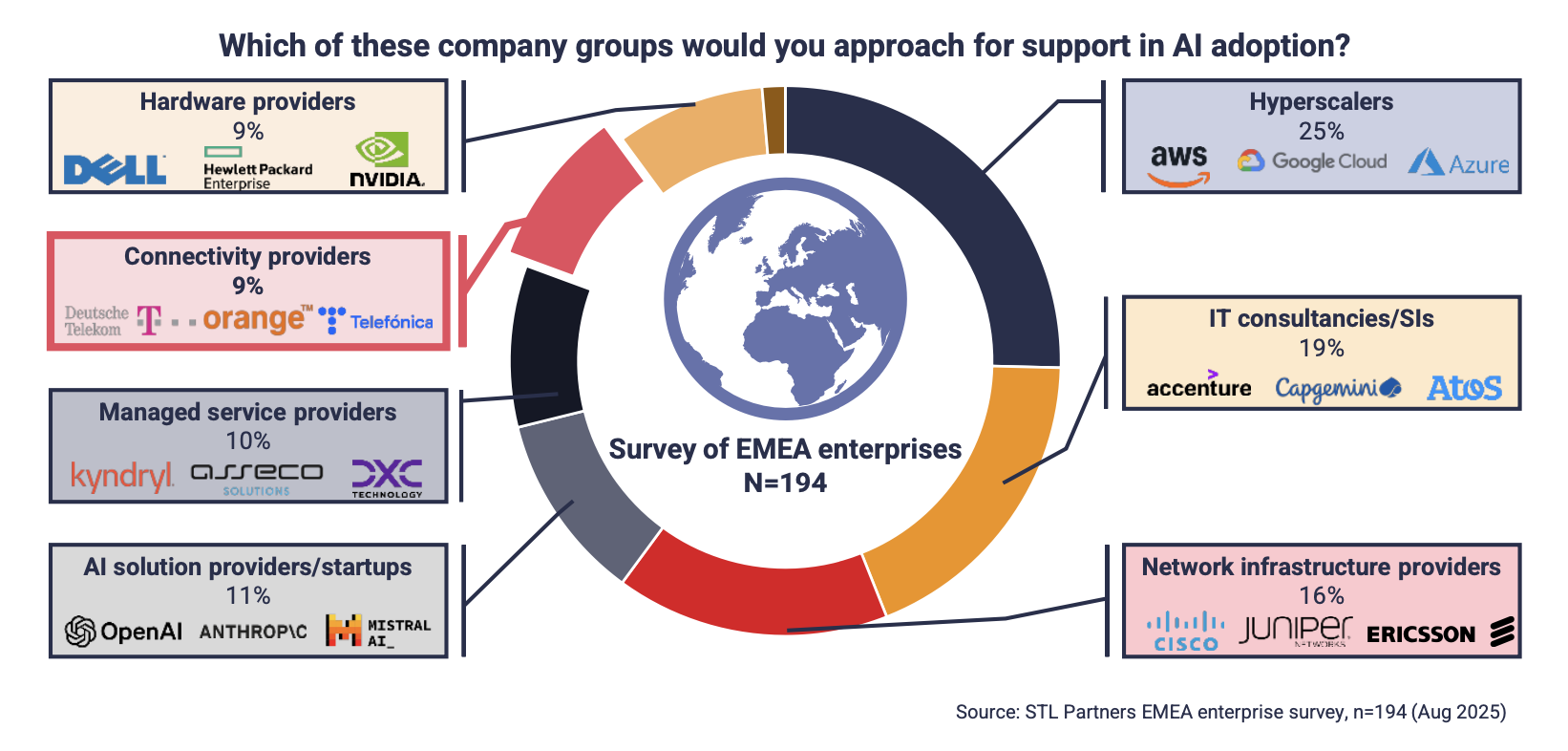
Enterprises in EMEA do not currently view telcos as a first-choice partner for enterprise AI adoption. STL Partners’ survey of enterprise AI decision-makers (August 2025, N=194) found that only 9% of net responses identified telcos as a group they would approach for support. This perception gap persists despite enterprise AI being an area where EMEA telcos should be highly relevant, supported by their unique strengths in connectivity, long-standing enterprise trust, and their ability to address sovereignty and regulatory requirements.
When asked how telcos could improve their credibility in enterprise AI, enterprises overwhelmingly pointed to a deep understanding of AI infrastructure and workload requirements as the top priority. This was followed by proven AI deployments in relevant industries and strong integrations with leading AI and cloud platforms.
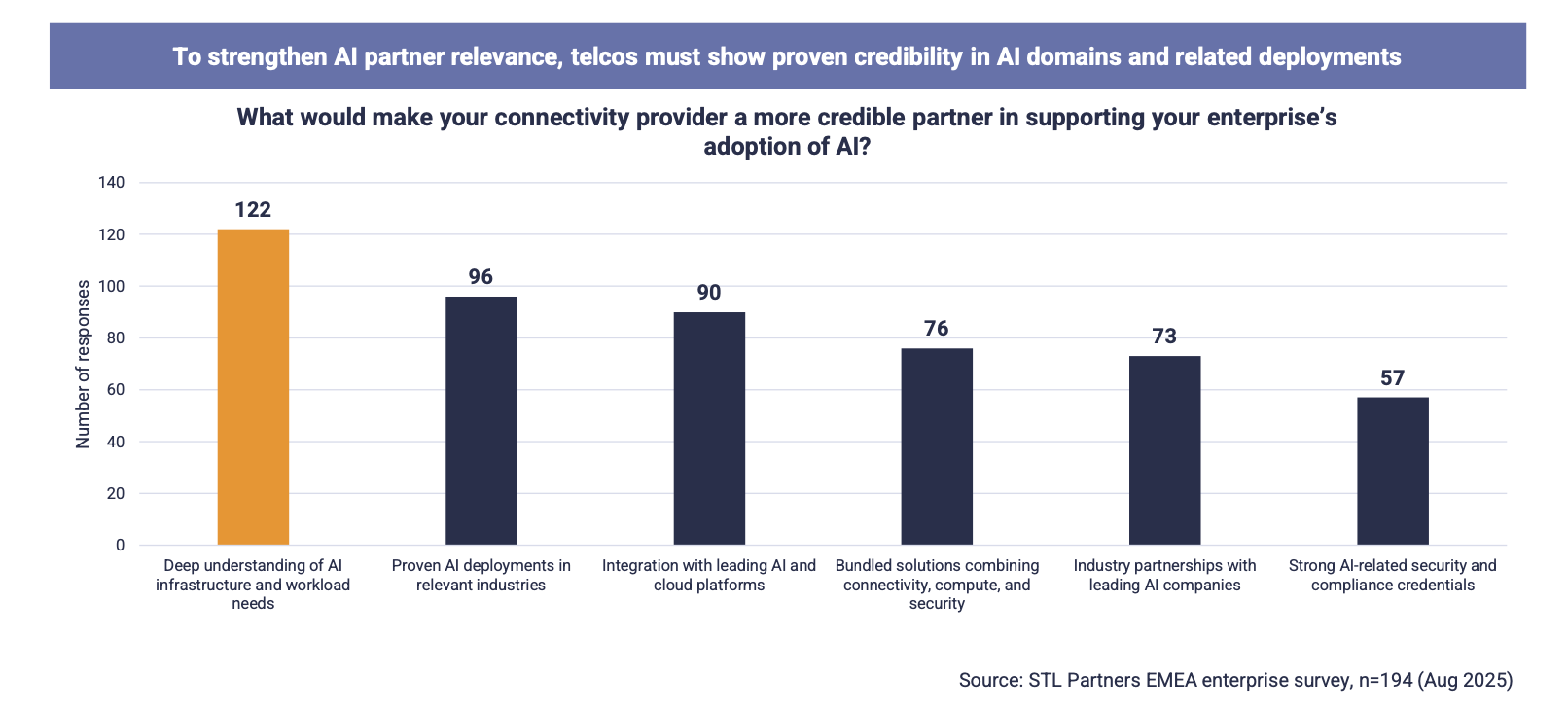
These responses suggest that telcos are not yet widely perceived as experts in enterprise AI, that their propositions have not been sufficiently adapted to the requirements of the AI era, and that they have not convincingly demonstrated their ability to act as credible partners. This is not a question of optics or re-labelling offerings as “AI-ready”, but one of concrete action and demonstrable proof points.
The telco response: Key insights from the roundtable
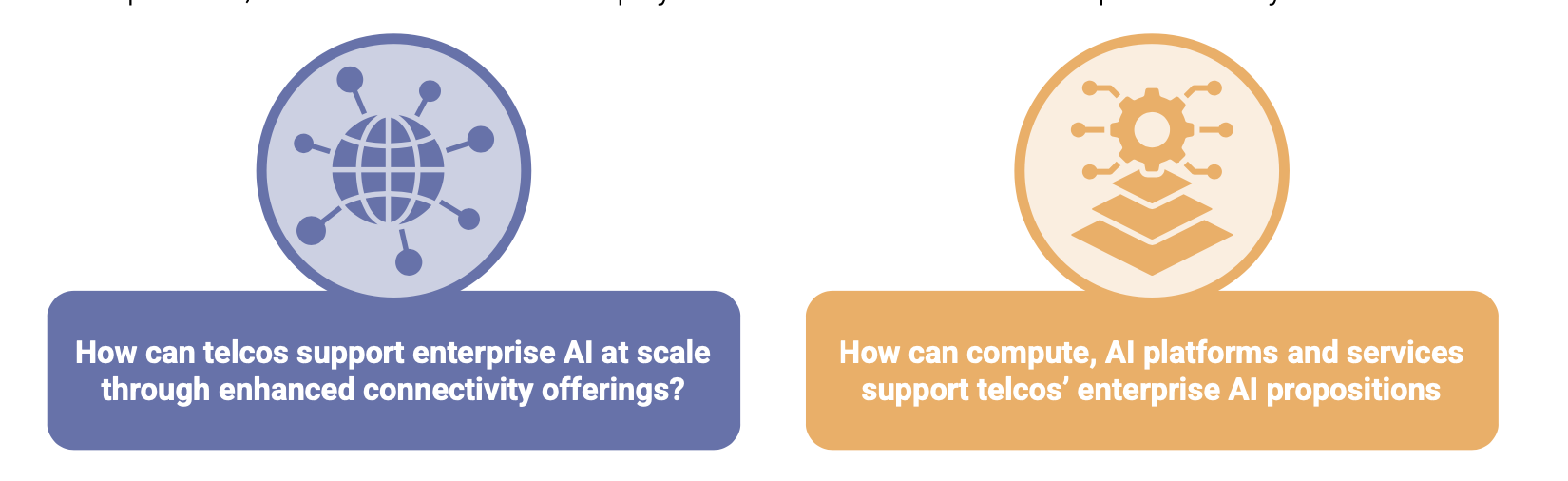
At the roundtable, we presented this challenge to the telco representatives and asked them to propose responses and solutions that were both credible and commercially viable for operators. By collectively sharing perspectives and ideas, the discussion focused on how telcos can best support enterprise AI in EMEA, reclaim relevance with enterprise customers, and, in turn, unlock new monetisation opportunities. Discussions at the event centred on two core areas
1. Connectivity solutions for enterprise AI, the traditional core of telcos’ value proposition, and how these need to evolve to better support AI-driven workloads at scale.
2. AI-specific services and solutions, including compute infrastructure, AI platforms, and adjacent capabilities, that could enable telcos to play a more substantive role in enterprise AI ecosystems.
Connectivity solutions for enterprise AI: The EMEA telco industry perspective
Connectivity remains the traditional foundation of telcos’ enterprise propositions, but the discussions highlighted how profoundly enterprise AI is reshaping what “good” connectivity actually means. Enterprises often articulate their needs in familiar terms, such as predictable bandwidth or low latency, yet these requests frequently mask more complex underlying requirements driven by digitised operations, expanding data collection, and AI moving from experimental pilots into day-to-day business processes.
As AI workloads increasingly span local, regional, and global environments, network requirements are becoming more dynamic, application-specific, and technically complex. Static connectivity models are proving insufficient, with growing demand for more adaptive, on-demand, and NaaS-like networking capabilities that can scale and change as applications evolve. In a context where 5G monetisation remains under pressure, AI-related services were widely seen as a potential growth lever, albeit one that will require operators to move beyond inward-looking experimentation and towards more standardised, repeatable offerings that can scale.
Against this backdrop, participants stressed the importance of deeper and more informed customer dialogue. Many enterprises remain uncertain about their AI adoption trajectory, AI architectures and how these will ultimately affect their network requirements, while telcos themselves are still working through what the right service constructs should look like. Expectations around predictability, availability, security, and sovereignty are rising, with some use cases placing a far greater emphasis on demonstrable resilience, quality and “hyper-availability” than before. While the opportunity is clear, the market is still early, and operators are learning alongside their customers how best to translate emerging AI workloads and their interactions into concrete, monetisable connectivity propositions.
In terms of where telcos can act today, sovereignty emerged as a particularly strong entry point. For many enterprises, concerns around data protection, national resilience, and regulatory compliance are the primary drivers for engaging with AI platforms, often ahead of more performance-led or integrated connectivity propositions. Sovereignty, security and granular monitoring were framed as controlled enablement: the ability to combine global technology with greater local control.
The discussions also underscored how AI cuts across network design and operations in ways that are still underappreciated. Network planning increasingly needs to be compute-aware, accounting not only for connectivity metrics but also for the location and availability of CPUs, GPUs, and edge resources. Security considerations are evolving too, particularly as agentic AI introduces new challenges around identity, interaction, and the visibility of shadow AI. Participants pointed to the need for protected services, better observability, and clearer lessons from earlier cloud adoption, while also recognising the importance of being able to prove performance and quality, potentially through tools such as digital twins (of the network).
Finally, the roundtable highlighted that realising these opportunities will depend on new enablers and partnerships. Delivering true data sovereignty requires full visibility and control over where traffic flows at any moment, ensuring it never leaves defined geographic boundaries. This is an area where telcos, or federations of telcos, have a unique advantage, but one that is constrained today by a lack of geographic awareness in routing. Addressing this gap, alongside the development of APIs to locate where agents and models are running and progress on AI-related standardisation, was seen as critical if operators are to move from potential to proof in enterprise AI.
Compute, AI platforms, and services for enterprise AI: The EMEA telco industry perspective
While connectivity forms a key foundation of enterprise AI enablement, the roundtable discussions made clear that compute, platforms, and AI-specific services are where many enterprises see the greatest gaps between ambition and reality. Scalability remains a persistent challenge, with organisations struggling to move beyond pilots into production at scale. At the same time, enterprises continue to wrestle with how to measure the return on AI investments and link initiatives to tangible business outcomes. Many participants noted that customers are increasingly focused on practical applications of AI that solve everyday operational problems, yet progress is often constrained by poor data organisation, weak governance, and the absence of clear taxonomies. This has resulted in relatively few business cases that extend beyond AI hype.
These challenges are compounded by structural constraints around investment and regulation. Many enterprises are reluctant to commit capital to large-scale AI factories, particularly given the uncertainty around future demand and technology evolution. At the same time, strict data residency, sovereignty, and regulatory requirements mean that many organisations want to retain a high degree of control, often favouring on-premise or locally hosted solutions. This combination of high ambition, low maturity, and constrained investment creates a space where telcos could play a more active enabling role.
Participants identified several service opportunities where operators could credibly add value. Again, sovereignty figured highly here. Sovereign AI factory models, which layer AI workloads and applications on top of controlled infrastructure, were seen as particularly compelling in addressing governance challenges while supporting real-world use cases. Edge compute sites were also highlighted as a way to process sensitive data closer to source, helping enterprises reconcile AI adoption with regulatory and security requirements. Beyond infrastructure, there was strong emphasis on the need for education and advisory services, helping enterprises understand what different AI workloads require and how to select the right tools for specific outcomes.
Hybrid delivery models are especially promising. Services such as GPU-as-a-Service could allow enterprises to develop and experiment in hyperscaler cloud environments, while relying on telcos to deliver secure, sovereign infrastructure closer to the customer for production workloads. This approach could reduce upfront investment while addressing concerns around data control and compliance. However, participants stressed that this would require operators to invest not only in compute capabilities but also in robust cybersecurity, both to protect their own platforms and to meet enterprise expectations around trust and resilience.
Finally, the discussions highlighted the importance of partnerships in making these propositions scalable and commercially viable. Start-ups and independent software vendors were seen as valuable sources of niche, agile AI tools tailored to specific use cases, while hardware providers and AI specialists could strengthen end-to-end solutions, particularly where sensors and edge intelligence are involved. At the same time, participants cautioned against overly narrow partnerships, emphasising the need to engage with the full AI ecosystem if telcos are to move beyond isolated offerings and establish themselves as credible platforms for enterprise AI.
Conclusion
The roundtable discussions underscored that EMEA telcos have a real opportunity to strengthen their relevance in enterprise AI, but only if they move decisively from promise to proof. Enterprise AI is reshaping expectations around both connectivity and compute, driving demand for more adaptive, assured networks alongside sovereign, secure, and scalable AI infrastructure. Telcos are well positioned to respond, particularly through sovereignty-led propositions, hybrid delivery models, and closer alignment with enterprise outcomes, but success will depend on translating these strengths into clear service constructs, credible partnerships, and demonstrable value rather than incremental repositioning.
If you have questions about the themes explored in this article, would like to discuss the insights from the roundtable in more detail, or are interested in participating in future sessions, please contact Cisco here and STL Partners here. We would welcome further dialogue with operators and industry stakeholders on how telcos can strengthen their role in supporting enterprise AI in EMEA.
Looking for advisory services in AI? Schedule a call.
Download the AI insights pack
Download the data centre insights overview pack
Our overview explores the evolving role of telcos in the AI ecosystem—examining how they act as consumers of AI, as enablers of AI adoption across industries, and as providers of AI-driven solutions to others.

Blog post: Real-time data for autonomous networking
Telcos remain ambitious about network autonomy, but most AI deployments are still narrow, domain-bound and far from real-time. STL Partners’ research with 11 senior telecoms stakeholders points to operators’ data foundations as the limiting factor. This article highlights that agentic systems need both real-time event data and discoverable context to supervise automated networks, and sets out three priorities for building the data architecture that makes network autonomy possible.

Can orbital data centres overcome terrestrial constraints?
Power and land constraints are prompting novel approaches to data centre construction, notably orbital data centres.

From showcase to shelf: MWC Shanghai highlights how Chinese telcos monetise AI
three demos from China’s telcos at MWC Shanghai 2026 illustrate the different ways telcos are trying to build businesses around AI.

What the Mythos ban means for AI sovereignty
On 12 June 2026, the US ordered Anthropic to disable Claude Fable 5 and Mythos 5 for any foreign national worldwide. The directive turned the frontier model itself into a sovereignty question, not …

The Rise of AI-as-a-Service: Top 3 Enterprise Use Cases by Telcos
As enterprise deployments now account for nearly 40% of telco GenAI initiatives, the shift toward AI-as-a-service is accelerating

Lessons from the dot-com bubble for the AI era
We explore the emerging possibility of an AI bubble, drawing comparisons between the contemporary AI landscape and the dot-com bubble.