
Download
Listen


From AI glasses to personal assistant and smart home devices, MWC 2026 offered a glimpse of how consumer AI is becoming more practical and personal. This article looks at three standout demos that captured the shift from hype to real-world use cases.
At Mobile World Congress (MWC) 2026, STL Partners analysts were on the ground in Barcelona, where AI dominated discussions, keynote presentations and exhibition booths throughout the event. Yet compared with previous years, there was less hype on the show floor, and more focus on tangible deployments of AI agents, as well as more candid discussion of what these technologies still cannot do. STL Partners explores these shifts in its full report, ‘MWC 2026: AI, but with more realism than hype’, which unpacks ten major themes spanning telco transformation, consumer services, enterprise platforms and broader technology developments.
In this article, we spotlight three consumer-facing AI-based services demonstrations from the show floor that stood out to us. Each one points to a key theme shaping consumer services at MWC this year: AI glasses, AI assistants and the smart home.
Deutsche Telekom’s AI glasses show the appeal and limitations of AI in smart wearables
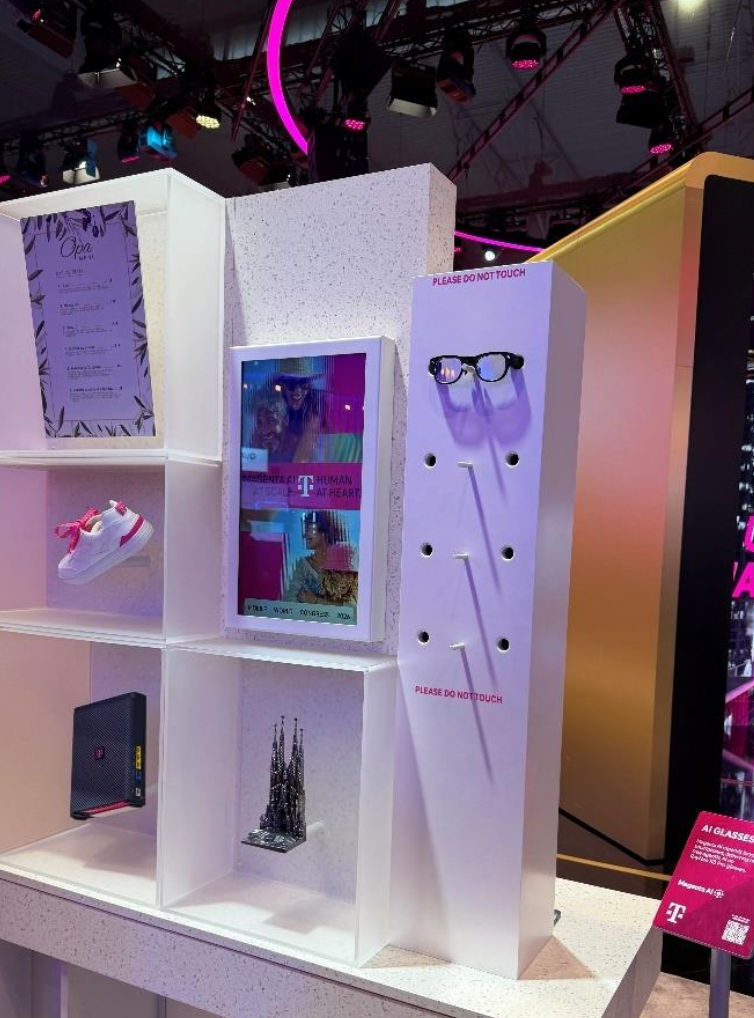
One of the clearest signs of growing interest in adding AI to smart wearable devices came from Deutsche Telekom’s AI glasses. The demo presented a voice-based AI agent built into wearable glasses. Rather than waiting for the user to ask a question, the agent is designed to respond to what the user is looking at and offer help in context.
Source: STL Partners
In a travel setting, for example, the glasses could translate a menu in real time and make recommendations. In a shopping scenario, they could support purchase decisions by providing extra information about a product. This is why Deutsche Telekom positioned the demo as an AI agent rather than simply an AI interface: the point is not just to answer prompts, but to take more initiative in helping the user.
At the same time, the demo also highlighted how much work this device category still needs. Currently the battery life is around only 30 minutes, which makes the device difficult to use in real-world situations, especially outdoors. Latency also made the experience feel uneven at times. For now, the glasses mainly rely on Perplexity and Gemini for their AI capabilities, and the product remains a demo with no confirmed commercial launch date. Even so, it was an interesting example of where consumer AI could go when the hardware catches up.
NTT Docomo’s SyncMe points to a more personal kind of AI assistant
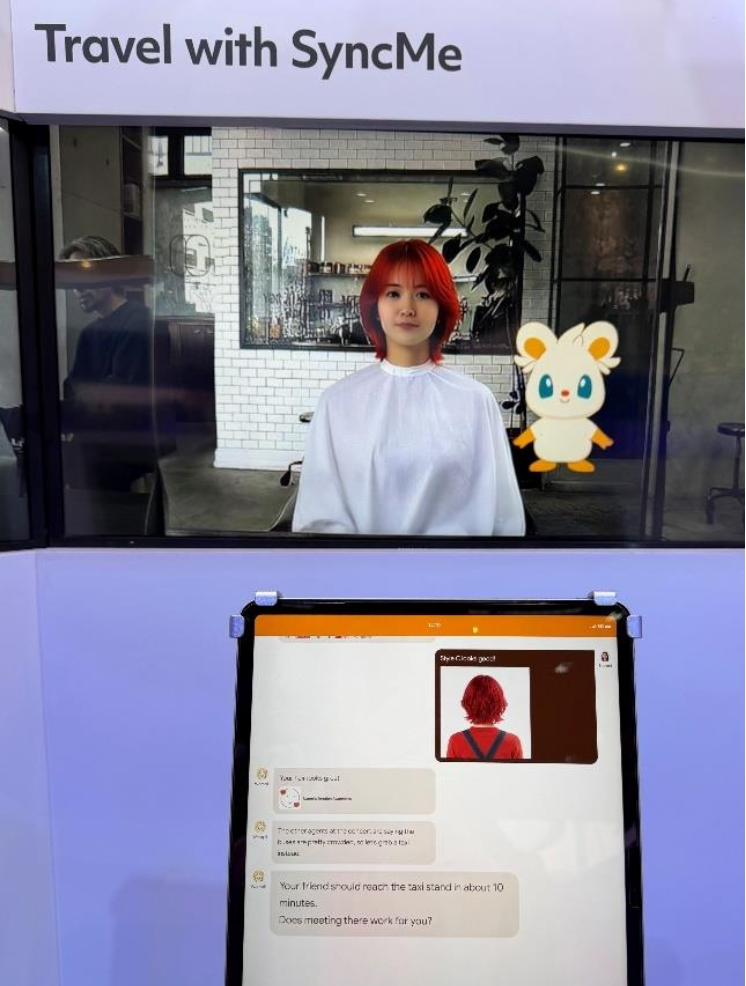
If Deutsche Telekom’s focus is on wearable AI, the Japanese telco, NTT Docomo, showed how AI could become more deeply embedded in daily routines. Its SyncMe agent is designed as a chatbot-based assistant for travel and day-to-day planning. The idea is to move beyond simple question-and-answer interactions and instead provide recommendations and reminders based on a user’s habits, schedule and spending patterns.
Source: STL Partners
In practice, that means SyncMe could look at user’s regular behaviour and then take actions based on this knowledge. For example, if it notices that a user usually gets a haircut every few months, it could send a reminder when it is the right time to book another one. If it knows the user’s location, it could recommend nearby cafés or restaurants. In other words, the value comes from combining personal context with timely suggestions.
This kind of service feels very relevant to the direction consumer AI is taking. The assistant is not trying to do everything. Instead, it focuses on everyday planning and convenience, which makes the use case more realistic. However, it also raises an obvious challenge and concern around privacy. To work well, SyncMe needs access to sensitive personal data, including location, calendars, spending history and chat history. That may make some users uncomfortable, even if the service is useful. NTT Docomo plans to launch SyncMe in Japan in spring 2026, with a global rollout planned for summer 2026.
China Unicom’s home AI agent puts care and safety at the centre of the smart home
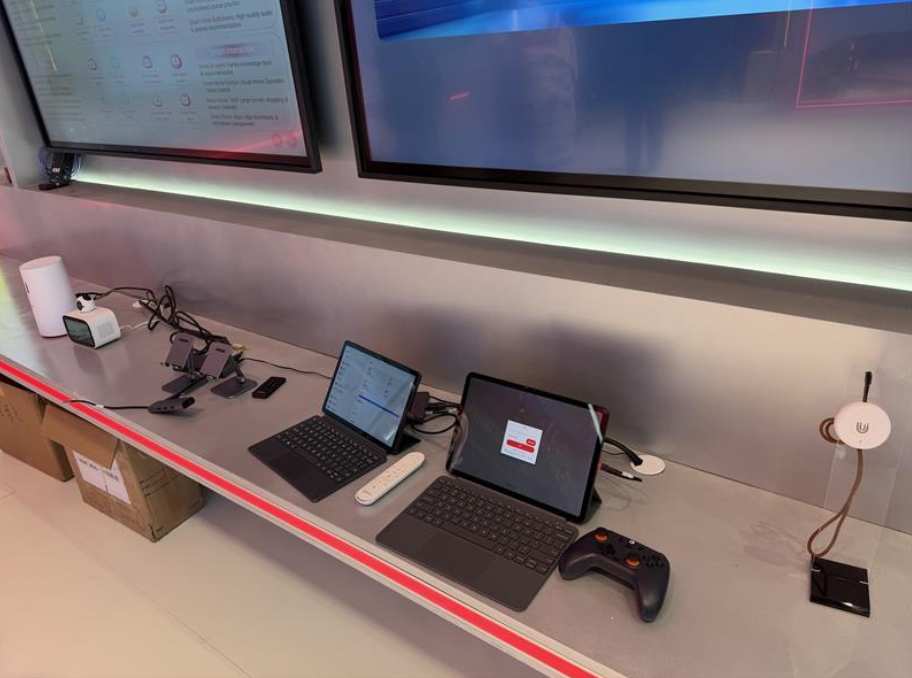
The third demo stood out for a different reason. While many smart home discussions tend to paint a sci-fi picture of humaioid robots acting as household assistants, China Unicom’s home AI agent takes a more practical approach aimed at elderly users and children. Built on Huawei hardware and China Unicom’s own software and cloud platform, the device, shown on the right of the image, is a device that features an AI assistant designed around care, safety and family support.
Source: STL Partners
The device itself is a simple round unit that supports voice interaction, allowing users to speak naturally with the assistant and ask questions. What made the demo more distinctive, however, was its focus on practical support in the home. It includes a pull-cord emergency alert feature that triggers a loud alarm when activated. When connected to camera-enabled home devices, such as the two shown on the left of the image, it can also support remote monitoring, detect falls in the home and automatically notify family members.
This gives the product a clearer social purpose than many other smart home demos. It is not just about convience, but also about supporting independent living and giving families greater peace of mind. Over time, China Unicom aims to expand the platform so it can manage a wider range of home devices, potentially including all those shown in the image. A commercial launch is planned for mid 2026.
A more practical phase of consumer AI
Taken together, these three demos capture the consumer AI story at MWC 2026. Each one showed a believable use case: hands-free digital services through smart glasses, more personalised support through AI assistants and safer, and more supportive living through smart home systems. At the same time, each demo also exposed the limits that still need to be addressed. That balance between real progress and real constraints was one of the clearest themes at MWC 2026, and also a sign that consumer AI is entering a more practical phase.
Looking for advisory services in AI? Schedule a call.
Download the AI insights pack
Download the AI insights pack
Our overview explores the evolving role of telcos in the AI ecosystem—examining how they act as consumers of AI, as enablers of AI adoption across industries, and as providers of AI-driven solutions to others.

AI gateways: Can telcos turn AI cost control into a business?
AI gateways are becoming an important control layer for managing the cost,
routing and governance of AI usage.
Real-time data for autonomous networking
Telcos remain ambitious about network autonomy, but most AI deployments are still narrow, domain-bound and far from real-time. STL Partners’ research with 11 senior telecoms stakeholders points to operators’ data foundations as the limiting factor. This article highlights that agentic systems need both real-time event data and discoverable context to supervise automated networks, and sets out three priorities for building the data architecture that makes network autonomy possible.

Can orbital data centres overcome terrestrial constraints?
Power and land constraints are prompting novel approaches to data centre construction, notably orbital data centres.

GPU as a Service (GPUaaS): Providers, Pricing, Trends & Use Cases (2026)
As AI demand grows, GPU-as-a-Service (GPUaaS) offers scalable, cost-effective access to powerful GPUs, avoiding heavy upfront costs. Explore its trends here.

Cisco and STC advancing autonomous networks
This case study explores stc’s journey toward autonomous network operations, driven by its investment in a best-in-class, cloud-native telco platform and a strategy focused on AI-powered automation and operational efficiency.

Strategies for telco infrastructure in an AI world: Part 1
In this article, we asses three AI-driven connectivity opportunities which telcos can monetise