
Download
Listen


A desktop AI agent, a model-routing platform and an AI-enabled set-top box: three demos from China’s telcos at MWC Shanghai 2026 illustrate the different ways telcos are trying to build businesses around AI. This article takes a closer look at each.
STL Partners analysts were on the ground at MWC Shanghai 2026 in late June. In contrast to Barcelona, where global operators compete for attention, the Shanghai event is shaped largely by China’s big three telcos and their vendor partners, which makes it a useful window into how China Telecom, China Mobile and China Unicom are approaching AI. You can read our full analysis of the event in the report: MWC Shanghai 2026: Tokens, robots and reach for the sky.
In this article, we look at three demos from the show floor that stood out to us. Each represents a different route into the AI market: an AI agent for office work, a platform for serving AI models and a consumer device for the home.
China Telecom’s TeleAgent: An AI agent built around office work and security
Following OpenClaw’s surge in popularity in China earlier this year, all three Chinese telcos have launched their own AI agents. China Telecom’s TeleAgent is aimed at everyday office work. Available to download from China Telecom’s Tianyi AI open platform for personal computers, the agent has been free to use since its launch in May, though the company says it plans to introduce a combined token-and-subscription pricing model later this year.
TeleAgent runs on China Telecom’s in-house AI model, Xingchen, with open-source models available as a paid option. A key advantage over agents from the AI hyperscalers is its preset skills covering common office tasks, such as processing expense receipts, monitoring news, reviewing contracts and generating simple web pages. It also offers a skills marketplace tailored to China-specific office tasks, where users can pick up new capabilities or publish their own skills built for their organisation’s needs. Security is the other advantage China Telecom promotes. The agent runs inside a sandbox that confines its actions to a single designated folder, keeping the rest of the user’s files stay out of reach, supported by user authorisation and audit mechanisms.
But whether these advantages are enough to win over consumers is less clear. China Telecom’s customer relationships are strongest in enterprise and government, and its consumer ambitions for TeleAgent remain untested.
China Mobile’s MoMA: routing AI tasks across models
Launched in May this year, China Mobile’s Mixture of Models and Agents (MoMA) platform sits behind AI applications and acts as an aggregation channel. The platform is designed with a three-layer architecture: a bottom layer that aggregates more than 300 AI models through a single point of access, a smart routing layer in the middle and a top layer that delivers the output into China Mobile’s services, including its MobileClaw agent, AI phones, cloud PCs and AI e-commerce.
China Mobile’s MoMA platform
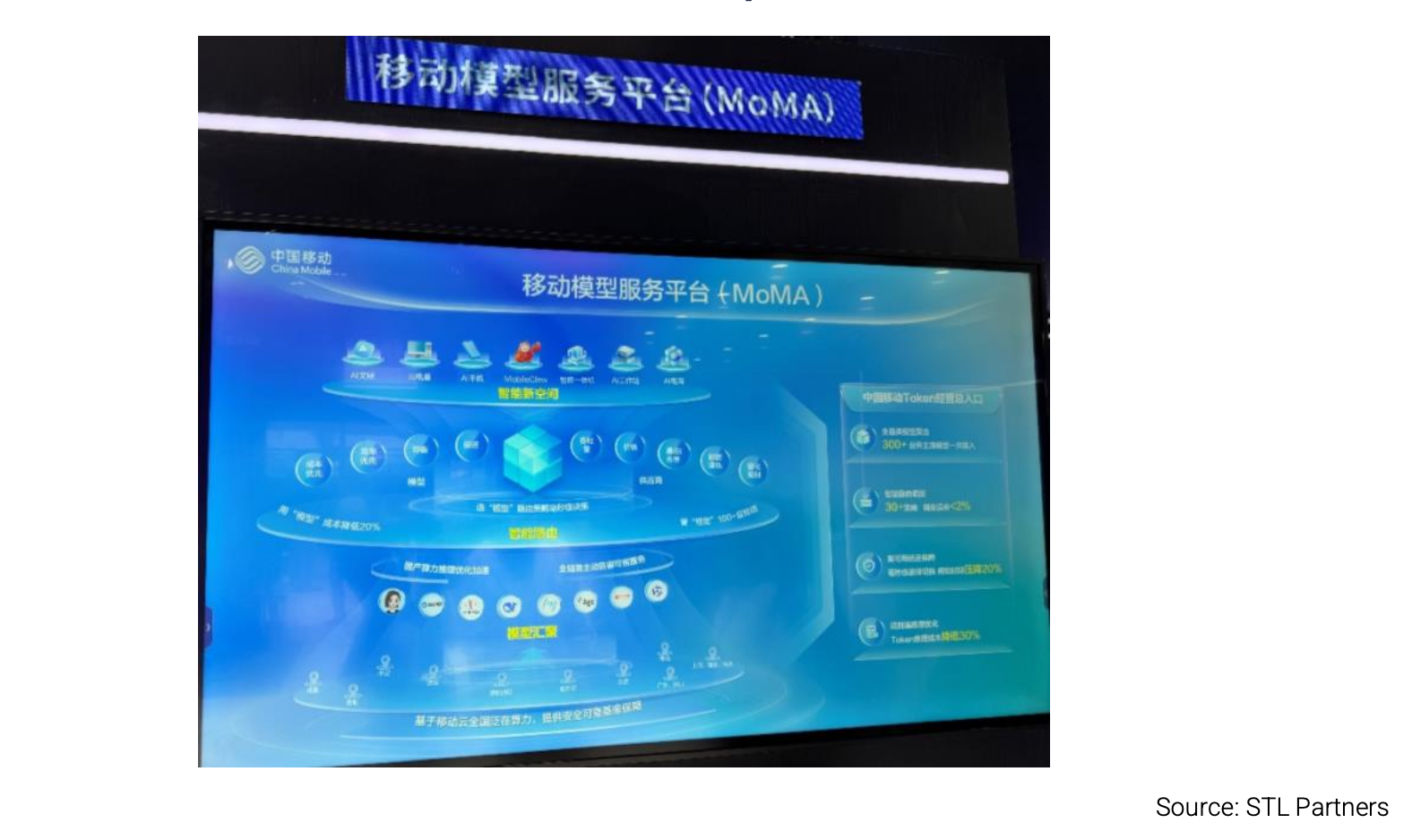
The smart routing layer is the most interesting part of the platform, and arguably where a telco can add the most value. For each task, MoMA selects a model based on more than 30 routing strategies that weigh factors such as cost, latency, throughput and data privacy. China Mobile claims this reduces AI model usage costs by 20% and token inference costs by 30%, with millisecond-level failover reducing perceived latency by a further 20%. These are the company’s own figures and are difficult to verify, but the underlying logic is clear. As the number of available models grows, few customers will want to choose between them for every task, and a routing layer that automatically optimises for factors such as cost and latency addresses a genuine need. The open question is whether customers will trust a telco, rather than a cloud or AI provider, to perform that role.
China Unicom’s Tongtong: a modest approach to smart home
The third demo was less ambitious in scope, which is partly why it stood out. Unicom Tone, or Tongtong, is China Unicom’s smart home assistant, built around the TV set-top box rather than a new device category. Users can watch TV as normal, but the AI comes in through the remote. A built-in voice assistant helps users to select channels, recommend content and call up a film from just a few spoken lines. China Unicom says a future version could deliver the capabilities through its router..
A built-in camera supports home monitoring and two-way video calls, which display on the TV screen and can be answered from a family member’s smartphone. The calls run over a fixed-line number, which is an unusual choice that ties the service to China Unicom’s existing landline business. The stand also showed several companion devices, including camera units and a smaller ‘youth edition’, suggesting plans for a wider ecosystem. Pricing is straightforward: monthly plans ranging from RMB 30 to 60 (USD 4.5 to 9) covering both the TV service and the landline.
China Unicom’s smart home tone
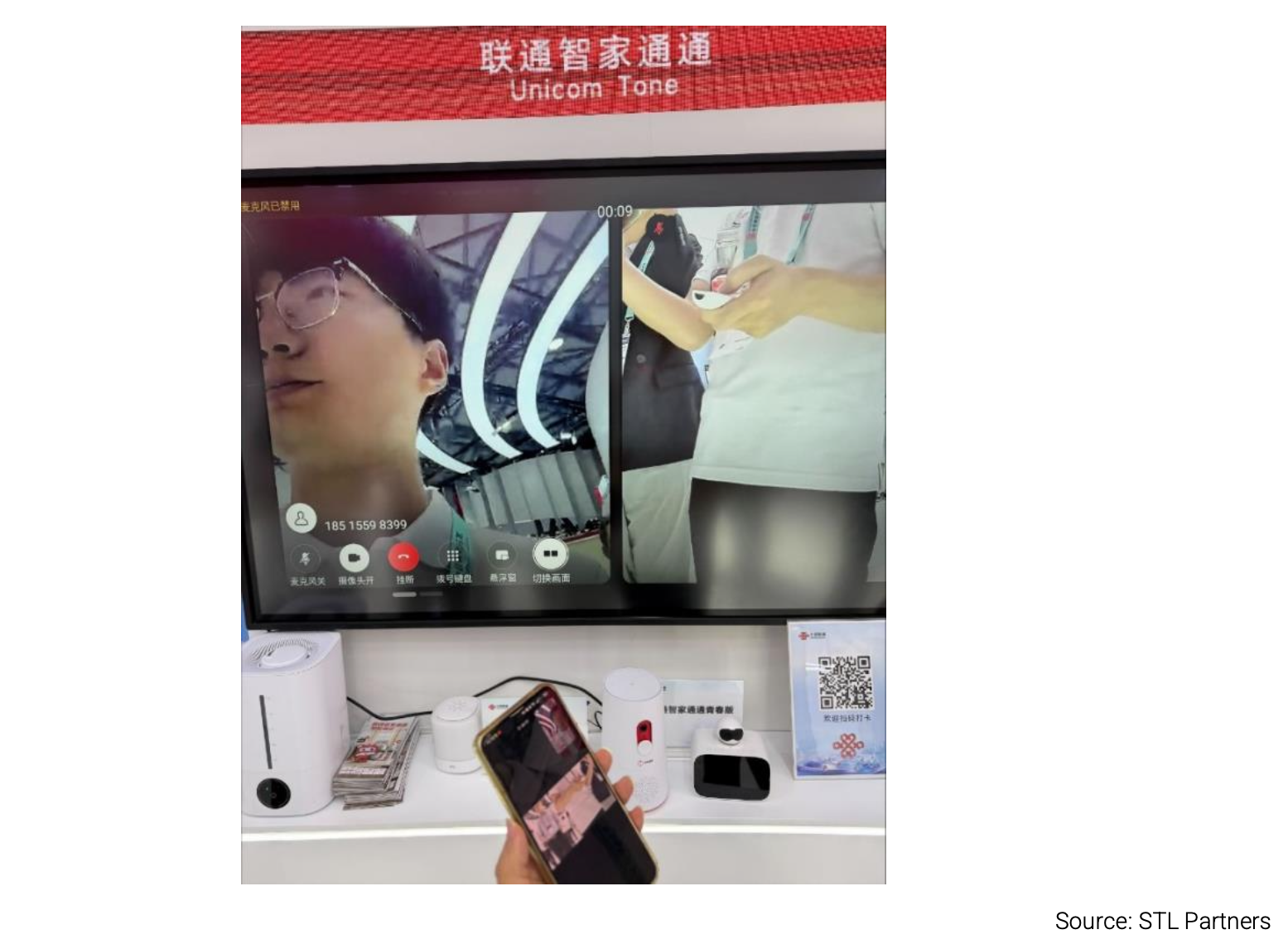
Tongtong expands on a demo we highlighted at MWC Barcelona in March, where China Unicom showed a home AI agent designed around care and safety for elderly users and children, with features such as emergency alerts, fall detection and family notifications. Seen together, the two demos point to a consistent strategy: while much of the industry frames the smart home around humanoid robots as household assistants, China Unicom keeps building from smart devices towards family connection. It is a limited proposition by comparison, but one that could be realistically deployed in ordinary households .
From showcase to shelf
Each demo still has questions to answer, from TeleAgent’s consumer appeal to MoMA’s unverified cost claims. What they share is a concrete answer to how the products would be sold: through channels and billing relationships that the telcos already own. After several years of AI showcases at industry events, that shift from technology transformations to products with a credible path to market was, for us, the more meaningful signal from Shanghai.
Looking for advisory services in AI? Schedule a call.
Download the AI insights pack
Download the AI insights pack
Our overview explores the evolving role of telcos in the AI ecosystem—examining how they act as consumers of AI, as enablers of AI adoption across industries, and as providers of AI-driven solutions to others.

AI cybersecurity incidents: risk or opportunity for telcos?
This article explores what telcos need to do in order to protect themselves and capitalise on the opportunity.

What the Mythos ban means for AI sovereignty
On 12 June 2026, the US ordered Anthropic to disable Claude Fable 5 and Mythos 5 for any foreign national worldwide. The directive turned the frontier model itself into a sovereignty question, not …

The Rise of AI-as-a-Service: Top 3 Enterprise Use Cases by Telcos
As enterprise deployments now account for nearly 40% of telco GenAI initiatives, the shift toward AI-as-a-service is accelerating
From showcase to shelf: MWC Shanghai highlights how Chinese telcos monetise AI
three demos from China’s telcos at MWC Shanghai 2026 illustrate the different ways telcos are trying to build businesses around AI.

Lessons from the dot-com bubble for the AI era
We explore the emerging possibility of an AI bubble, drawing comparisons between the contemporary AI landscape and the dot-com bubble.

Building networks of trust: How creating a human–AI partnership can help redefine network operations
How a new, cross-domain AI approach leveraging the latest AI techniques can help elevate employee roles and responsibilities in network operations teams.