
Download
Listen


The term physical AI refers to the transition of AI from the mostly digital sphere into more real-world scenarios and physical processes. Exactly what that means can vary depending on who you speak to, but the overall trend is clear. This article discusses the different ways that people are thinking about this term, and its impact on the digital transformation of many industries.
Why do we care about physical AI?
Vendors and service providers active in private networks and enterprise connectivity should care about physical AI. Understanding physical AI matters because many of the technologies grouped under this label have demanding connectivity requirements. As physical AI systems become more autonomous and mobile, reliable wireless connectivity will increasingly become a critical enabler.
Three subtly different meanings
Is physical AI a real technology phenomena, or just an empty buzz word? The term has rapidly emerged as one of the most discussed terms in the AI industry. Following the rise of generative AI and, more recently, agentic AI, vendors and analysts are increasingly positioning physical AI as the next major wave of innovation. However, there is little agreement about what the term actually means. Is it just a pretentious way of saying “robots”? Below what people actually mean when they are talking about physical AI.
The narrowest definition = AI enabled robots
This definition is not only the narrowest way in which this term is being used, but also the one that probably makes most sense to the layperson, feels the most instinctively like what this buzzword should mean. Essentially, the idea here is that physical AI is AI embodied in robots. AI systems that have some sort of physical body, some capacity to sense the world around them, process and make decisions based on the data that comes from those sensors, and take physical actions.
A warehouse robot, a self-driving car, or the latest model Roomba vacuum cleaner would all fit this definition. Under this definition, there are many examples of physical AI in use in the world today, but they are expected to proliferate significantly over the coming years, with growing implications for a wide range of industries and everyday life.
Nvidia’s broader definition = AI that understand the physical world
Leading GPU chipmaker Nvidia has a loud voice in the world of AI, and it favours a broader definition. This broader definition sees physical AI as any AI that can understand the laws of the physical world and interact with real world environments.
It could be argued that it is not possible to interact with real world environments without being embodied in some physical way, as in the first, narrower definition. But if we set that interacting with the physical world piece aside, the simple requirement of understanding how the physical world works and being able to make observations and predictions about things that happen in it is broader. Foundational models for autonomous driving and digital twins of physical assets would count. The examples above would also count, as AI is not going to be suitable to be embodied in a driverless car, a warehouse robot or a Roomba without being capable of physical-world reasoning.
Marketing speak = physical AI as a next-wave ecosystem
The term physical AI is used in some quarters as a broad term that encompasses the whole, expanding ecosystem of AI, robotics and autonomous systems. We often see big consultancies and other tech industry commentators grouping robotics, automation, industrial AI and autonomous systems as a united “physical AI market”. In this guise, physical AI is not defined very precisely as in the other two examples, but rather employed as a broad term for what we believe is coming next in AI development and commercialisation, and all the market players that support it.
Why physical AI matters
Whether the definitions exactly align, most people are talking about broadly the same thing. The unprecedented rapid mass adoption of generative AI technologies has happened exclusively in the digital realm – AI is using data from the digital world, and producing output in the digital world for users to do with what they will. The next great frontier is for the mass adoption of AI into more physical, real-world scenarios, impacting individuals and enterprises alike in new and unpredictable ways.
At MWC 2026 and other tech shows, one of the most mentioned and demoed sides of this was using smart robots for service jobs, personal delivery to people who are out and about, or in an office environment. These solutions may have been showcased because they are among the more advanced or commercially attractive applications in the near term. More likely, however, is that these types of solutions are demoed, because they are the easiest for many lay people to understand and connect with. It is something they could imagine happening in their daily life, something the average person can imagine having occasion to use. But there are many more compelling examples of physical AI already active and having an impact and poised to grow significantly in the industrial world.
Industrial examples
Dark factories
A great example of physical AI in action is the dark factory. A dark factory, or lights-out manufacturing, is a highly automated production facility that operates with little to no human labour on-site, making it possible to literally leave the lights and heating off. Leading examples include
- The FANUC factory in Japan, where smart robots are employed building other industrial robots
- A Philips electric razor manufacturing plant in the Netherland that is almost entirely human-free. The facility is overseen by a small team of human specialists, fewer than 10 overall
- Tesla Gigafactories all over the world rely heavily on dark factory concepts for battery cell manufacturing
- Several gigantic light-out manufacturing facilities exist in China, operated by companies such as Xiaomi and Changying Precision technology
This high degree of automation in manufacturing leads to greatly increased efficiency, and in some cases reducing a variety of risk factors. The trend towards great automation in manufacturing is gaining momentum. While not every facility is on the verge of “going dark”, and not every manufacturer will be committed to going this far at all, the general direction of travel is for more and more AI and automation in manufacturing – and this is bound to involve physical AI, regardless of how you define it.
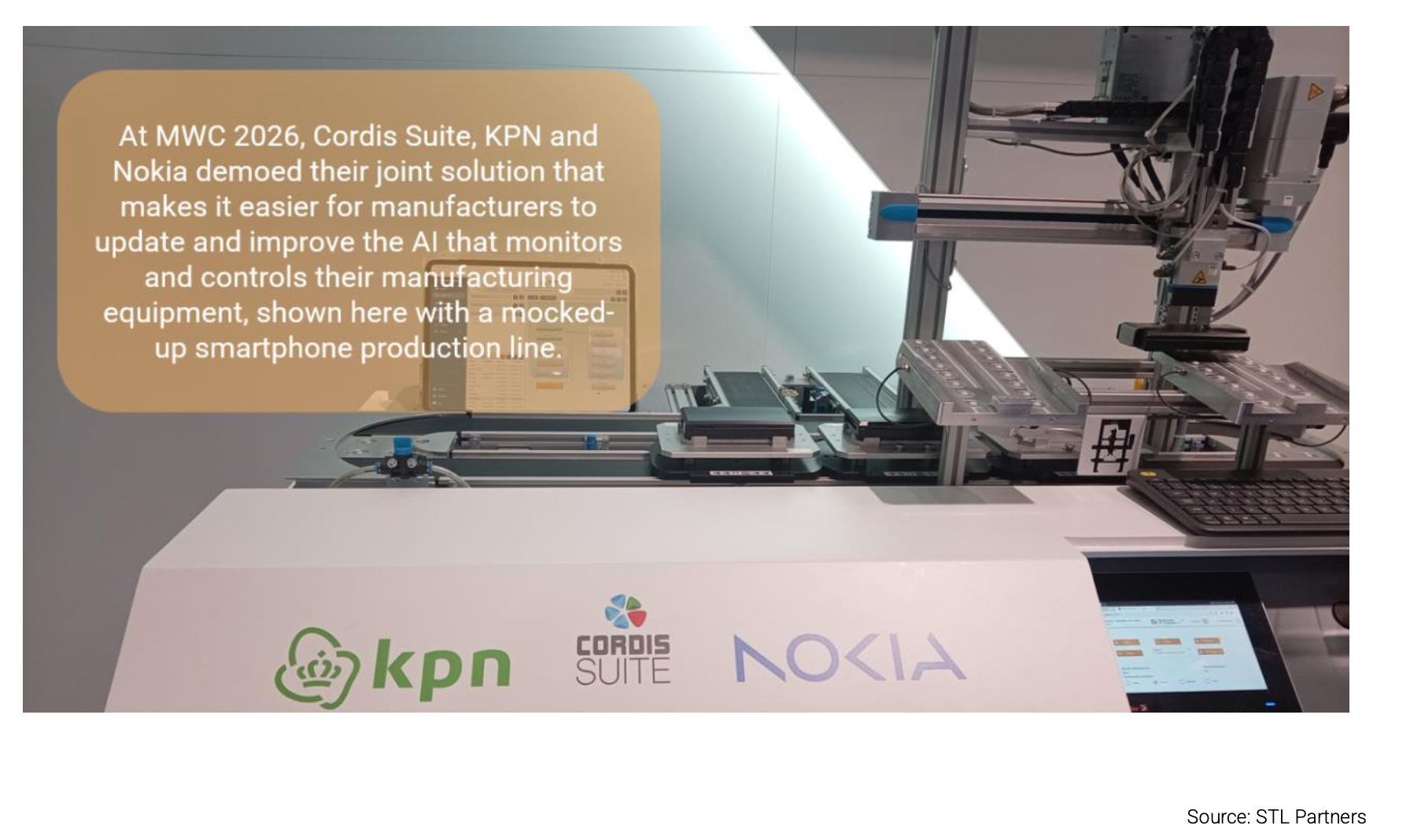
Companies like KPN and Cordis Suite are making it easier to have AI controlling equipment in factories
AGVs/AMRs
Across STL Partners’ Edge and Private Networks practices, we look in detail at the impact of various leading use cases on the needs for and uptake of these two technologies. The use of automated guided vehicles (AGVs) and automated mobile robots (AMRs) is one of these leading use cases, that has already seen notable uptake in industries from transport and logistics to healthcare.
Like dark factories, AGVs/AMRs are a concrete example of physical AI in action today, and one that is growing strongly. In our latest edge computing market sizing forecast, STL Partners calculates that the technology market size for enabling AGV use cases was over USD15bn in 2025, and expects it to have roughly doubled by 2030. That likely means much more than doubling the total number of deployed AGVs in the field, thanks to economies of scale and trends for reducing technology prices.
Physical AI and private networks
As more physical AI use cases are deployed in various settings, it is logical that demand for private networks will also grow. Not all physical AI needs a private network of course. Some are fine with wired or Wi-Fi connections, other will get by with public network connectivity, and some may even be completely self-contained. But many will need the guaranteed performance and coverage of either on premise private networks or dedicated network slices. The solution referenced in the picture above, for example, Cordis Suite allows the AI controlling the assembly line robots to be hosted and managed on on-premise edge servers, and KPN provides the private 5G network that allows that AI to control the equipment remotely in real time. Situations where the use case is mission critical, or very latency sensitive, or has high security demands, or a great need for mobility with no interruptions in connection, or any combination of the above, will be those where private 5G is a natural complement to implementations of physical AI.
Private 5G, and indeed edge computing capabilities, are going to be key enabling technologies as physical AI spreads in industrial and other settings.
Are you looking for specialist support in private networks?
Read more about private networks
Private networks insights pack
Our pack will provide you with a summary of insights from our private cellular networks practice

The role of private networks in the utilities sector
As utilities companies pursue digital transformation, many are exploring the value of private networks in enhancing their operations

5 innovative end-to-end private network specialist providers
End-to-end specialist private network providers are reshaping industries with bespoke private LTE and 5G solutions.

An insight into the future of AI-RAN
Discover insights from our recent interview with Dr. Alex Jinsung Choi on the AI RAN Alliance’s vision, drivers of RAN evolution, and how AI RAN tackles key industry challenges.
What is physical AI? Definitions, examples and implications for private networks
The term physical AI refers to the transition of AI from the mostly digital sphere into more real-world scenarios and physical processes.

How AI can accelerate IT and OT convergence to transform customer experience
AI can play a central role in enabling convergence, acting as a unifying intelligence layer across IT and OT.
Edge computing at MWC 2026
In contrast to previous years, when edge computing had drifted somewhat to the periphery of the agenda, it was more prominent at MWC 2026, with discussions and demonstrations across the Fira reinfo…