
Download
Listen

Telcos are starting to turn generative AI from pilot projects into real consumer products. In recent months, many have accelerated the rollout of consumer-focused GenAI solutions, looking for ways to monetise their AI investments. This article explores three examples of how telcos are applying AI applications in the consumer space.
Telcos are starting to roll out a wave of new B2C applications, from smarter digital assistants to AI-powered security and creative tools. According to STL Partners’ recent report, AI for consumers: Telcos’ efforts to monetise AI, three use cases currently stand out as the most prominent B2C offerings by telcos:
1. Digital assistants
2. Cybersecurity tools
3. Content creation and management solutions
Type of AI applications for consumers, offered by telcos worldwide (up to July 2025)
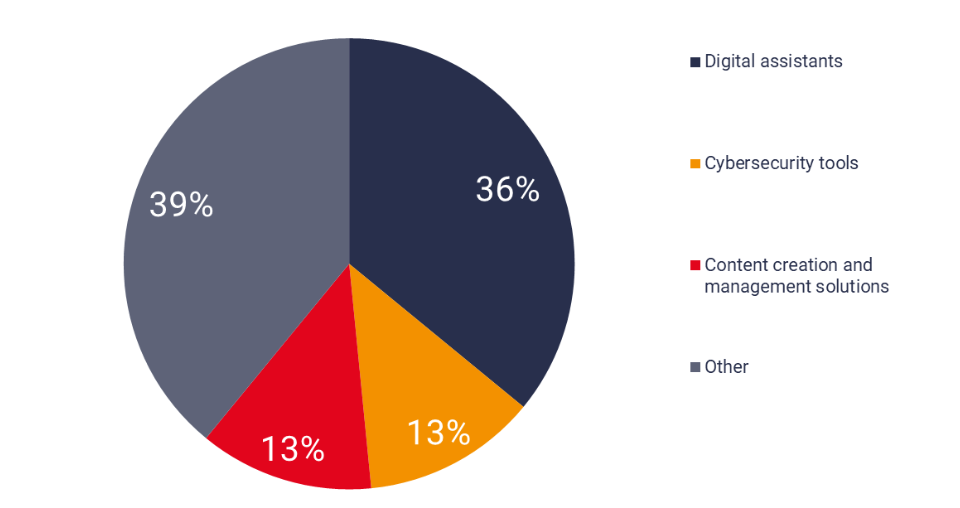
Among these use cases, digital assistants take the lead, representing 36% of B2C AI offerings. These typically involve embedding AI assistants into devices or entertainment apps and bundling them with AI tool subscriptions, such as Perplexity Pro and Google Gemini . Cybersecurity tools are a close second, emerging as one of the most promising areas for telcos. These network-level AI systems detect and block fraud and scams in real-time to protect users. Meanwhile, content creation and management solutions are gaining popularity as telcos experiment with GenAI in media experiences, from AI-generated avatars to co-created content that enhances cultural experiences and drives social media engagement. This article presents three example use cases of how telcos are adopting AI tools for consumers.
1. Digital Assistants
Deutsche Telekom has been one of the most proactive telcos in bringing AI-powered devices to consumers. The company first unveiled the concept of its AI phone in February 2024 and showcased a prototype in March 2025 at Mobile World Congress MWC in Barcelona. Just a few months later, in August 2025, it officially launched the T Phone 3 and T Tablet 2 across ten European countries, followed by a Pro version of the T Phone 3 on 6 October 2025, which features an embedded personal AI secretary.
The devices all come with Perplexity’s AI assistant built in, accessible via voice, text or a dedicated ’Magenta AI’ button on the lock screen. With this smart assistant, users can manage their day-to-day tasks, from scheduling personal appointments, translating conversations in real-time, planning trips, creating content, to even getting tutoring support. The experience is further enhanced by Picsart’s AI tool, allowing users to edit photos and create avatars directly on their devices. The T Phone 3 Pro further integrates Piscart directly into the camera. To encourage adoption of AI features, Deutsche Telekom includes 18-month Perplexity Pro and Picsart Pro subscriptions with each device. Customers who don’t own the devices can still access selected AI tools for free through Deutsche Telekom’s service app, MeinMagenta. In Germany, the T Phone 3 is priced at EUR149, the T Table 2 at EUR199, and the T Phone 3 Pro at EUR229.
Why it matters:
By pricing the AI phone at around EUR200, Deutsche Telekom lowers the barrier to “AI-first” phones, bringing advanced AI capabilities to the mass market. More importantly, the initiative marks a shift from app-based AI experiences to device-integrated intelligence, redefining how consumers interact with AI technologies and transforming AI into an everyday feature of the smartphone experience.
2. Cybersecurity tools
In August 2025, Indosat Ooredoo Hutchison (IOH) launched SATSPAM (Satuan Anti Scam dan Spam), an AI-powered anti-spam and anti-scam solution built directly into the network of its mobile brand, IM3. The launch responded to a pressing issue facing customers: around 65% of Indonesians face fraud attempts every week, from phishing texts to fake investment offers.
Unlike app-based security tools, SATSPAM operates automatically and continuously for every IM3 prepaid customer with an active data plan, scanning calls and messages in real time to detect and block suspicious activities. An advanced tier, SATSPAM+, adds extra protection with features such as real-time link detection and weekly threat reports. The solution is powered by IOH’s sovereign AI factory, supported by partners like Tanla (platform provider), Mastercard, the Global Anti-Scam Alliance (GASA), and the GSMA.
Why it matters:
By embedding AI-driven security directly into the network, IOH delivers a tangible and everyday benefit to its customers, shielding millions from scams and fraud without requiring extra apps or upgrades. The initiative reinforces the telco’s role as a trusted digital gatekeeper, demonstrating how AI can be applied not just for innovation, but for safety and trust at scale .
3. Content creation and management solutions
In March 2025 at MWC, KT showcased its vision for the next generation of live sports and entertainment with the launch of “K-Stadium”. The concept reimagines how audiences experience events, blending AI and immersive technologies to make audience engagement more dynamic and personal.
The K-Stadium concept features a futuristic sports arena, and inside it, fans can enjoy AI-powered real-time subtitle translation for in-venue announcements, making matches accessible to international audiences. An AI-generated avatar “digital human AI Lee Kang-in”, welcomes and interacts with visitors, while AI-generated cheer songs bring customisation to sporting events. Each feature is uniquely tailored to the game and its supporters.
KT also ran a K-pop Dance Stage challenge, where visitors danced alongside AI-generated K-pop idols through motion capture and augmented reality (AR), with content available in 40 languages, demonstrating how AI can merge entertainment, culture, and technology to create globally shareable fan moments. STL Partners’ report, Live experiences: How telcos can score a winner, provides more valuable insights into how telcos can monetise their network investments by participating in the live experience ecosystem.
Why it matters:
By applying GenAI to fan experiences, KT is opening up new monetisation opportunities, such as premium seating upsell and immersive content packages. More importantly, the same GenAI application can be applied beyond stadia to streaming, retail, and virtual events, creating brand new avenues for value creation across the entertainment ecosystem.
Next step for telcos: finding real value in consumer GenAI
B2C GenAI is no longer confined to pilots or showcase demos; it is moving into real-world deployment. Telcos are actively exploring ways to monetise AI through consumer offerings, either by integrating AI into existing devices or by launching entirely new services. Digital assistants, cybersecurity solutions, and creative media experiences are starting to prove their tangible value in customers’ everyday lives. For telcos, the next step is to keep experimenting with consumer AI tools, not only to enhance customer experience but also to create sustainable revenue streams. By embedding GenAI into services that go beyond core connectivity, telcos can position themselves at the heart of the digital lifestyle.
Looking for advisory services in AI? Schedule a call.
Download the AI insights pack
Download the AI insights pack
Our overview explores the evolving role of telcos in the AI ecosystem—examining how they act as consumers of AI, as enablers of AI adoption across industries, and as providers of AI-driven solutions to others.
From showcase to shelf: MWC Shanghai highlights how Chinese telcos monetise AI
three demos from China’s telcos at MWC Shanghai 2026 illustrate the different ways telcos are trying to build businesses around AI.

How AI can accelerate IT and OT convergence to transform customer experience
AI can play a central role in enabling convergence, acting as a unifying intelligence layer across IT and OT.

The Rise of AI-as-a-Service: Top 3 Enterprise Use Cases by Telcos
As enterprise deployments now account for nearly 40% of telco GenAI initiatives, the shift toward AI-as-a-service is accelerating
From showcase to shelf: MWC Shanghai highlights how Chinese telcos monetise AI
three demos from China’s telcos at MWC Shanghai 2026 illustrate the different ways telcos are trying to build businesses around AI.

Lessons from the dot-com bubble for the AI era
We explore the emerging possibility of an AI bubble, drawing comparisons between the contemporary AI landscape and the dot-com bubble.

Building networks of trust: How creating a human–AI partnership can help redefine network operations
How a new, cross-domain AI approach leveraging the latest AI techniques can help elevate employee roles and responsibilities in network operations teams.