Login to access
Want to subscribe?
This article is part of: Executive Briefing Service
To find out more about how to join or access this report please contact us
Modern telecom networks drive competitiveness, but organisational factors can thwart progress. We identify five startup practices telcos should adopt to enable true techco transformation.
Telcos are building pathways to techco – but face increasing technological complexities
Telcos universally recognise that network modernisation and transformation is no longer optional – it is the foundation for unlocking next-generation technologies, such as AI, automation and 6G. Successful transformation enables operators to run leaner, move faster and unlock new sources of growth to ensure sustained competitiveness.
For many, the north star of transformation is to evolve into a techco – i.e., an operator of highly automated networks that creates value beyond pure connectivity. Cloud-native adoption has been an important first phase of this journey, and the benefits of modernisation are clear:
- Efficiency: Elastic scaling to avoid over-provisioning, higher utilisation through shared workloads and energy savings from more optimised networks.
- Automation: Reduced manual work through CI/CD pipelines and network-as-code practices.
- Agility: Service launches accelerated from 12–18 months to weeks or even days.
- Resilience: Self-healing architectures that isolate failures and minimise downtime.
- Growth: Unlocking new services, such as network slicing and API exposure to enterprise customers, while creating the platform required to capture the value of AI.
If you are not a subscriber, enter your details below to download an extract of the report
Achieving level 4/5 network autonomy and deploying agentic AI – both in network operations and customer-facing services – is impossible without this foundation.
Yet network transformation introduces new levels of complexity. Disaggregation, hardware abstraction, cloud infrastructure and virtualised functions add multiple layers to the network stack and introduce more parameters, interdependencies, points of failure and a higher risk of incidents. Where engineers once managed relatively monolithic systems, they must now navigate distributed, dynamic environments. The fear of incidents can shift the focus from value creation to incident avoidance, slowing transformation progress. And as telcos look to deliver on further technological transformation, such as autonomous and agentic networks, they need a rock-solid cloud-native foundation.
Impact of cloud-native, AI and automation on the telco stack
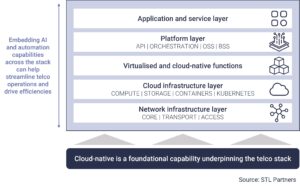
This complexity raises the stakes for reskilling. Engineers need broader and deeper expertise across domains, along with stronger testing, troubleshooting and resolution skills before deployment. As interdependencies multiply, cross-functional skill sets that understand the interactions between different technological layers and collaboration across teams become essential. This requires a shift away from siloed operations to more dynamic operating models.
Table of contents
- Foreword
- Methodology
- Editorial independence
- Executive summary
- Telcos are building pathways to techco, but face increasing technological complexities
- Operational readiness is the primary obstacle to realising the techco vision
- Channelling the startup approach: A useful model for operational transformation
- Startups cannot cut corners
- Startup practices can help telcos to truly embody the ‘techco vision’
Related research
- The telecom industry in the AI era: How telcos can follow the money
- Cloud-native evolution: Unlocking CSP transformation
- Telecom network evolution forecast: A platform approach to monetising 5G
- The telecom techco: The role of network cloud, automation and AI