Login to access
Want to subscribe?
This article is part of: Network Innovation
To find out more about how to join or access this report please contact us
Broadband network autonomy requires more than programmability. This report explores how providers can turn software-defined networking, cloud-native and artificial intelligence deployments into autonomous operations.
Broadband network autonomy requires operating model change
Broadband networks need to maintain service quality as traffic demand changes and different applications compete for available capacity. Video, gaming, cloud applications, AI workloads and enterprise services can place different demands on the network, and those demands are always evolving. Maintaining service quality increasingly depends not only on providing sufficient capacity, but on how effectively the network can manage different traffic and application flows.
Broadband service providers therefore need networks that are reliable, responsive and intelligent: able to assure service quality, anticipate problems, adapt to changing demand and support the delivery of new services. At the same time, broadband networks themselves are becoming more complex. Fibre penetration continues to increase, but providers must manage this alongside legacy access technologies, multiple generations of network equipment and a growing mix of physical, virtualised and cloud-based functions. The objective is therefore not simply to automate individual engineering tasks, but to improve network performance while making it easier to launch and operate services on top of it. For end customers, this should mean a more consistent, responsive broadband experience, with fewer service disruptions, faster problem resolution and performance that adapts more effectively to changing demand.
Broadband providers are not starting from scratch. This ambition builds on a long-running transformation, from early SDN initiatives in the 2010s to investment in NFV and, more recently, cloud-native platforms. These programmes have progressively introduced software control into broadband networks, from customer premises equipment (CPE) and fibre access through aggregation, transport, the IP edge and core. STL Partners’ survey shows that 78% have already partially or fully deployed SDN and/or NFV in their broadband network. For most providers, the question is no longer whether these technologies can move beyond trials, but how to turn their deployment into sustained operational benefits.
SDN and cloud-native are part of the journey to autonomous broadband
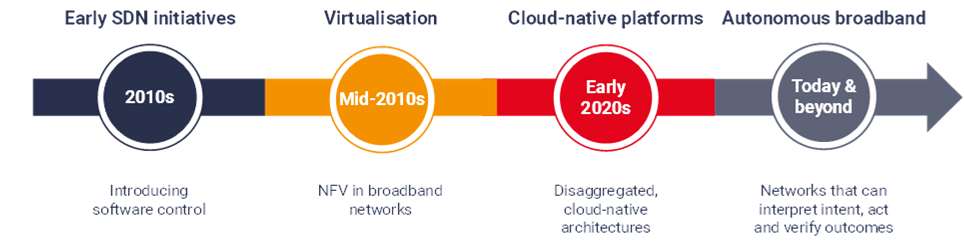
Source: STL Partners
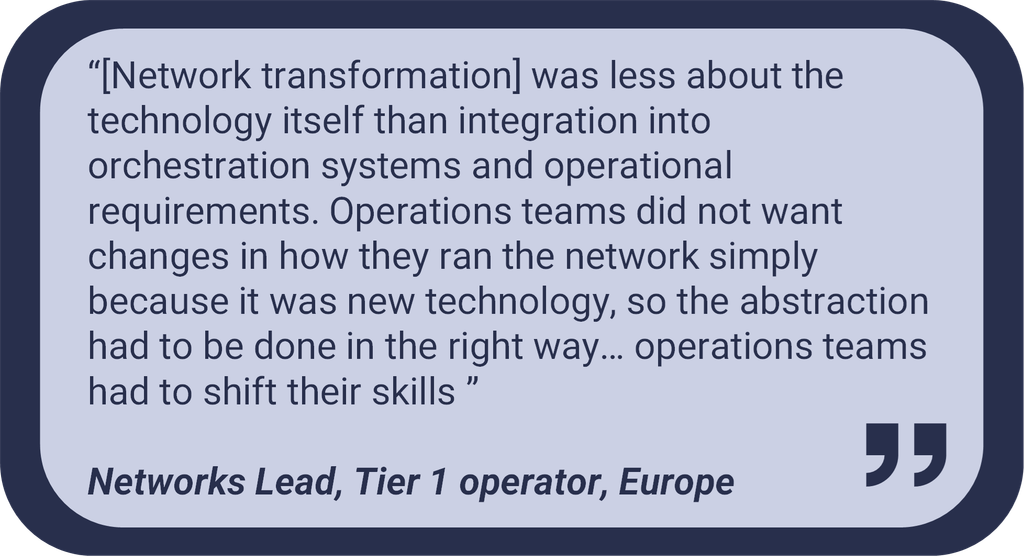
Deploying technology does not automatically improve financial and operational KPIs. Some broadband providers report having substantially changed their network infrastructure without achieving the flexibility or resource efficiency they originally envisaged. This exposes an important distinction: cloud-native is not something broadband operators buy; it is something they need to do. Moving an access control function onto Kubernetes (the widely adopted, open-source, cloud-native infrastructure management and orchestration platform), disaggregating an optical line terminal (OLT), introducing a software-defined controller, or virtualising a network function does not by itself create a cloud-native operating model. If infrastructure remains dedicated, integration remains bespoke and changes still depend on lengthy engineering and approval processes, then many of the constraints of the previous architecture remain.
The real benefits come when the operating model changes with the technology. Broadband providers need to rethink how they share compute and network resources, release and upgrade software, manage legacy and new infrastructure, divide responsibilities across internal teams and suppliers, and operate services end to end. A European Tier 1 operator described its broadband network transformation as roughly 30% technology, 30% skills transformation and 40% investment justification and operating model change. This involved decisions about supplier relationships, migration and how much responsibility to retain in-house, illustrating how much of the challenge lies outside the technology itself.
Operating model change matters because broadband providers increasingly see their investments in programmability and cloud-native platforms as the foundation for a more autonomous network. The logic is clear: a network cannot act autonomously if its underlying elements are not programmable. SDN and cloud-native architectures are therefore part of the journey, not the destination. Their strategic value lies in providing the programmable foundation on which broadband networks can progressively make more decisions for themselves.
Broadband providers should therefore treat cloud-native transformation and autonomous networking as part of the same operating model shift, rather than as separate technology programmes. The aim is to bring programmability, data and decision-making together so networks operate more dynamically. This more dynamic operation could be realised in several ways, for example speeding up service activation, identifying and resolving faults more efficiently, or managing capacity effectively as demand changes. It should also make it easier to manage the transition between access generations while maintaining service quality.
Table of contents
- Foreword
- Executive Summary
- Introduction: Broadband network autonomy requires operating model change
- Broadband networks are more programmable, but operating models have not kept pace
- Brownfield integration and lifecycle management are the practical test of cloud-native operation
- Broadband network autonomy depends on trusted decisions, not just automated actions
- Bounded workflows provide the clearest route from analysis to autonomous action
- AI is already improving network operations before it is trusted to act autonomously
- Data must carry service context before AI can make reliable network decisions
- Trust depends on explicit decision rights, guardrails and accountability
- Cross-domain intent is needed to turn automation into end-to-end service autonomy
- Programmability creates commercial opportunities
- Standards can reduce integration friction; but value depends on industry engagement
- Interoperability needs to work in practice, not just on paper
- Fixed-mobile convergence shows how standards can reduce integration complexity
- Autonomy also requires a common understanding of network data
- Industry engagement is needed to turn standards into deployable implementations
- Recommendations: Turning programmability into autonomous operations
Related research
- Real-time data for autonomous networking
- AIS – Autonomous networks case study
- Agentic AI in telecoms: What is live now and coming next?