Login to access
Want to subscribe?
This article is part of: Network Innovation
To find out more about how to join or access this report please contact us
Autonomous networks need agents that can be trusted to act on live events. That means solving two problems: data that is thorough enough to catch a genuine anomaly, and fast enough to remain valid by the time a decision is made. How should operators approach both?
Today’s challenge is making trusted data visible and accessible across domains
Telcos are implementing AI to further automate their network operations, with the ultimate goal of reaching fully or near-fully autonomous operations. As telcos push towards higher levels of autonomy, agentic AI becomes fundamental to handling the network’s growing complexity and responding to conditions in real time, rather than relying on static, rules-based automation. Much of this value can be unlocked by deploying smaller, domain-specific agents. For example, scoped to the radio access network (RAN), core or OSS, that reason and act locally and coordinate with one another, rather than necessarily relying on a single system that has already unified data across every domain.
However, data is the key challenge holding telcos back from realising this vision. Insights from a recent research programme show how this breaks down into two related problems: processing the sheer volume of data and making it discoverable, accessible and trusted across domains.
If you are not a subscriber, enter your details below to download an extract of this report.
Processing data economically at scale
Telco networks generate petabytes of heterogeneous data daily, making it economically difficult to process it. This is a challenge not only for AI but for enterprise-wide analytics more broadly. Centralised architectures such as data lakes, data warehouses and lakehouses have been the primary way telcos have tried to solve this scale problem. For example, AT&T consolidated its fragmented data estate into a single cloud lakehouse, achieving an ROI of 300% over five years and retiring around 40% of its previous infrastructure. The savings came from removing duplicated and siloed infrastructure, not from any one model.
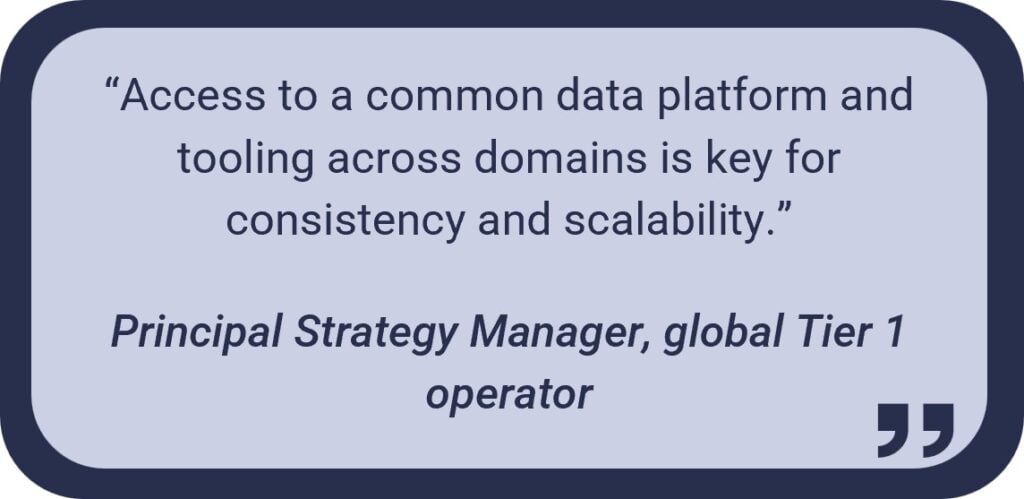
These initiatives have delivered other benefits, such as consistent tooling and data governance across the organisation and enabling historical analysis. Many telcos are still migrating to centralised architectures. However, these architectures are slow and costly to build, and operators may risk missing near-term AI value if they wait to unify all their data before deploying AI.
Making data discoverable, accessible and trusted
This remains the major challenge many telcos face today. The main causes are:
- Organisational issues as data owners: The domain teams (for example, RAN, core, OSS, customer) do not consistently transform and present their data in a way that other domain teams can easily understand and use, whatever the underlying reason. This could be due to a lack of resources, lack of incentivisation, not seeing the immediate value in it, or data owners not wanting to give up control of the data due to internal politics.
- Technical challenges due to complex, multi-vendor legacy estates: Different systems often produce different data, or the same data in different formats, making it technically difficult to unify.
Research methodology
Our research programme involved in-depth interviews with 11 senior individuals across the telecoms ecosystem, including telecoms operators and their vendor partners. The research focused particularly on AI readiness in environments where real-time decision-making is critical, with an emphasis on network operations and automation. This includes understanding how operators are evolving their data foundations, including architecture, governance, contextualisation, real-time capabilities and cross-domain interoperability, to support more advanced AI-driven and autonomous operations.
Table of contents
- Foreword
- Executive Summary
- Today’s challenge is making trusted data visible and accessible across domains
- Autonomous networks need the same trusted data, but faster and more thorough
- Real-time agentic decision-making
- Conclusion
Related research
- Agentic AI in telecoms: What is live now and coming next?
- Agentic AI: Making operator data AI ready
- Telco generative AI adoption tracker
