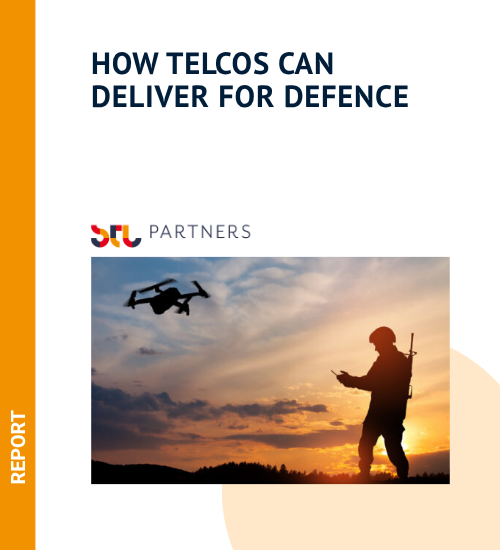
How telcos can deliver for defence
£3,000.00 excl VAT
As telcos deploy more resilient and programmable networks, they could become key suppliers to armed forces. Dual-purpose tech solutions by telcos are valuable also to the population and civilian critical services during extreme weather events or energy blackouts, as much as during military conflict.
Description
Format: PDF file
Pages: 39
Author: Marina Koytcheva
Publication date: April 2026
Introduction
As the geopolitical landscape shifts, governments across the world are increasing defence spending. In Europe, for example, the European Commission’s forthcoming Multiannual Financial Framework and the emerging ReArm Europe initiative call for a major uplift in EU defence investment.
At the same time, civilian digital technologies are evolving rapidly, paving the way for new levels of automation that could be applied on the battlefield, as well as in ports, mines, factories and other industrial facilities. Despite the advances in artificial intelligence, most equipment still needs to be monitored and sometimes controlled remotely. Therefore, the armed forces are looking for a reliable means to wirelessly connect large numbers of drones and robots, which have become key weapons, as is apparent in the war in Ukraine.
As they begin to integrate satellites with terrestrial infrastructure, 5G Advanced networks could be used to provide reliable and continuous connectivity for military forces both on, and behind, the front line. During a conflict, dual-use 5G Advanced networks may be required to keep both soldiers and civilians online and informed, allowing them to source help and supplies, as well as supporting morale.
For telecoms operators, the automation of warfare, and the uplift in defence budgets, could provide opportunities to increase revenues. Setting out its new strategic plan in February 2026, Orange said it plans to grow ‘trusted cloud solutions and trusted AI services,’ and invest in specific verticals such as defence and health. The Group aims to generate an additional EUR500 million of revenue from ‘trusted B2B services’ by 2028; and Orange Cyberdefense has an objective to reach EUR2 billion in revenue by 2030.
At the same time, for many telcos, the development of military-grade systems may not be optional – national governments may oblige incumbent telcos to ensure that their infrastructure could be employed by the miliary during a war.
This report begins by outlining what the defence sector needs from the telecoms industry before identifying key enabling technologies. It then considers the potential complications for telcos targeting this market and concludes by making key recommendations, supported by examples and case studies.
This report builds on previous STL Partners’ publications, including:
- 5G: The next phase
- Real-time automation: The future of transport & logistics
- NTNs and telcos: Is it fight or flight?
Five defence-related recommendations for telcos
Our insight covers the following key points:
- Executive summary
- Introduction
- Connectivity is crucial to modern warfare
- Ukraine underlines the value of remote control
- Connectivity challenges: Need for network redundancy
- Satellites are strategically important assets
- Grey zone conflicts threaten civilian infrastructure
- Key dual-use technologies
- Cellular Communications for Defence
- Network in-a-box/portable and temporary base stations
- Non-terrestrial networks
- 5G standalone technology
- Massive IoT
- Integrated sensing and communication
- Network APIs
- Campus-wide private networks/edge compute
- High-altitude platforms
- Case study: Lockheed Martin embraces 5G
- The need for network resilience
- High-level recommendations
- Make the integration of D2D connectivity a high priority
- Provide managed connectivity to train robots
- Prove that programmable networks can deliver for defence
- Build up and/or acquire defence expertise
- Engage directly with new digital defence initiatives
- Further considerations
Technologies and industry terms referenced include: 5G, Aerospace and defence industry, AI, AI security, customer, Cybersecurity, Defence modernisation, Defence policy, Defence sector, Defence spending, Economic impact, EU defence strategy, EU funding, EU policy, Europe defence, European Commission, Geopolitical shifts, Global security landscape, government policy, Innovation, Investment trends, Military expansion, Military investment, Multiannual Financial Framework (MFF), National security, Orange, Policy analysis, Public sector strategy, Regional security, Strategic defence, Strategic planning, Strategy, Telefonica