
Download

As enterprise deployments now account for nearly 40% of telco GenAI initiatives, the shift toward AI-as-a-service is accelerating. From sovereign AI infrastructure and platforms to AI-powered cybersecurity, explore how China Unicom, Ooredoo Kuwait, and StarHub are pivoting their unique assets.
Telcos are increasingly moving beyond internal experiments to embrace AI-as-a-Service (AIaaS) as their primary engine for B2B growth. As GenAI matures, telcos are positioning themselves as a foundational backbone for enterprises adopting AI, focusing heavily on enabling infrastructure and platform solutions. According to STL Partners’ Telco Generative AI Adoption Tracker (November 2025 update), over 50% of telcos’ GenAI projects announced in the period of September and November 2025 were B2B-focused. As a result, B2B solutions now represent 38% of all recorded telco deployments of GenAI initiatives, marking a clear trend moving toward corporate utility.
Implementations of AI in products, up to November 2025
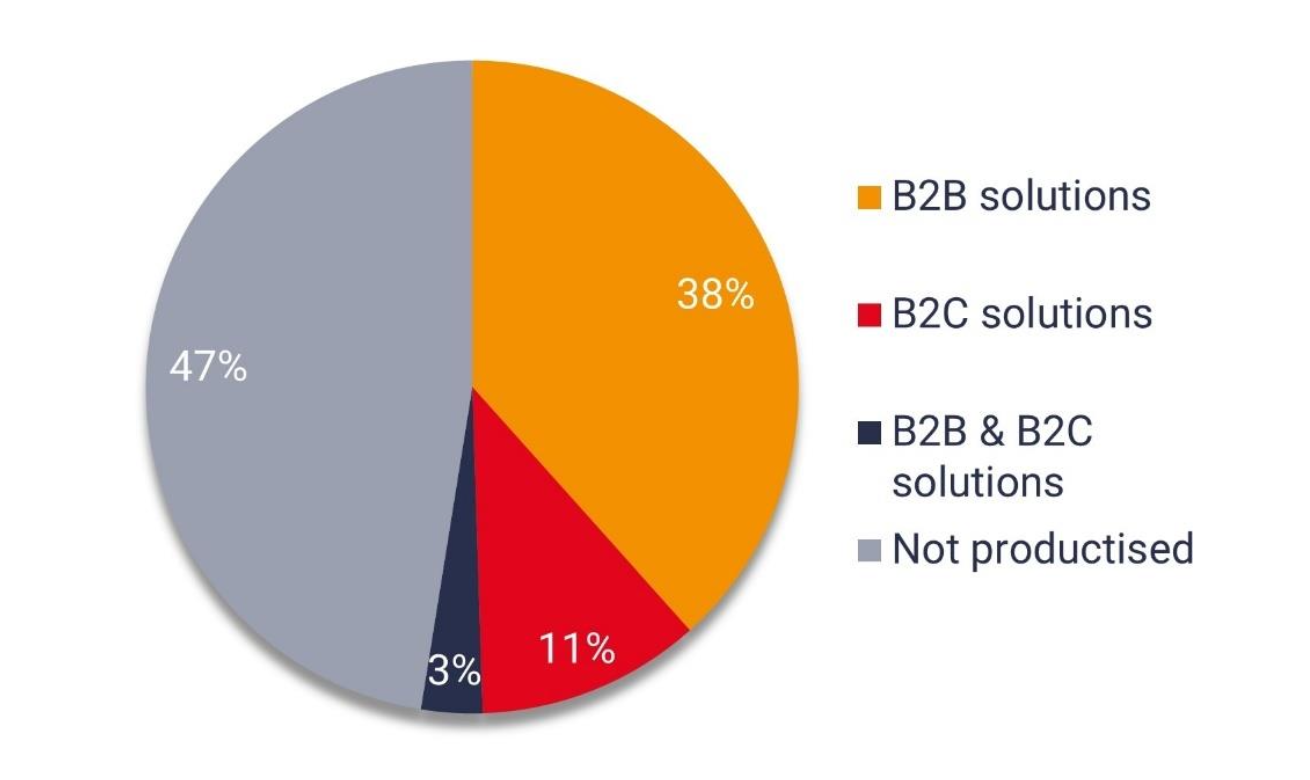
A look at recent implementations reveals that telcos are prioritising AI infrastructure and AI platforms over standalone applications. Rather than simply selling tools, they are offering the computing power, data platforms, and model frameworks that government and enterprise clients need to build their own solutions. The following three examples from China Unicom, Ooredoo Kuwait, and StarHub illustrate how diverse regional players are converging on a shared goal: becoming indispensable partners in the enterprise AI ecosystem.
China Unicom: An orchestrator of an integerated AI platform
Launched in September 2025, China Unicom’s Cube AI platform is a clear example of a telco developing an in-house AI platform to capture the B2B market. Cube AI provides an end-to-end environment where enterprises can manage the entire lifecycle of AI models and intelligent agents, from initial training to deployment.
What makes the platform significant is its ability to unify cloud, edge, and device computing resources through standardised APIs. This allows China Unicom to monetise its existing network assets alongside new AI capabilities. By positioning itself as an orchestrator of enterprise workloads, China Unicom is securing a long-term role as a central hub for scalable AI innovation.
Ooredoo Kuwait: Leading with sovereign AI infrastructure
In November 2025, Ooredoo Kuwait took a different route by focusing on sovereign AI infrastructure. In partnership with Nvidia, it launched a specialised data centre equipped with Nvidia H200 GPUs. This facility is about trust and residency. By enabling public and private organisations to develop and operate AI models locally, Ooredoo addresses the critical need for data governance and national security.
The sovereign positioning is central to the service’s value proposition, particularly for government and regulated sectors with strict data residency needs. The sovereign approach allows Ooredoo to differentiate itself from global hyperscaler cloud providers, offering a secure, compliant alternative for regulated industries that cannot risk moving sensitive data across borders.
StarHub: Enhancing cybersecurity through partnerships
While some build from the ground up, Singapore’s StarHub demonstrates the power of the partnership-led model. By collaborating with Vectra AI, StarHub integrated GenAI directly into its managed cybersecurity portfolio. This initiative uses AI-driven threat detection to monitor network activity and automate incident response for enterprise customers.
For StarHub, the value lies in practical application: by embedding AI into a high-priority service like cybersecurity, it can offer immediate, tangible benefits to customers without the overhead of building a proprietary foundational model. This example shows smaller scale but practical AIaaS offerings can still play an important role in telcos’ broader B2B GenAI strategies.
Conclusion: Defining the enterprise value proposition
These strategies highlight a critical shift in the industry. There is no single path to AI monetisation in the enterprise market, but clear patterns are emerging. Telcos that are finding early value are aligning GenAI investments with their existing strengths:
- Scale and integration (e.g., China Unicom’s AI platforms)
- Physical assets (e.g., Ooredoo Kuwait’s sovereign AI infrastructure)
- Trusted relationships in specific verticals (e.g., StarHub’s managed cybersecurity)
Ultimately, the most successful telcos aren’t treating GenAI as standalone product. Instead, they are weaving it into the very fabric of their B2B offerings, combining connectivity, compute, and security into a single, indispensable enterprise proposition.
Looking for advisory services in AI? Schedule a call.
Download the AI insights pack
Download the data centre insights overview pack
Our overview explores the evolving role of telcos in the AI ecosystem—examining how they act as consumers of AI, as enablers of AI adoption across industries, and as providers of AI-driven solutions to others.

From showcase to shelf: MWC Shanghai highlights how Chinese telcos monetise AI
three demos from China’s telcos at MWC Shanghai 2026 illustrate the different ways telcos are trying to build businesses around AI.

Lessons from the dot-com bubble for the AI era
We explore the emerging possibility of an AI bubble, drawing comparisons between the contemporary AI landscape and the dot-com bubble.

Building networks of trust: How creating a human–AI partnership can help redefine network operations
How a new, cross-domain AI approach leveraging the latest AI techniques can help elevate employee roles and responsibilities in network operations teams.
From showcase to shelf: MWC Shanghai highlights how Chinese telcos monetise AI
three demos from China’s telcos at MWC Shanghai 2026 illustrate the different ways telcos are trying to build businesses around AI.

How AI can accelerate IT and OT convergence to transform customer experience
AI can play a central role in enabling convergence, acting as a unifying intelligence layer across IT and OT.

The Rise of AI-as-a-Service: Top 3 Enterprise Use Cases by Telcos
As enterprise deployments now account for nearly 40% of telco GenAI initiatives, the shift toward AI-as-a-service is accelerating