
Download
Listen

This article explores how a new, cross-domain AI approach leveraging the latest AI techniques can help elevate employee roles and responsibilities in network operations teams, transforming the department into a hub for service design and innovation.
Telecom operators are pursuing the “North Star” of network autonomy — resilient, self-optimising networks that run efficiently and scale intelligently. Yet, despite investment in virtualisation and automation, networks remain complex to manage and require significant human intervention to operate. The next step in the network automation journey is establishing a human-AI partnership built on trust, transparency and shared intelligence. Once operators establish this partnership and gain confidence in AI’s recommendations, the networks can begin to execute tasks autonomously — allowing human roles to focus on innovation and strategy.
From traditional AI to a dual intelligence approach
Traditional AI — built on rule-based and pattern-recognition algorithms — has helped operators automate tasks and detect known anomalies, but it remains limited by the patterns it has been trained on and lacks contextual and cross-domain understanding. Deployed in silos, traditional AI reacts to known issues rather than learning from them, as it is often trained and optimised for specific datasets — for example, data from a single network domain or vendor, such as RAN probes from Ericsson . This limits its ability to draw insights across domains or adapt to new conditions. The future lies in combining two novel technologies that complement the capabilities of traditional methods:
• Analytical AI, powered by network data-trained time series foundation models, is optimised to understand sequential network behaviour, delivering a step change in detection, noise reduction and forecasting. These advanced models are also capable of multi-variate analysis, looking across domains at multiple KPIs to provide enhanced cross-domain insights for anomaly detection and prediction.
• Reasoning AI, enabled by generative models, brings adaptive reasoning, scenario modelling and cross-domain insight. This increases contextual interoperability and the strategic value of insights delivered by Analytical AI.
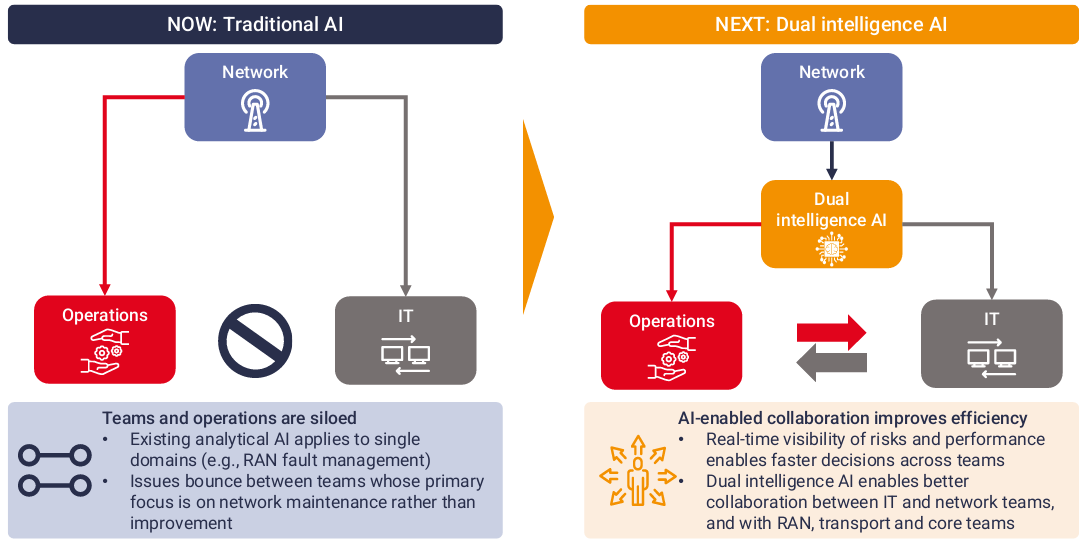
The complementary abilities of analytical and reasoning AI leverage a unified, cross-domain data layer from which models can generate explainable and actionable recommendations that humans can understand and trust. This novel approach, referred to in this article as ‘dual intelligence AI’, can help create a human-AI partnership.
Rather than overwhelming teams with alerts, dual intelligence AI can present root-cause hypotheses, showing supporting data and recommending next steps. Engineers stay in control and make final decisions but gain a collaborator that broadens their view and accelerates decision-making.
Dual intelligence AI also helps build employee trust through feedback. Every time an engineer validates an AI recommendation or refines a threshold, that human input becomes data that strengthens future decisions. This creates a continuous learning loop where engineers are not only monitoring AI but teaching it too. Over time, that operational experience becomes embedded in the models themselves, ensuring the system reflects real world context and the collective expertise of the network operations (NetOps) teams. This creates a steady progression toward greater autonomy, where networks manage more tasks independently but remain accountable to human guidance.
Adopting this approach not only simplifies operations but also accelerates innovation. In private 5G and network slicing deployments, for instance, analytical AI automates calibration and testing, while reasoning AI tailors configurations to customer intent and performance targets. Guided by human-defined policies and outcomes, AI delivers the speed and accuracy required for large scale execution. Each deployment then feeds new insights back into the models, helping shorten design cycles and enabling faster rollout of new, on-demand network services.
This approach has tangible value. STL Partners’ modelling shows that a typical operator with USD16 billion in revenue can unlock USD400 million from operational expenditure (opex) savings . Crucially, around 70% of opex savings come from process efficiency and better decision support rather than headcount reduction. The benefit lies not in reducing roles, but in making people more effective.
Elevating human capability
With dual intelligence AI, routine fault detection and remediation becomes largely automated, allowing teams to focus on higher value work. Engineers shift from reacting to faults to improving resilience and customer experience. For junior staff, AI empowers them to move beyond routine tasks and tackle complex issues early with the support of a trusted AI partner. For experienced professionals, it frees time for service design and innovation.
In doing so, NetOps teams evolve from a maintenance centric function into a capability building one — through collaboration between human decision making and AI insight. The impact of this transition is twofold:
• Network operations teams become a collaborative hub. As AI takes on more of the monitoring and orchestration workload, network operations teams become a collaborative hubs and the skills required will change. Engineers will need stronger data literacy and systems thinking — understanding how network, IT and business data interrelate. Communication and the ability to collaborate across departments will become core competencies, as teams must translate AI outputs into operational and commercial impact.
• Adopting a dual intelligence approach also changes how attractive NetOps becomes to new talent. The change in responsibilities and skills will naturally attract a new generation of talent — people motivated by the opportunity to build new products and network capabilities rather than maintain existing ones. At the same time, by converting complex legacy network knowledge into natural language, AI lowers entry barriers for newcomers, reducing reliance on retiring experts with niche institutional knowledge. Engineers, software developers, and data specialists will see NetOps as a creative and high-impact environment where they can shape future services. For operators, it’s a unique opportunity to reposition network operations as a driver of innovation and growth
Figure 1: Dual intelligence AI transforms network operations teams into a collaborative hub
Source: STL Partners
Building trust: the path to autonomy
The path to closed-loop automation is dependent on trust between humans and AI. Engineers need to understand how AI reaches conclusions and be confident that its recommendations are transparent and reliable. Dual intelligence AI helps build that confidence by working alongside people — explaining its reasoning, showing supporting data and allowing for human oversight.
This is the direction network operations is heading in: not toward replacement, but closer collaboration. The value of AI lies in combining human judgement with machine efficiency to simplify operations and accelerate innovation. As this partnership strengthens, operators will move naturally from maintenance to innovation — creating networks that are more efficient and trusted.
This article was published for a research programme in collaboration with IBM.
Looking for advisory services in AI? Schedule a call.
Download the AI insights pack
Download the data centre insights overview pack
Our overview explores the evolving role of telcos in the AI ecosystem—examining how they act as consumers of AI, as enablers of AI adoption across industries, and as providers of AI-driven solutions to others.

From showcase to shelf: MWC Shanghai highlights how Chinese telcos monetise AI
three demos from China’s telcos at MWC Shanghai 2026 illustrate the different ways telcos are trying to build businesses around AI.

How AI can accelerate IT and OT convergence to transform customer experience
AI can play a central role in enabling convergence, acting as a unifying intelligence layer across IT and OT.

The Rise of AI-as-a-Service: Top 3 Enterprise Use Cases by Telcos
As enterprise deployments now account for nearly 40% of telco GenAI initiatives, the shift toward AI-as-a-service is accelerating
From showcase to shelf: MWC Shanghai highlights how Chinese telcos monetise AI
three demos from China’s telcos at MWC Shanghai 2026 illustrate the different ways telcos are trying to build businesses around AI.

Lessons from the dot-com bubble for the AI era
We explore the emerging possibility of an AI bubble, drawing comparisons between the contemporary AI landscape and the dot-com bubble.

Building networks of trust: How creating a human–AI partnership can help redefine network operations
How a new, cross-domain AI approach leveraging the latest AI techniques can help elevate employee roles and responsibilities in network operations teams.