
Download


The telecom industry seems to think that private 5G is failing as a driver of new growth. But this is more because this opportunity was recently the victim too much hype – growth is happening, and some players are taking advantage. Why are telcos still so frustrated?
What happened to private 5G hype?
Even 30 years after it was first published the Gartner hype cycle remains a useful and widely applicable framework to help understand the maturity of technology markets. It can certainly help us understand the mood suorrounding private 5G.
Private 5G is moving through the hype cycle

Hype hype hype!
When did private 5G reach the peak of inflated expectations? A notable milestone was the publication of a market sizing report in 2019. Commissioned by Nokia to help map enterprise targets and undertaken by Harvard University, the study estimated that the total addressable market for private 5G could eventually stretch to 14mn sites. 14mn enterprise sites equipped with a private 5G network. That is a lot, bearing in mind that STL believes there are closer to 3,000 private mobile networks deployed by the start of 2025, and of these only around 18% are 5G. So, maybe, perhaps, eventually there will be 14mn sites with private 5G, but it is going to take us an extremely long time to get there if we ever do.
Nokia’s Harvard market sizing exercise, and probably others like it, helped lay the groundwork for some serious private 5G hype. This was further fuelled by the eagerness of the telecoms industry. In the early 2020s, telcos were getting worried about the failure to drive growth through 5G services. It was always expected that the new monetisable 5G use cases would come in industrial settings – but these proposed use cases often needed some of the more advanced capabilities of 5G, which were proving tricky to realise and slow to emerge on public networks. Dedicated private 5G networks are designed on a much smaller scale and are inherently greenfield (usually) making those features that bit easier to realise. Being able to charge the end user, the enterprise, for rolling out those cpaabilities in a network just for them, seemed to address the unanswered questions around monetisation mechanisms for such capabilities. Telcos were hooked.
Private 5G was seized upon as the promised new source of growth, the way for telcos to insert themselves into in the digital transformation of other industries, and build ongoing relevance. Afterall, this opportunity is all about mobile networks, and who knows more about mobile networks then telcos? Of course there will be a huge place for them in this rapidly growing market! Or so they thought.
Where did the hype go?
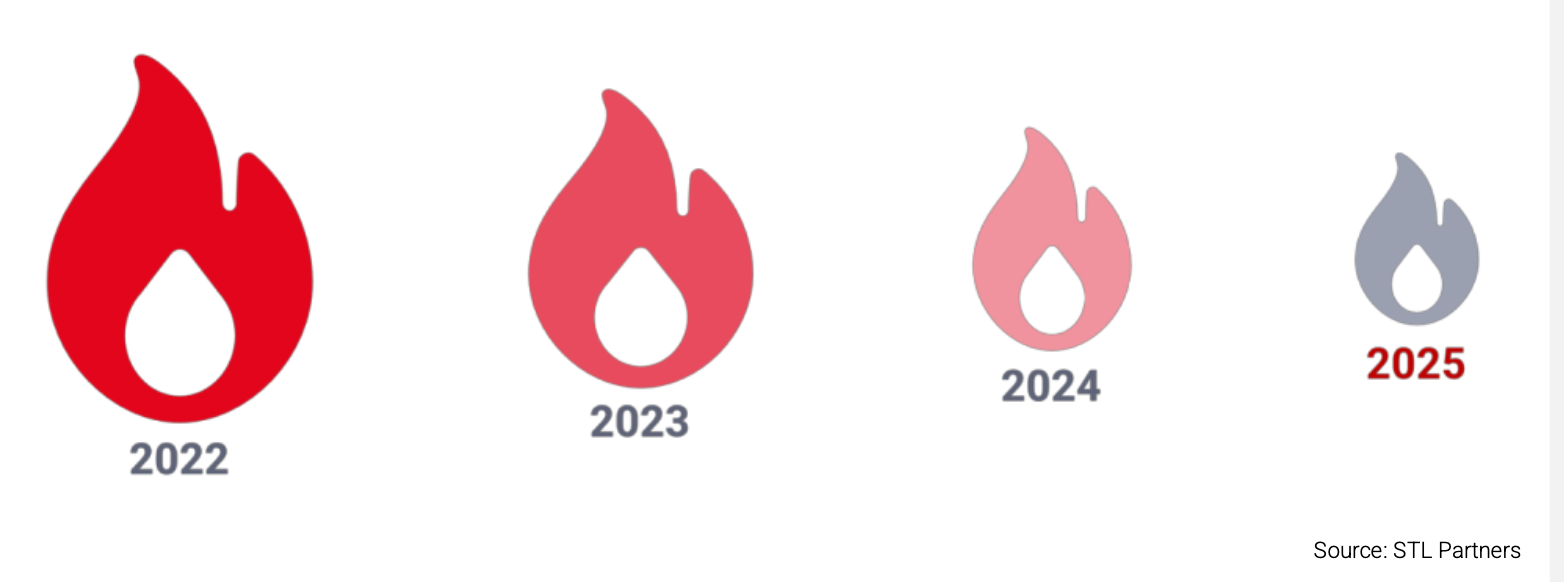
Maybe the hype peaked around 2022/2023? In any case, it has gone now, because the truth is that there are plenty of barriers to growth in private 5G. There was a great deal of what that had to be done, and much that still needs doing, to covercome these barriers and help private 5G achieve its potential. There has been good growth, but it has been a lot slower than the hype suggested, and some players have struggled more than others. The telcos themselves may be doubly disappointed because contrary to their hyped expectation, they are not necessarily the natural entities to be providing private 5G.
Disillusionment is inevitable
According to Gartner tech lore, the peak of inflated expectations is rapidly followed by the trough of disillusionment. Why disillusionment with private networks?
- It is not easy – A private network is not simply a shrunk down public network – it is a different beast and presents its own challenges, and being good at one does not make you good at the other. It is also difficult to make a horizontal approach work, because the needs and challenges of different industries are so diverse.
- Enterprises don’t care about connectivity – Trying to convince an enterprise that it needs to spend money on new connectivity, to allow it to do a whole host of new things, that it is expected to work out itself, is a hard sell. It is an even harder sell if trying to do some of those new things is not a current priority, and/or the enterorise already has one or more connectivity solution that allow it to do some of those things, to some extent. To be convinced to invest, enterprises need to see immediate value in the shape of a solution to a current problem or demand, possibly sweetened with a road map to further value a short way down the line, and a promise of future proofing
- Cost and complexity is too high – We hear about many failed private network sales, where businesses are initially curious, but get quickly put off either when they start to understand the full price tag, or as they begin to see how involved the whole process is, and how much investment in ongoing management there will be. These are factors that are absolutely being dealt with by vendors, service providers and Sis active in the private network space, but they have been a significant obstacle to growth thus far.
Telcos trapped in the trough
These challenges and obstacles have succeeded in deflating the hype, but plenty of companies are quickly pushing through the trough of disillusionment to the slope of enlightenment, because they are successfully adapting to tackle these challenges, and are seeing growth. Even big companies like Ericsson and HPE, that are seeing private network success have admitted that they are having to adjust how they approach enterprises, increasing verticalisation and partnering to tailor their offers. Others admit that private 5G connectivity is nigh on impossible to sell on its own, but that it needs to be presented as part of a digitisation platform, with a very outcome-led sales approach. And companies such as Boldyn and others are not only working to bring costs and complexity down but are pushing forward with improved private network as a service offerings.
But many telcos remain trapped in the trough. Unsure if the overall market is just tiny, or if they are taking a much smaller market share than they imagined. Struggling to convince management teams that it is worth investing more in selling the private network solutions they have developed. Unable to build beyond PoCs. Why are they stuck, and how can they escape?
Conclusion
There are multiple reasons, but we believe that key among them is underdeveloped expertise in deploying private networks, and lack of verticalisation.
Many telcos lack expertise in deploying small-scale mobile networks in challenging environments, despite their great expertise in macro networks. They can try to fill this through hard graft and starting smaller and simpler, but many will benefit most by working more closely with systems integrators that are showing they understand the space well. A share of the revenue stream is better than none at all.
Most telcos have also not successfully verticalised enough to pursue the industry-specific, application-led approach that is essential to growing the private 5G market. They are not close enough to the verticals, and to enteprise more generally, to realy understand their prioroties and needs, and how they make decisions. Overcoming this weakness is difficult, and partnerships with those that do have this specialisation, as well as working closely with other vertical specific tech vendors, will again be key. Telcos will need to be flexible, and humble enough to accept a background role when appropriate.
Are you looking for specialist support in private networks?
Read more about private networks
Private networks insights pack
Our pack will provide you with a summary of insights from our private cellular networks practice

Scaling private 5G: the role of A3 (Analytics, Automation and AI)
Integrating Analytics, Automation, and AI (A3) into private networks can streamline deployment, reduce costs, and make networks more scalable

What is a campus network?
Campus networks are becoming a critical component of private network innovation, offering MNOs and vendors new opportunities to meet the connectivity demands of large, multi-vertical environments.

Private LTE/5G network providers: An overview
This article explores the lifecycle of private LTE/5G networks and the different types of solution providers involved in their deployment and management.