Login to access
Want to subscribe?
This article is part of: Network Innovation
To find out more about how to join or access this report please contact us
Agentic AI in network operations ushers in an era of ‘5 x 9s probability’, to replace 5 x 9s reliability. The technology is making good progress, but telcos are grappling with how to manage the risks.
Agentic AI in NetOps has not yet reached its tipping point
Major operators around the world have made considerable progress with testing, trialling and deploying agentic AI to support NetOps – with two main caveats:
- Deployments are mostly across a single network or service domain.
- Deployments are mostly in co-pilot or actual pilot mode: with the final decisions and actions still not carried out by AI agents; or, if they are, this is in the context of pilots (i.e., trials) rather than fully live, scaled deployments.
Definition of agentic AI in NetOps
Agentic AI in NetOps means more than using AI and machine learning (ML) to automate and optimise NetOps and performance. The distinction between AI-driven automation and agentic AI is that, in the latter, the agent makes and executes critical decisions about operations and the network itself, rather than relying on a human to have the final say.
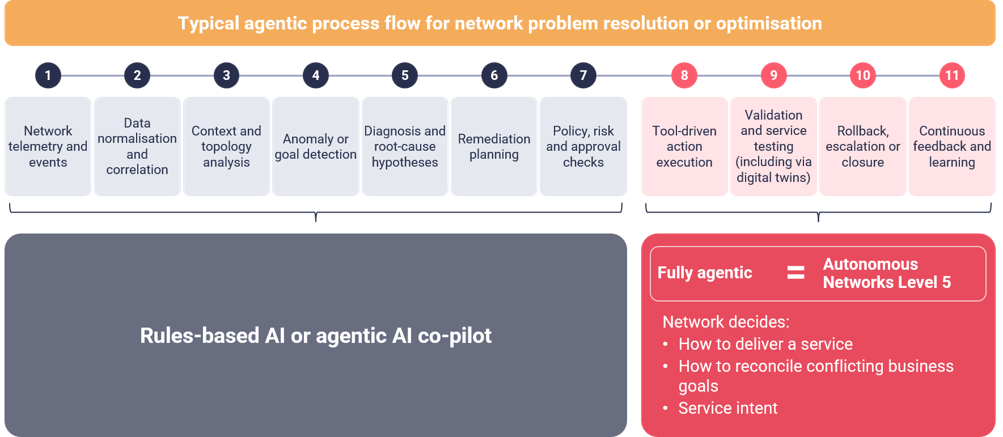
A typical AI + agentic AI process flow relating to network problem resolution and optimisation can be represented as shown here.
Agentic co-pilot and fully agentic process flow
Source: STL Partners
Few operators have implemented stage 8 (tool-driven execution) at scale, although the use of digital twins (stage 9) is growing. The factors behind this situation are discussed below, but one significant inhibitor is the difficulty of fully rolling back the agent’s actions if they cause problems anywhere in the network.
In this report, we discuss examples of 10 network operational functions – or function sets – where agentic AI is already having an impact, to a greater or lesser extent. We have grouped these into three overarching categories as illustrated in Figure 4. These represent most of the network operational functions at telcos, but it is not an exhaustive list. We do not, for example, discuss security functions, given that agentic and AI security is a vast topic in its own.
We focus on live, scaled deployments in commercial networks, where these exist; but we will also refer to trials or pilots that offer potential. And we will discuss instances of live deployments that are not fully agentic to illustrate the distinction between agentic and non-agentic AI.
If you are not a subscriber, enter your details below to download an extract of the report
Table of contents
- Executive Summary
- Agentic AI in NetOps has not yet reached its tipping point
- Definition of agentic AI in NetOps
- Why do agentic AI at all?
- Top use cases across 10 operational domains
- Network performance
- Fault handling and change
- End-to-end use cases and enablers
- The challenges are not just technical
- The data challenge
- Governance
- Operational and organisational impact
- Determining the ROI
- Strategic clarity: new wine, new skins……..
- Conclusion: 5 x 9s reliability must give way to 5 x 9s probability
Related research
- Real-time data for autonomous networking
- Beyond software-defined: What it take to make broadband networks autonomous