
Download
Listen


Mobile World Congress provides an opportunity for telcos to promote collaborative initiatives. In 2026, we heard calls for telco collaboration in AI safety and governance, the regulation of the wider AI economy and cybersecurity, for example. But calls for joint innovation were quieter.
Collaboration for innovation
A key innovation practice is that of collaboration, not just in a strategic partnership sense, but by establishing wider ecosystems where multiple partners, including peers, contribute value together or by nurturing relationships with start-ups.
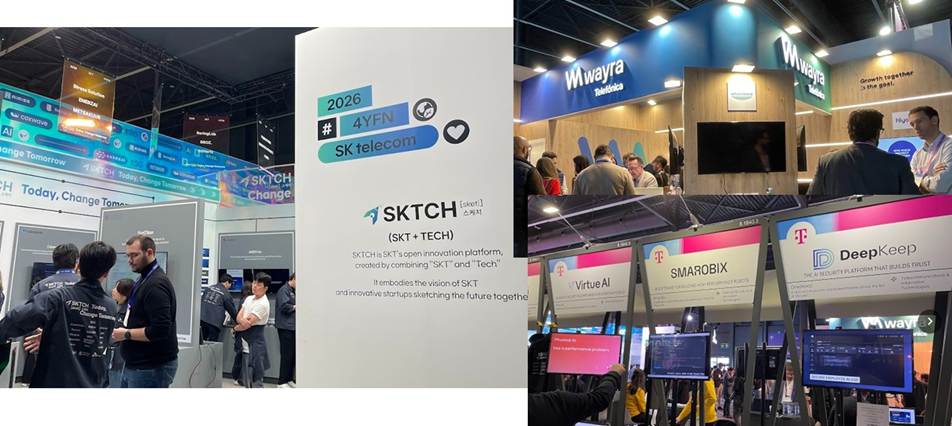
This year, telco presence in the 4YFN (‘four years from now’) start-up and innovation space seemed lower than in previous years. We spotted just five telco stands showcasing the offerings of associated start-ups: Korean operators KT and SKT (with a wholly AI-focused series of start-up propositions), Swisscom Venture Lab, Deutsche Telekom’s Hubraum and Telefónica’s Wayra.
Figure 1: Three of the five telco participants in the 4YFN zone
Source: STL Partners
Progress of promising telco collaborations
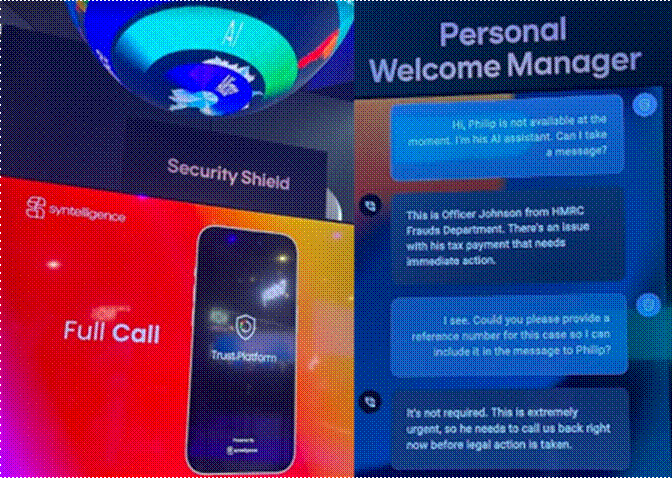
The Global Telco AI Alliance – announced at MWC 2024 – once promised collaborative innovation towards a universal telco LLM and even a global personal AI assistant. Collaboration was intended to enable better telco AI outcomes and the opportunity for scale in telco AI propositions. However, its associated joint venture Syntelligence showcased a reduced remit at MWC 2026: that of a “Trust Platform Provider”.
Syntelligence propositions demonstrated in Barcelona included Welcome Manager (a voice assistant) and Security Shield (scam call protection). These are AI-based services targeted at telcos who have not developed such propositions themselves.
Figure 2: Syntelligence: A trust platform
Source: STL Partners
Aduna, the telco joint venture intended to enable a one-stop-shop for developers to leverage unified telco network API propositions, did not have a stand at MWC this year. Despite this, there was activity behind closed doors and work is being done to share learnings and success stories for the purpose of extending market coverage and driving engagement with demand-side players (i.e. the developer audience).
Examples of collaborative value creation
Examples of telcos creating value in a more open, multi-party ecosystem were limited.
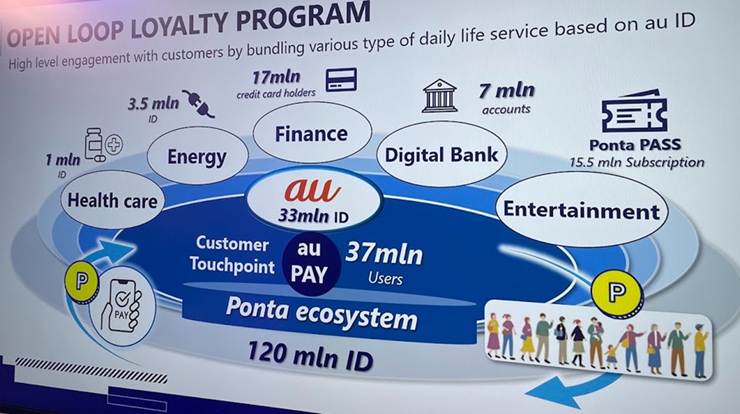
- KDDI showcased its multi-partner au loyalty management programme, hoping to offer loyalty management services to other telcos.
Figure 3: KDDI’s loyalty solution
Source: STL Partners
It is currently supporting Mobicom Mongolia in shifting its customer base to postpaid subscriptions, before introducing loyalty services. The key ingredient for KDDI’s loyalty programme has been its payment system auPay, which strengthens the collaboration proposition for partners.
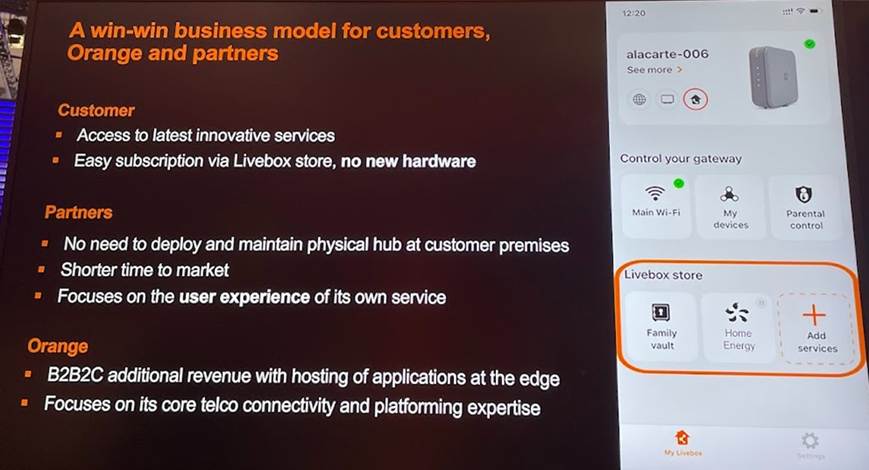
- Orange’s Livebox Store is another example of a multi-partner value-added service for customers. Orange is expanding its home router capability beyond connectivity to host third-party services.
Figure 4: Orange Livebox Store
Source: STL Partners
Third-party applications can be installed on the router, and customers can use Orange’s app to obtain and/or manage the service (a Bitdefender VPN service was launched in Morocco in late February 2026). However, the partner is not “integrated” into Orange – the partner keeps the customer relationship (they can choose how to interact with them, via Orange or not). The vision is for Livebox to host smart home (and other) applications, eliminating the need for customers to install multiple orchestration devices (hubs) in the home.
Key takeaways
Based on our experience at MWC, telcos, with a few exceptions, appear to be struggling to innovate in a more open fashion. Most telco innovation initiatives depend on bringing together a finite number of strategic partners (or acquisition targets). Few are seeking ways to bring new value to customers by partnering more loosely and broadly, in a manner that has been so successful for techcos such as Amazon or Salesforce.
Inter-telco collaboration on AI (or lack of it) may have been impacted by differences in AI ambitions, pace and progress between telco participants. Different in-market regulatory environments may also have played a part. These differences will continue to be factors that oppose the type of collaboration telcos were calling for at MWC 2026 (e.g. AI safety and regulation).
Telcos need to realistically appraise their capacity and willingness to work with others if they are to have influence as an industry and support innovation in this way.
Do you want to know more about our research in this area?

Connected Britain 2026: Take aways for telco leaders
While telcos continue to criss-cross the country with connectivity, the industry gets a reminder of its national purpose – and why it needs to focus on the quality of its connections.
From showcase to shelf: MWC Shanghai highlights how Chinese telcos monetise AI
three demos from China’s telcos at MWC Shanghai 2026 illustrate the different ways telcos are trying to build businesses around AI.
Takeaways from Infosecurity Europe 2026
In early June 2026, Infosecurity Europe once again brought together many companies and experts to explore the latest trends in the increasingly complex cybersecurity landscape. Here are our takeaways.
Connected Britain 2026: Take aways for telco leaders
While telcos continue to criss-cross the country with connectivity, the industry gets a reminder of its national purpose – and why it needs to focus on the quality of its connections.
From showcase to shelf: MWC Shanghai highlights how Chinese telcos monetise AI
three demos from China’s telcos at MWC Shanghai 2026 illustrate the different ways telcos are trying to build businesses around AI.
Are collaborative telco innovation efforts flagging?
Mobile World Congress provides an opportunity for telcos to promote collaborative initiatives. In 2026, we heard calls for telco collaboration in AI safety and governance, the regulation of the wid…