
Download
Listen


NaaS is one of the platform models telcos are best placed to pursue, building on network assets and capabilities they already control. But STL Partners’ Telco-as-a-platform Index shows that strong service architecture is only one part of a successful platform model: revenue and ecosystem execution lag significantly behind. NaaS offers a useful lens into what telcos still need to get right to build platforms that scale.
Telcos have a stronger right to play in platforms close to the core
Telcos are increasingly looking to platform models as they search for new sources of enterprise growth and respond to customers’ expectations for more flexible, on-demand services. The resulting platform-based services can take many forms, from connectivity and cloud platforms to IoT, AI and vertical-specific propositions, but they share a common shift away from bespoke, manually delivered services towards capabilities that are more modular, software-led and reusable.
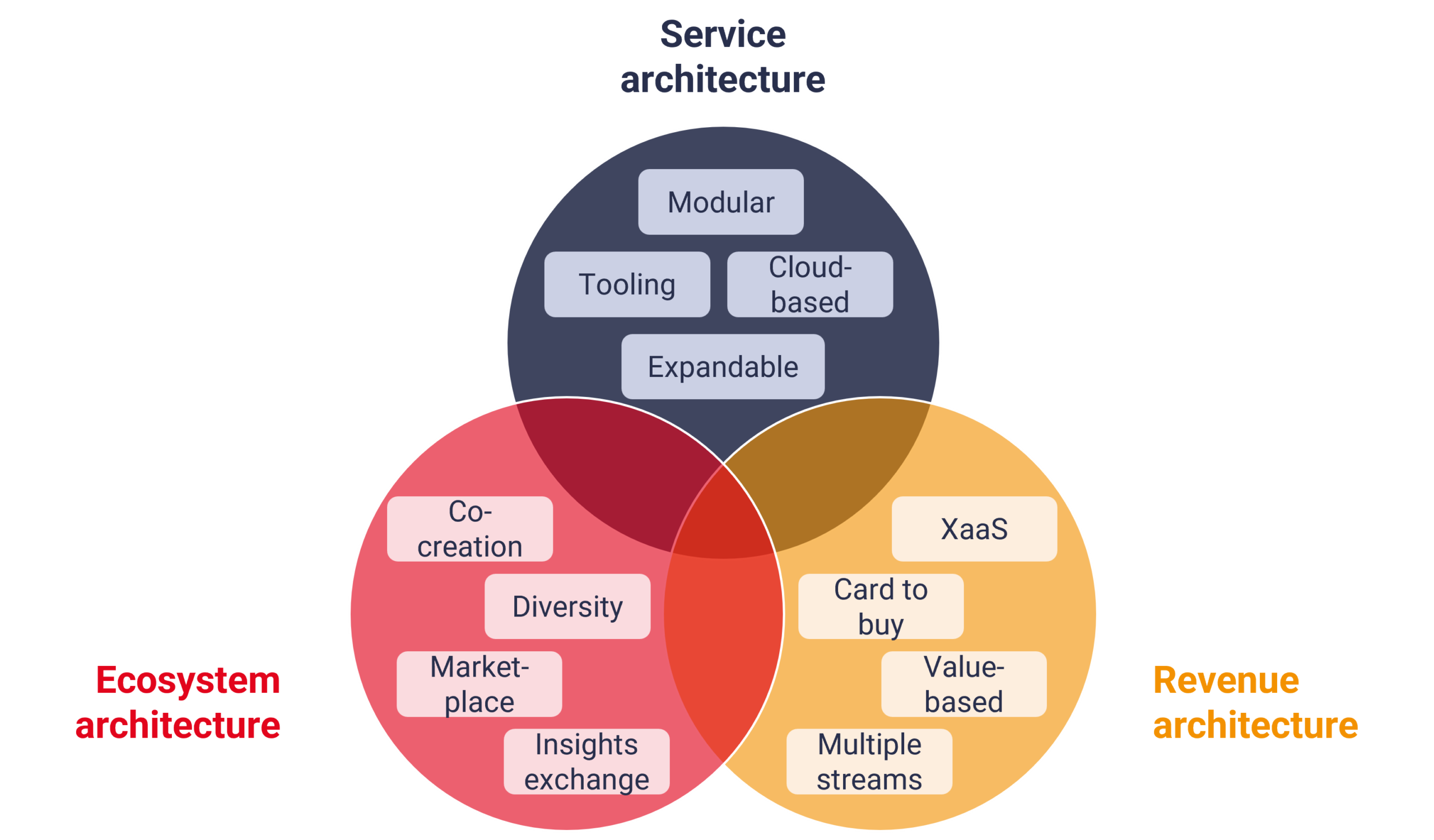
Too often, telcos focus on the technical side of platformisation: making services more modular, open and software-led. In STL Partners’ view, a successful platform model needs to extend across three interconnected pillars: service architecture, covering how capabilities are modularised and delivered; revenue architecture, covering how they are bought and monetised; and ecosystem architecture, covering how partners help extend and create value around the platform. Together, these three pillars determine whether a platform is not just technically enabled, but commercially scalable.
Three structural pillars of a successful platform strategy
Source: Applying the platform mindset: STL Partners’ enterprise manifesto
STL Partners’ telco as a platform index (TaaP) assesses how effectively operators are putting these principles into practice. We evaluated 70 unique enterprise platforms across 22 telcos, scoring their execution across each of these three pillars. One of the index’s key findings is that platform performance is strongest at either end of the spectrum: platforms closest to the connectivity core and those furthest from it tend to outscore those in the middle.
Close-to-core platforms such as NaaS, cloud interconnect, IoT connectivity and cloud communications as a service are among the stronger performers. This partly reflects the advantages telcos already have to build on, including physical and virtual network infrastructure, established customer relationships and service assurance capabilities. NaaS is therefore one of the platform models operators are particularly well placed to pursue — and provides a useful lens for examining how far telcos have progressed beyond the technical foundations of platformisation.
A NaaS platform in the full telco-as-a-platform sense is not achieved simply by making connectivity modular, self-service and dynamically configurable. Those capabilities also need to be matched by flexible commercial models and an ecosystem that can extend the platform’s reach and value. The rest of this article uses NaaS to explore where operators are already executing well, where the gaps remain, and what stronger revenue and ecosystem architecture can look like in practice.
Service architecture is a strong point for telcos
Operator platforms tend to score well on service architecture, and the index reflects that pattern. Among the NaaS platforms covered are Singtel Paragon, Verizon Network as a Service and Telstra InfraCo – all examples of telco platform offerings with relatively mature service architectures.
- Singtel Paragon is perhaps the clearest example of what a strong platform service architecture looks like in practice. It gives enterprises a single platform through which to manage 5G network capabilities, multi-access edge computing resources and applications, reducing the complexity of managing them separately. Network slices can be created on demand and almost instantly, while applications can be deployed across Singtel MEC and public-cloud environments through the same orchestration layer.
- Verizon Network as a Service integrates connectivity and network services within a programmable, virtualised environment extending from the core to the edge. The platform brings together capabilities including SD-WAN, SD-LAN and SASE, with service management supported by automation, orchestration, APIs and closed-loop assurance. Its service model applies cloud-like principles to deliver, with scalable, on-demand provisioning through a programmable environment.
- Telstra InfraCo comes at it from the asset side. Created to manage and commercialise much of Telstra’s fixed infrastructure estate—including fibre, ducts, exchanges and data centres—it has built a digital layer over those assets. APIs support processes from quoting and ordering through to service management across a growing range of wholesale products, are exposed through the Telstra Developer Portal and are aligned with TM Forum standards where appropriate. InfraCo describes these APIs as the building blocks of Telstra’s emerging Network-as-a-Product model, turning traditionally static infrastructure into something increasingly programmable and easier for customers to integrate into their own systems.
What these three examples show is that operators are becoming increasingly adept at modularising network capabilities and making them programmable. Capabilities that were traditionally closely tied to physical infrastructure and static service configurations can increasingly be exposed as reusable service components, making them easier to provision, combine, automate and consume independently. In other words, telcos are becoming more mature in building the service architectures needed to support a platform strategy.
What telcos are still missing
Improvements in service architecture are not confined to a handful of operators. Telcos globally are investing heavily in the technical foundations needed to expose and automate network capabilities. Our TaaP index shows the effort paying off: most platforms score well on service architecture, scoring on average 91 out of 100. However, the other two pillars lag considerably behind, with revenue architecture averaging 53 and ecosystem architecture 52.
For NaaS platforms, this gap indicates that telcos are less advanced in how new technical capabilities are monetised and opened up to third parties. Weaker revenue architecture means that pricing and commercial models often remain closer to traditional connectivity models than to more flexible, consumption-based or outcome-based approaches. Weaker ecosystem architecture, meanwhile, suggests that NaaS platforms remain relatively limited in their ability to support third-party participation, expose capabilities through developer-friendly interfaces, and enable partners to build, combine or sell services on top of the network.
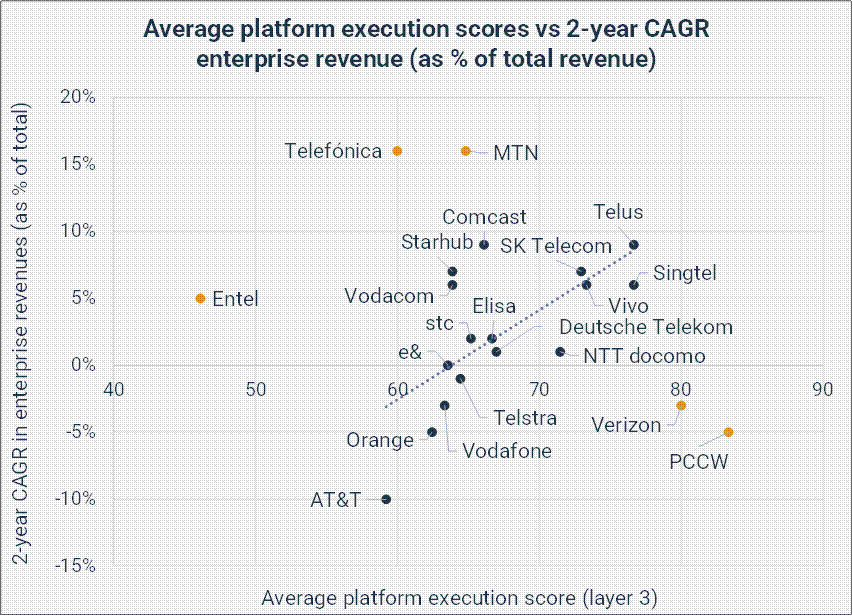
Compared with the scale of investment already committed to the network and technical service architecture, building out the other two pillars is typically less capital-intensive, but no less critical to platform success. Yet they have often received less attention or been addressed later in the journey. This is particularly striking because many of the forces pushing operators towards platforms are commercial: customers want greater flexibility in how they buy and consume services, while achieving scale increasingly depends on partners and routes to market beyond the telco’s direct channels. The Index finds a directional correlation between stronger platform execution and enterprise revenue growth, reinforcing the importance of addressing all three pillars.
Source: STL Partner’s Telco as a platform index
Building revenue architecture, the Orange way
The first gap is revenue architecture: turning a technically flexible service into a commercially flexible one. This is what allows a platform to monetise its capabilities effectively. Flexible per-unit pricing, outcome-based models, lower-friction purchasing and the ability to scale consumption without renegotiating traditional contracts can all make the platform easier to adopt.
Orange Business’s Evolution Platform shows what that looks like in practice. It is a cloud-native, self-service platform for enterprise connectivity, cybersecurity and cloud infrastructure, built around a central console and APIs that let customers compose, deploy, monitor and adjust services on demand, rather than buying them through a traditional sales cycle. The platform launched in August 2022, and by 2025 had signed 427 enterprise customers. It runs on an IaaS-style commercial model with clear usage-based pricing and a degree of dynamic pricing on top; the mechanics are not fully transparent externally, but pricing and provisioning are both self-serve and requested through an API.
Evolution Platform’s commercial architecture has become a key part of the proposition itself, supporting enterprise adoption by reducing purchasing friction and making it easier for customers to scale their consumption over time.
Building ecosystem architecture, the Telefonica way
The second gap is ecosystem architecture, which enables how partners participate in creating, extending and distributing value around the platform. A true platform is a rejection of the traditional, linear supply model, where inputs are simply bought in from a selected vendor. It also differs from a conventional partnership, where collaboration is bespoke and closed. A true platform ecosystem instead is built for multiple third parties to collaborate freely, enabled by shared tools and processes rather than one-off agreements.
Telefónica’s Kernel platform shows this logic applied to external network APIs. Kernel is Telefónica’s API and data platform, built around security, privacy and user consent, and it underpins the company’s Open Gateway capabilities across its footprint. Telefónica has developed a portfolio of 11 Open Gateway APIs, several of which are commercially available in its operating markets.
Kernel is already supporting live enterprise use cases rather than only pilots. Brazilian bank Itaú uses a SIM Swap API to help prevent fraud during transaction validation, logistics platform Frete.com uses a KYC API to verify drivers at registration, and Vinted uses a Number Verification API to improve account security. These are individually narrow use cases, but together they show Telefónica’s Open Gateway capabilities operating in live production environments rather than only in developer sandboxes or trials.
What sets Kernel apart is the breadth of its ecosystem. Telefónica works with aggregators such as Twilio and Vonage to broaden commercial reach, and with integrators such as Deloitte and NTT Data to support enterprise deployments. It also works with cloud providers such as Microsoft Azure to improve developer access – a relationship that has since deepened into migrating Kernel to a SaaS product on Azure, alongside a joint go-to-market strategy to sell Kernel-based solutions to operators across the sector. That last move takes Telefónica beyond exposing network APIs on its own networks and positions it as a supplier of the underlying platform technology to its peers.
What this means for operators
A successful platform model requires more than strong service architecture. Operators need to combine technical flexibility with commercial models that make services easy to consume and scale, and ecosystems that allow partners to extend the platform’s reach and value. Orange and Telefónica illustrate what stronger execution across these two pillars can look like, while the Index suggests ecosystem strength becomes an increasingly important differentiator among the most mature platform players.
The lesson extends beyond NaaS. Whatever the platform, service architecture alone does not determine whether it scales; it has to be combined with effective revenue and ecosystem architectures. NaaS makes this especially visible because operators already control much of the underlying infrastructure and have a clear right to play. Where those technical foundations are already in place, the next challenge is to make services easier to buy, monetise and extend through partners. That is where the next phase of NaaS platform execution needs to focus.
For a detailed view of how operators are progressing across service, revenue and ecosystem architecture, see the Telco as a platform index, which benchmarks platform maturity across all three pillars. You can find it here.

Selling the ingredient vs baking the cake
Should telcos simply supply the network API ingredients, or move further up the value chain and bake the cake themselves? We explore four different roles operators can play, from wholesale API supp…

How should telcos price network APIs? A practical framework for driving adoption
Pricing remains one of the toughest questions in network API commercialisation. Different APIs, use cases and markets require different approaches, and setting prices too high can restrict adoption…

API-driven Silent Authentication: why telcos can’t afford to move slowly
Authentication is becoming a growing pain point for digital businesses. Customers increasingly expect fast, seamless digital journeys, while organisations face pressure to strengthen fraud controls…
Selling the ingredient vs baking the cake
Should telcos simply supply the network API ingredients, or move further up the value chain and bake the cake themselves? We explore four different roles operators can play, from wholesale API supp…
How should telcos price network APIs? A practical framework for driving adoption
Pricing remains one of the toughest questions in network API commercialisation. Different APIs, use cases and markets require different approaches, and setting prices too high can restrict adoption…

Winning at NaaS: the platform challenge goes beyond technology
NaaS is one of the platform models telcos are best placed to pursue, building on network assets and capabilities they already control. But STL Partners’ Telco-as-a-platform Index shows that strong service architecture is only one part of a successful platform model: revenue and ecosystem execution lag significantly behind. NaaS offers a useful lens into what telcos still need to get right to build platforms that scale.