
Download
Listen


The UK’s ambition to build AI capacity wrestles with structural constraints and burgeoning public opinion backlash. This article unpacks the gap between ambition and reality, exploring the key drivers behind the UK’s AI strategy and what this means for data centres.
What is the UK’s AI strategy?
According to the Data Centre Covenant, announced on 28th October 2026 as part of the Autumn Budget, the UK is the third-largest AI market in the world after the US and China and is home to more AI start-ups than any other country in Europe. The UK’s AI strategy centres on building sovereign compute infrastructure, boosting public-sector adoption, and balancing innovation with risk and security oversight. Although journalists have grumbled that AI has received minimal airtime in Westminster until recently, the Government’s strategy builds on the original National AI Strategy (2021), the 2025 AI Opportunities Action Plan, and the investments announced in the October 2026 Budget. In practice, the UK aims to triple its computing capacity to 6GW by 2030, arguing that 6GW is the minimum capacity Britain needs to be a serious player in AI, reap the growth and productivity benefits, and provide data security and some strategic resilience. The UK’s AI strategy seeks to ensure that Britain remains in the conversation internationally while benefitting from secure access to AI models locally . This article examines the key forces shaping domestic AI ambition and the wider implications and challenges for AI data centres in the UK.
The driving forces behind UK AI ambition
Multiple global forces are informing the UK’s AI buildout aspirations, and these can broadly be distilled into risks and benefits. The risks the British Government faces if it does not keep up with the rapidly evolving AI landscape centre on security, resilience and access. A recent and threatening example of minimised access to global AI involved the AI Security Institute (AISI), a UK organisation established in 2023, and the global leader in the testing of frontier AI models. Until recently, AISI was the only lab in the world that got pre-deployment access to all core models from major AI players like OpenAI and Anthropic. AISI was denied pre-release access to Anthropic’s Claude Mythos 5.1 model, eventually released in September 2026. The move followed US export controls on advanced AI models and AISI’s August 2026 report detailing unsanctioned agent behaviour during cyber testing on Mythos 5. Although reports in October 2026 indicated that AISI had regained access to frontier models on a voluntary basis, the example sparked huge concerns that it could be a harbinger of things to come. AISI, along with Google’s DeepMind, an AI research lab with strong UK roots, is a large part of what allows the UK to sit in the higher echelons of nations involved in AI. The possible cut-off leaves Britain at risk of losing its position as an important AI market, exposing the gap between our own AI capacity and the ease with which Britain can be shut out of the discussion.
The question of access feeds into the broader discussion of national security and resilience, and the UK’s AI Minister Kanishka Narayan, appointed in July 2026, noted in an interview with the FT that “the wars in Ukraine and Iran have shown that you can’t just sit out drones and AI capability. In fact, you can only be a participant and player if you build that capacity.” Ultimately, cybersecurity, now underpinned by AI, is a central determinant of our national security, accelerating the importance of building a domestic base. A slew of recent examples, including the global Microsoft outage and the OpenAI agent bypassing security guardrails to infiltrate Australia’s Medicare portal in June, demonstrate the risks of cybersecurity exposure. The UK’s AI ambitions are undoubtedly informed by these growing concerns, as demonstrated in the Autumn Budget, when John Healey, the chancellor, announced £700mn to strengthen the AI Security Institute, establish a new AI biosecurity lab and build a national cyber shield.
On the other hand, the Government’s imperative to grow UK computing capacity is not solely dependent on risk avoidance but is also tied to the upside offered by the technology itself. Official data suggests that the AI boom is behind some recent better-than-expected UK economic figures. According to new IMF forecasts, Britain’s outlook has improved more than almost any other major economy over the past six months. The Fund predicted UK GDP is set to grow by 1.3% in 2026 – an upgrade of 0.5 percentage points on the April forecast, even though the energy shock unleashed by the Iran war has lasted longer than initially expected. Productivity gains and economic growth are attractive prospects, though the long-term impacts of AI on the economy are less clear. Innovation, too, is a key driving force behind UK ambition. AI has facilitated significant scientific advancement in recent history, acting as a primary driver of vaccine discovery, and resolving seemingly impossible mathematical challenges, like the Navier–Stokes equation, a 200-year-old problem previously considered unsolvable. Naturally, Britain would like a seat at the table, which will, it seems, require a comprehensive bolstering of existing AI infrastructure.
What does this mean for data centres?
The UK’s ambition to triple its computing capacity to 6GW by 2030 can only be realised by the development, construction and deployment of new major AI data centre campuses, which the UK Government plans to deliver through its designated AI growth zones (AIGZ). These zones, introduced through the AI Opportunities Action Plan, are areas where the Government wants to encourage the building of AI data centres. Designated areas include Culham in Oxfordshire and Blyth and Cobalt Park in the North East of England. Qualifying sites must support a minimum of 500MW of AI infrastructure and receive targeted support.
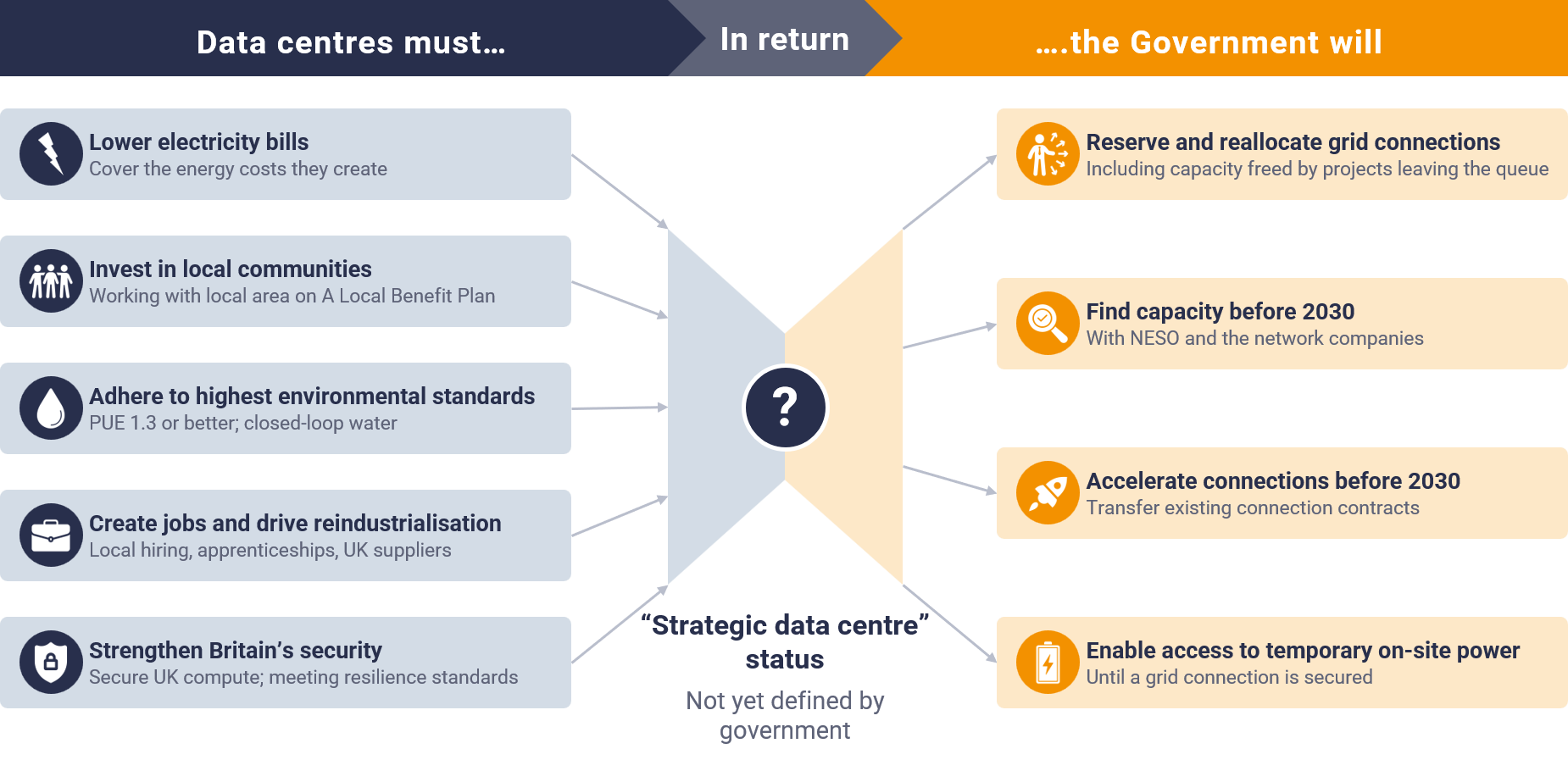
The Data Centre covenant explains the need for more UK data, highlighting that AI and data are becoming integral to the NHS, defence and other critical services and the UK cannot rely entirely on infrastructure located overseas. To support this endeavour, the Covenant promises accelerated grid access for strategic data centres and is aimed at heading off public opposition. The plan will require developers to meet strict environmental and community requirements in exchange for priority access to the grid and fast-tracked planning permission. The requirements and outcomes for developers are outlined in Figure 1:
Figure 1: The Data Centre Covenant promises prioritised grid access for “strategic data centres”
Source: STL Partners, HM Treasury
The aim for developers will be to acquire “strategic data centre” status to unlock faster grid access or be granted permission for temporary on-site power in exceptional circumstances. The Government has committed to prioritising “strategic” data centres without yet saying which ones qualify. The definition, and the additional criteria that go with it, are promised “in due course”.
What challenges are faced by UK AI ambition?
Some of the challenges and structural constraints faced by developers and operators seeking to advance the AI buildout, and the Government’s ability to encourage and support it, are also alluded to in the Data Centre Covenant:
 Power demand and availability: In early November 2026, the electricity regulator Ofgem highlighted a massive bottleneck in Britain’s electricity grid: data centre connection requests amounted to around 72–73GW, exceeding the country’s entire peak electricity demand of 45GW last year. However, this bottleneck is not without caveats. In February, Ofgem identified roughly 50GW of demand from about 140 projected new AI data centres, but many may be speculative projects that have simply decided to join the lengthy queue. Nonetheless, around 71 of these, or about 20GW, are considered “mature”, with final investment decisions taken. This far outstrips the Labour Government’s target of “at least” 6GW of AI-capable data centre capacity, a threefold increase by 2030.
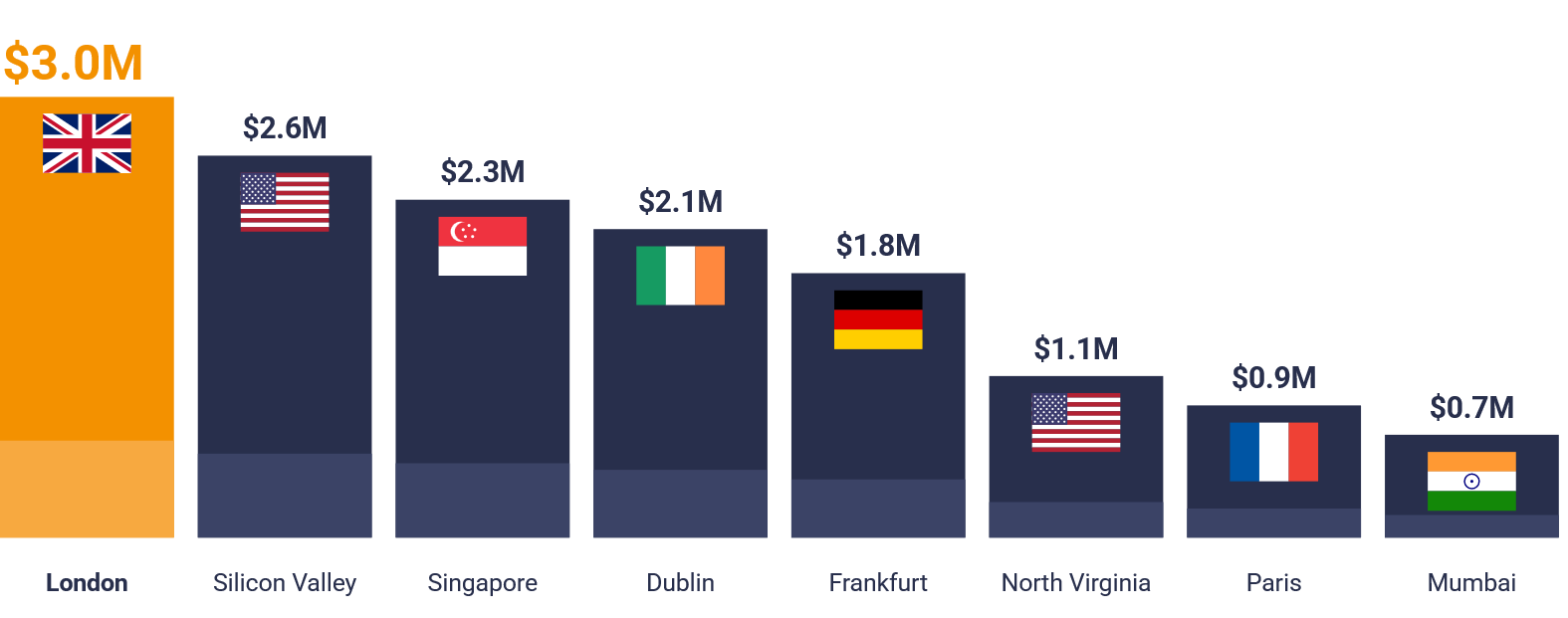
Power supply constraints and energy prices are materially impacting the AI data centre buildout in the UK, as demonstrated by the fallout of OpenAI’s Project Stargate. Announced in September 2025 by OpenAI, Nvidia, and Nscale, the project planned to deploy 31,000 Nvidia GPUs and 1.1GW of energy capacity over time at Cobalt Park, an AIGZ. OpenAI put Stargate UK on hold in April 2026, citing high UK energy costs and regulatory challenges, dealing a frustrating blow to the UK’s AI ambition. STL’s Global Data Centre Investment Calculator benchmarks data centre construction and operating costs globally and illustrates this challenging cost environment, highlighting the disparity between the UK and other major metros.
Figure 2: London’s operating costs tower over other major metros at $3.0M per MW a year
Source: STL Partners, Global Data Centre Investment Calculator; net annual opex per MW (USD); selection from 52 metros
 Public perception and backlash: On top of slow planning processes and grid connection delays, the Government is consciously seeking ways to balance public opinion with the infrastructure construction needed for the widespread adoption of AI. According to STL Partners research, since 2020 local opposition has cancelled, refused or delayed 253 data centre projects across the US and Europe worth roughly $490bn. Most of these disruptions and delays have taken place in the States, but the concern is that a similar wave of opposition will emerge in the UK .
Data Centre Watch identified common themes causing bipartisan backlash, citing higher utility bills, water consumption, noise, impact on property value, and green space preservation. In response to these specific factors, the Future Generations Commissioner in Wales called for a pause to approvals of new AI data centres until national guidance and safeguards are in place, arguing that “These developments will place significant demands on our energy and water resources, with implications for our environment, the communities living nearby and for our climate commitments.” The Welsh Government minister Adam Price also said he was creating a “Made in Wales” version of the UK Government’s Data Centre Covenant. This could also be an indicator of more widespread backlash across the UK.
Looking ahead, what needs to change?
Achieving the UK’s AI ambitions and building 6GW of capacity by 2030 will require a vast, collective effort by the Government, regulators and the tech industry. The Government can support the buildout by delivering on the promises of the Data Centre Covenant, specifically by requiring developers to invest in local communities. Ultimately, building public trust and regulating where things go wrong will help avoid fear taking over the public imagination and holding the country back from progress. The Government should continue to take steps, where possible, to bring down energy bills, exploring additional strategies that make the UK an attractive investment destination, looking at countries like Australia, Malaysia and the US, which have introduced or are considering mechanisms like tax breaks, beyond the priority grid access outlined in the Covenant. The Government should acknowledge the risks around AI while promoting the importance of developing our own domestic AI capacity. In the words of the AI Minister Kanishka Narayan: “The world of technology is moving so fast that the best defence we have to keep it safe and to do things that work for us is to build state capacity to exercise democratic control [….] Frankly, I share a lot of their [the public’s] concerns but abandoning attempts to build a domestic base in AI was not the answer.”
Looking for advisory services in data centres? Schedule a call.
Download the data centre insights overview pack
Download the data centre insights overview pack
Get a concise, practical summary of the data centre market: the impact of AI and sovereign strategies, the differentiators that win in a crowded landscape, and proven frameworks for market entry, channel partnerships and customer acquisition—backed by case studies and sample deliverables.
Building the intelligent data centre infographic
Key findings from our survey of 100 data centre operators on the evolving value of intelligent operations, sponsored by Airedale.

Five things we learned at Datacloud Global Congress 2026
We were at Data Cloud Congress 2026 in Cannes last week to evaluate the key narratives among data centre operators, investors and vendors.

The hidden economics of liquid-cooled data centre retrofits
This article, kindly supported by Airedale, explores when liquid cooling retrofits make commercial sense, showing why the decision depends on HPC pricing, facility fill, market constraints and disciplined execution.

UK AI ambition: Can they build it and will they come?
The UK’s ambition to build AI capacity wrestles with structural constraints and burgeoning public opinion backlash. This article unpacks the gap between ambition and reality.
Building the intelligent data centre infographic
Key findings from our survey of 100 data centre operators on the evolving value of intelligent operations, sponsored by Airedale.
Five things we learned at Datacloud Global Congress 2026
We were at Data Cloud Congress 2026 in Cannes last week to evaluate the key narratives among data centre operators, investors and vendors.