
Download
Listen

Should telcos simply supply the network API ingredients, or move further up the value chain and bake the cake themselves? We explore four different roles operators can play, from wholesale API supply to finished solutions, and what it takes to create – and capture – more value at each layer.
Introduction
Network API monetisation will require a multi-channel go-to-market. Operators can reach developers and enterprises through aggregators and other channel partners, sell directly, or build propositions around the APIs themselves.
But these are not simply different sales channels. They also represent different roles that telcos and other ecosystem players can play in turning network capabilities into something customers value.
We have used a few different analogies at STL Partners to describe these roles over the years. One that has increasingly stuck is a simple one: think of network APIs as ingredients.
The network API bakery: ready, set, bake?
Imagine the network as the source of a set of ingredients. An operator can simply supply those ingredients to somebody else; it can package and distribute them to make them easier to buy and use; it can start combining them into “cake mix” around a particular customer need; or it can go further still and bake the finished cake.
The network API bakery: four ways to create value from the same ingredients
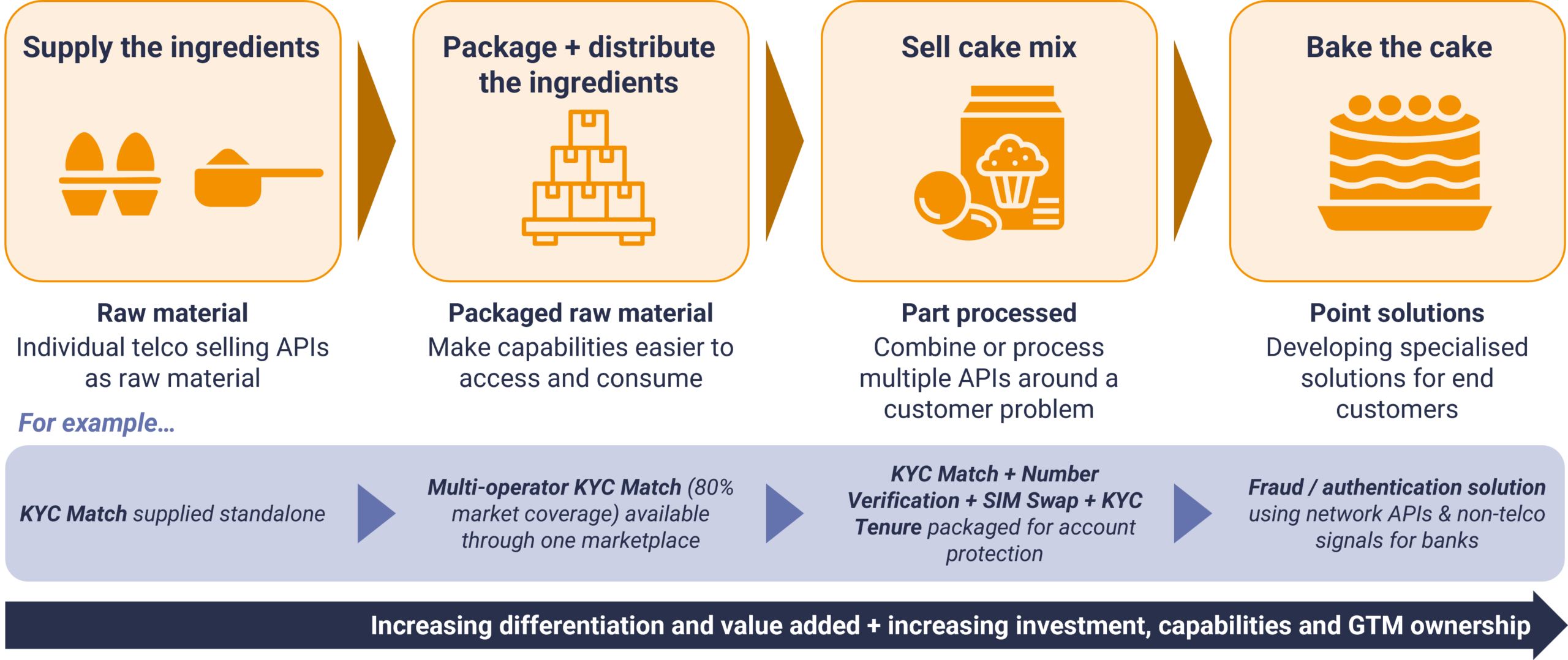
Source: STL Partners
Moving from left to right offers greater scope for differentiation and potentially a greater share of the value created. But it also requires more investment, stronger commercial and product capabilities, and a clearer right to play. Not every operator will want – or be well placed – to do all four.
Importantly, this is not a maturity curve. Moving further right is not inherently better. The same network capability could ultimately be monetised through several of these models at the same time.
1. Supply the ingredients
The simplest role is to make the underlying network capability available and let someone else decide what to do with it. The operator supplies the network API – Number Verification, SIM Swap or KYC Match, for example – and an aggregator, or other channel partner decides how to use it within its own proposition.
There is real value and money to be captured at this layer alone. Success is less about differentiation through the proposition and more about getting the fundamentals right: exposing high-quality APIs reliably, automating onboarding and delivery, keeping the cost to serve low, and distributing through partners that can generate meaningful volume. As standalone APIs become more standardised, the ability to provide them consistently and cost-effectively at scale becomes particularly important.
For some operators, this may be the right place to focus. Not every telco will have the appetite to invest heavily in direct sales, vertical expertise or solution development, and a well-executed wholesale model can still provide an attractive route to monetisation. The barriers to participating are also beginning to fall, with API enablement platforms increasingly offering more flexible commercial models, including revenue-share arrangements, that reduce the upfront investment required from operators.
Wholesale should therefore not be viewed merely as the first step towards a supposedly more sophisticated model. Being a reliable, cost-efficient supplier of valuable network ingredients can be a viable business in its own right — particularly for operators that want to participate in the opportunity without building a much larger network API business around it.
2. Package and distribute the ingredients
There is, however, another layer of value that can be created without fundamentally changing the ingredient. There is another layer of value that can be created without fundamentally changing the ingredient. The shift here is from simply supplying an API through somebody else’s channel to taking greater responsibility for how customers discover, buy and consume it.
This could take a couple of different forms including:
- Aggregate supply: Bring together APIs from multiple operators to provide the coverage customers need.
- Build routes to market and improve discovery: Move beyond relying solely on third-party aggregators by developing direct channels, marketplaces or catalogues where customers can discover and procure APIs.
- Simplify consumption: Reduce friction through common interfaces, onboarding, contracting, billing, sandboxes and developer tooling.
Aggregation is perhaps the clearest example. Customers rarely want to negotiate and integrate separately with every operator they need to reach, so there is value in solving that fragmentation. At a global and regional level, this is what players like Aduna, Bridge Alliance (BAEx) and Proximus Global are doing. At a domestic level, this follows a country federation model such as in Sri Lanka where operators have federated APIs to provide access across all four mobile networks.
But aggregation is only one version of this role. By building more direct routes to market, operators can also take on more of the customer education, awareness-building and demand generation that would otherwise sit with an aggregator or solution provider.
Playing this role is more demanding. Aggregation requires coordination across operators on coverage, technical implementation and commercial models, while building direct channels requires stronger product marketing, demand generation and sales capabilities – often some of the hardest capabilities for telcos to build. But there is a clear prize: operators can capture more of the value currently taken by intermediaries while staying closer to the customers and demand they ultimately serve.
3. Sell cake mix
The next role goes further: rather than simply making individual APIs easier to access and consume, operators start combining or processing network capabilities around a defined customer problem. The customer is buying something closer to an outcome, even if they still own or build the finished solution.
Take identity as an example. Number Verification, SIM Swap and KYC Match could each be sold independently, or packaged together around account protection or onboarding. The customer still builds the finished service, but much more of the ‘recipe’ has already been worked out.
This could take several forms:
- Combine capabilities into a bundle: Bundle complementary network APIs — or network APIs with proprietary / third-party capabilities — into a more complete proposition.
- Derive a higher-value output: Combine or process underlying signals to provide a score, alert, recommendation or decision rather than returning each raw input separately.
- Package around a customer need: Design the proposition around a specific use case or vertical, such as Mobile Network Verification, account protection or fraud prevention for financial services.
The value of this layer is that the recipe starts to become part of the product. Customers no longer need to understand every individual network capability or work out how they fit together; some of that product design and integration has already been done for them. This can reduce adoption friction and create greater differentiation than selling the same APIs individually.
Orange is already moving in this direction. Its Telco-grade risk signals for e-commerce payments solution combines Number Verification, SIM Swap, KYC Tenure and Device Reachability Status around a specific fraud use case, giving merchants network signals they can feed into their existing risk engine to help decide whether to allow, step up, review or block an action. The customer still owns the final fraud decisioning, but Orange has done much of the recipe design upfront.
Its Account Protection proposition brings together network APIs such as Number Verification and SIM Swap around the problem of securing login, password reset and account recovery journeys, rather than asking customers to start with the underlying API catalogue.
But simply bundling several APIs together is not enough. The combination needs to solve a meaningful part of the customer problem or make the capabilities materially easier to consume. Otherwise, it is just several ingredients in the same box.
4. Bake the cake
At the furthest end of the value chain, the network API effectively disappears from the proposition. The customer is no longer buying a SIM Swap, Location or Quality on Demand API; they are buying a fraud-prevention solution, a healthcare service, an industrial application or another finished product in which network capabilities are simply one of the underlying components.
The attraction for operators is clear. Rather than supplying one input into somebody else’s proposition, they have the opportunity to capture more of the value created, build greater differentiation and potentially own more of the end-customer relationship. But this is also where moving up the value chain becomes considerably harder. Owning the ingredients does not automatically mean you are best placed to bake the cake.
What does it take to bake the cake?
First, operators need to understand the customer problem, not just the network capability. Knowing that location or identity data is valuable is very different from understanding how that data needs to be combined with other capabilities to solve a specific problem for a bank, manufacturer or healthcare provider.
That also requires a different set of capabilities. Operators may need deeper vertical expertise, product development and orchestration capabilities, solution selling, implementation and ongoing service ownership. Existing customer relationships and brand permission matter too: in many markets, specialist technology providers may already understand the buyer and sit much closer to the relevant workflow.
Those capabilities will not be equally strong in every market or use case. Identity and fraud illustrate the challenge. Telco data can provide valuable signals, but sophisticated solutions combine these with behavioural, device, transaction and other (non-telco sourced) identity data – and specialist providers may already sit much closer to the buyer and workflow. For many operators, supplying differentiated network intelligence into those platforms may therefore make more sense than trying to recreate the entire fraud stack themselves.
The opportunity to bake the cake may instead be strongest where the operator already has a genuine right to win: established enterprise relationships, vertical expertise or an existing solution portfolio into which network capabilities can be embedded. TELUS Health in healthcare or Elisa’s industrial businesses illustrate the kind of customer position and domain capability that could make this model more credible.
Operators also do not necessarily need to develop every missing capability themselves. Partnerships with specialist technology providers can provide another route further up the stack, combining the operator’s network assets and customer reach with capabilities that would be costly or slow to build internally.
Ultimately, telcos need to earn the right to bake the cake. Moving into finished solutions only makes sense where the additional customer value and revenue opportunity justify the extra investment, complexity and competitive challenge.
Telcos do not need to choose just one role
These are not four stages that every operator should move through in sequence. Different roles will make sense for different APIs, customers and operators — and the same capability may ultimately be monetised through several of them at once.
This distinction became particularly apparent in conversations at a recent event earlier this year. When we discussed the opportunity for telcos to go beyond supplying ingredients and start baking the cake, some channel partners pushed back: give us the ingredients – we want to bake the cake.
And in many cases, they may be right. For an identity platform, CPaaS provider or global technology company, the telco may create the most value by supplying consistent, high-quality ingredients that the partner can combine with its own capabilities and distribute across a much larger customer base.
But that does not mean operators should confine themselves permanently to the bottom of the stack either.
Different customers will want different things. A sophisticated global platform may want a raw API. Another customer may want several network signals already packaged around an outcome. A domestic enterprise with an established telco relationship may prefer to buy the complete managed solution.
The strategic answer is therefore not to pick one box in the framework. Supplying the ingredients should remain table stakes, while operators selectively build further up the value chain where they have a genuine reason to do so.
Moving up the stack should create additional routes to market, rather than close existing ones.
Ultimately, the question is not how far up the network API value chain telcos can go. It is where they have a genuine right to create – and capture – more value.

How should telcos price network APIs? A practical framework for driving adoption
Pricing remains one of the toughest questions in network API commercialisation. Different APIs, use cases and markets require different approaches, and setting prices too high can restrict adoption…

Winning at NaaS: the platform challenge goes beyond technology
NaaS is one of the platform models telcos are best placed to pursue, building on network assets and capabilities they already control. But STL Partners’ Telco-as-a-platform Index shows that strong service architecture is only one part of a successful platform model: revenue and ecosystem execution lag significantly behind. NaaS offers a useful lens into what telcos still need to get right to build platforms that scale.

API-driven Silent Authentication: why telcos can’t afford to move slowly
Authentication is becoming a growing pain point for digital businesses. Customers increasingly expect fast, seamless digital journeys, while organisations face pressure to strengthen fraud controls…

Selling the ingredient vs baking the cake
Should telcos simply supply the network API ingredients, or move further up the value chain and bake the cake themselves? We explore four different roles operators can play, from wholesale API supp…
How should telcos price network APIs? A practical framework for driving adoption
Pricing remains one of the toughest questions in network API commercialisation. Different APIs, use cases and markets require different approaches, and setting prices too high can restrict adoption…
Winning at NaaS: the platform challenge goes beyond technology
NaaS is one of the platform models telcos are best placed to pursue, building on network assets and capabilities they already control. But STL Partners’ Telco-as-a-platform Index shows that strong service architecture is only one part of a successful platform model: revenue and ecosystem execution lag significantly behind. NaaS offers a useful lens into what telcos still need to get right to build platforms that scale.