Login to access
Want to subscribe?
This article is part of: Network Innovation
To find out more about how to join or access this report please contact us
Orchestration is rapidly becoming a critical asset and skill set for operators looking to optimise the value of existing assets, and create new services and marketable IP.
Services greater than the sum of their parts
‘Orchestration’ is a much-used term whose meaning can be elusive. That is partly because there are multiple types of orchestration, operating at different layers of the network. In addition, orchestration could be viewed as the cement that binds the more ‘glamorous’ parts of the network (such as the core and the RAN), and for that reason tends to be taken for granted. But it is integral to some of the more value-generating use cases discussed in this report.
STL Partners’ general definition of orchestration in telecoms networks:
Orchestration is the coordination and management of network resources and services, including multiple domains (for example, access, transport and core) and even multiple networks. Orchestration can encompass deployment, combining, configuring and scaling network functions, and delivering services according to business policies and the service’s required features.
In other words, orchestration plays a fundamental part in managing complex, multi-domain and increasingly software-based networks and in generating new services and value from them. In addition, orchestration, in its various forms, plays an important role in integrating new technologies (such as 5G standalone [SA]/5G-Advanced or AI) into existing network infrastructure and services.
But the best way to look at the potential value of orchestration is that the new services it enables are not composites of existing network services but are something greater than the sum of the network parts that help to build them. Orchestration makes the link from telecoms domains towards use cases in other verticals, and builds organic services and valuable customer outcomes from them.
If you are not a subscriber, enter your details below to download an extract of this report.
New services enabled by orchestration
Below, we discuss some innovative services that rely on orchestration of one sort or another and which telcos can introduce relatively easily in the short term. This is because they utilise existing network assets and capabilities. Orchestration can combine these assets in new ways to innovate services, creating a multiplier effect in which the value of the new services is potentially greater than the value of the services that would be delivered via each domain if they remained separate from one another (where the whole is greater than the sum of the parts) – and where existing assets are put to new uses.
We will also discuss cases where new services generate IP for the operator. That is to say, this is where the services represent something unique, initially offered only by that telco, and where the telco can potentially license the technology to other telcos, effectively acting as a vendor.
In addition, we will discuss how automated orchestration relates to technologies such as autonomous networks (ANs) and agentic AI that telcos are increasingly investing in.
Projected revenue mix across the global AI-driven economy (% of total revenues)
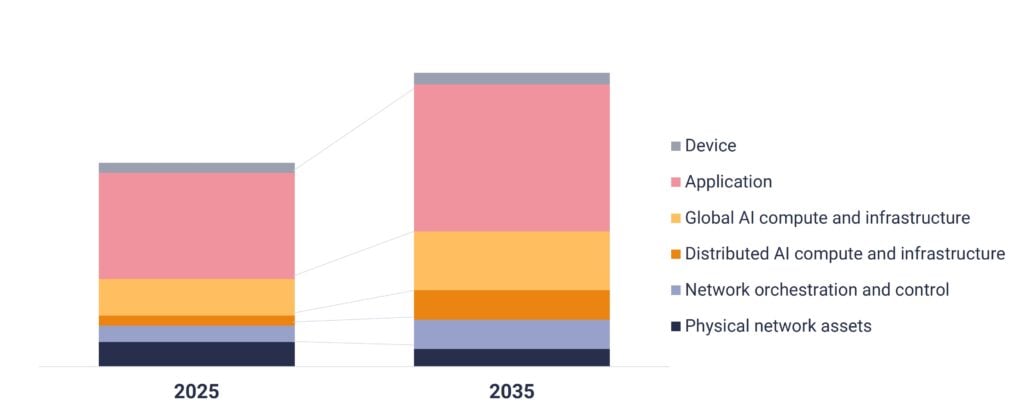
Source: The telecom industry in the AI era: How telcos can follow the money