
Download
Listen


This article examines how data centres are evolving and differentiating — through operating models, customer requirements, and infrastructure design — as AI, sustainability, and sovereignty reshape the industry.
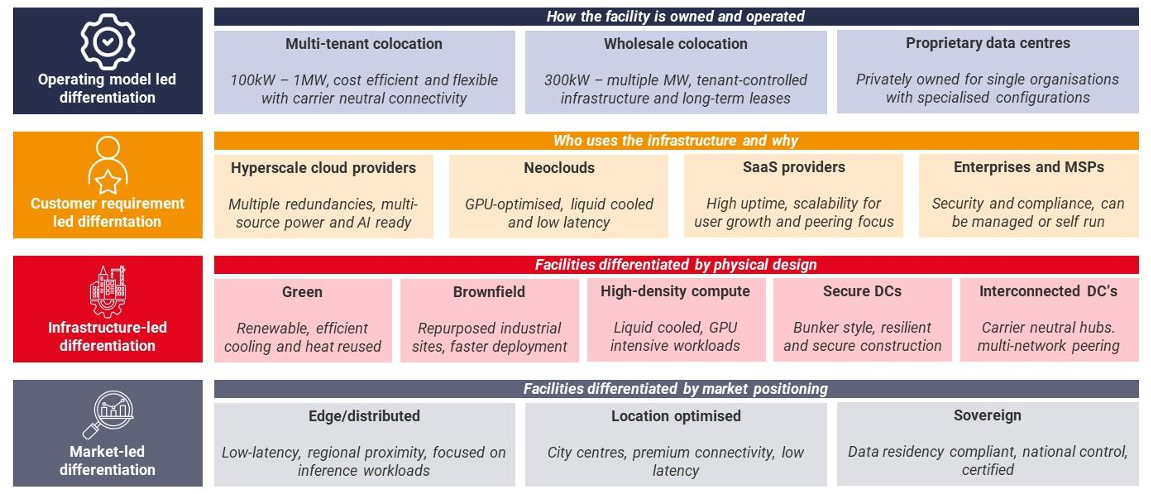
Data centres differ fundamentally in how they are designed and built, shaped by who operates them, what workloads they support, and the level of performance, flexibility or security required. These differences determine how effectively facilities deliver compute, manage power and cooling and connect to digital ecosystems. Understanding these distinctions is critical for both operators and customers. Operators must optimise infrastructure design to balance performance, and resilience. Customers, meanwhile, need to choose data centre partners that align with their workload, compliance, and growth requirements. This taxonomy explores how data centre infrastructure varies across four key dimensions — operating models, customer requirements, specialised infrastructure propositions, and location-driven differentiation — and illustrates how evolving computing demands, from cloud to AI, are redefining facility design across each.
Figure 1: Data centre infrastructures differ by varying requirements
Source: STL Partners
Operating model led differentiation

The way a data centre operates — whether it serves many tenants, a single wholesale client, or one enterprise — defines its core infrastructure choices. Each model balances flexibility, control, and efficiency differently.
Multi-tenant colocation facilities share infrastructure across multiple tenants. Power typically ranges from 100kW – 1MW per customer, who often sign 1–3-year leases. These environments need reconfigurable cage and cabinet layouts, extensive carrier-neutral connectivity and modular power distribution that enables quick customer onboarding. The model balances cost efficiency with standardised offerings that serve diverse tenant requirements simultaneously.
Wholesale colocation serves single tenants leasing entire data halls or floors, with power requirements starting at 300kW per customer and frequently reaching multiple MW or more. Infrastructure gets custom-built to tenant specifications (who often sign multi-year leases spanning 5-20 years), including bespoke power distribution systems and integrated cooling configurations. Tenants control infrastructure design decisions, optimising for their workload profiles rather than accepting standardised configurations.
Proprietary data centres are private facilities dedicated to a single organisation’s use. They may be owned and operated by the organisation itself or managed by a third-party provider under a single-tenant model, giving the occupier exclusive access to all infrastructure and capacity. Organisations use proprietary facilities when they need specialised configurations, have strict compliance requirements or operate at sufficient scale to justify the capital investment. These facilities prioritise customisation, compliance and control, absorbing all costs, from power and cooling to maintenance, to support mission-critical or sensitive applications.
Customer requirement led differentiation

If operating models determine how infrastructure is shared, customer types determine what that infrastructure must deliver. Each customer category reflects different performance, scalability, and resilience priorities.
Hyperscale cloud providers like AWS, Azure and Google Cloud operate vast networks of data centres, initially built to power cloud storage and computing, but increasingly transitioning towards also hosting AI-driven services such as model training. Their facilities include multiple power sources, backup generators and duplicate power systems to prevent outages. As AI and associated HPC requirements create much more heat, traditional air-cooling methods like computer room air handler (CRAH) units are being replaced by liquid cooling systems that can handle racks drawing over 50kW of power.
Neoclouds such as CoreWeave and Lambda provide GPU-as-a-service and specialise in AI workloads. Unlike hyperscale cloud providers who have built up a business hosting low-to-mid density CPU-based cloud computing workloads and are now pivoting towards GPU and ASIC-based HPC, neoclouds have a history in specialising in HPC, initially serving the crypto sector before pivoting to AI-enabling GPUaaS over the last 5 years. Rack power consumption can exceed 60kW, with some deployments starting to reach 100kW or higher. Air cooling is no longer a viable option at these densities — facilities need liquid cooling systems using water-based solutions or refrigerants to manage heat from GPUs consuming up to 1.2kW each, with 72 of these packed tightly together in a rack for the latest Nvidia reference architectures. These environments also demand high-throughput networking using cloud on-ramps and carrier-neutral connectivity for flexibility and resilience. Neoclouds’ most demanding connectivity is within the data centre, with low cross-GPU latency critical for performant AI training.
SaaS providers operate at conventional rack densities but emphasise reliability and uptime above all else. Infrastructure needs include guaranteed availability, high component redundancy and connections into multiple networks to connect them to their customers, as well as direct connections to major cloud platforms like AWS, Azure, and Google Cloud. Geographic location near internet exchange points reduces latency to serve off-net customers, while carrier-neutral environments provide extensive peering options. Critically, scalability matters — providers need flexible capacity expansion to handle user growth and feature rollouts without encountering infrastructure bottlenecks.
Enterprises and managed service providers (MSPs) share similar infrastructure needs, focusing on secure, reliable colocation with redundant power, cooling, and strong uptime guarantees. Both prioritise compliance certifications and flexible scalability to support growing business demands. MSPs add managed IT services, including 24/7 monitoring and support, while enterprises may manage some operations internally. They both rely on multi-carrier connectivity and at least use two geographically separated sites for resiliency and disaster recovery. This partnership allows enterprises to access expert IT management while retaining control over critical infrastructure.
Infrastructure-led differentiation

Beyond who operates or uses them, data centres differentiate themselves through the propositions that underpin their design — sustainability, repurposing, security, interconnection, or compute density.
Green data centres minimise environmental impact through renewable energy, cooling efficiency, and heat reuse. Green Mountain in Norway exemplifies this approach, powering all facilities with 100% renewable hydropower and leveraging Norway’s cold climate for efficient cooling. The company’s SVG1-Rennesøy site, converted from a NATO ammunition storage facility, utilises adjacent deep-water fjord cooling with constant 8-degree water temperatures year-round. Infrastructure modifications for sustainability include on-site renewable generation, free cooling using outside air in cold climates, advanced monitoring to optimise PUE ratings, and heat recovery systems redirecting waste thermal energy to district heating networks or agricultural operations.
Brownfield data centres repurpose existing industrial buildings to accelerate deployment and reduce costs. These data centres are particularly relevant in space constrained markets with strict regulation around new site builds. SUB1, a UK-based developer, converts brownfield sites on industrial estates with existing power availability into AI-ready facilities sized from 1-20MW for mid-sized deployments up to 50-100MW+ for large-scale operations. This approach delivers high-density infrastructure in months rather than the multi-year timelines required for greenfield construction, with facilities available for single-occupier purchase or exclusive lease. The brownfield model requires evaluating structural suitability for raised floors and HVAC loads, securing planning permissions for security perimeters and external plant equipment, and assessing electrical infrastructure including substation proximity and power upgrade feasibility.
High-density compute facilities serve AI and GPU-intensive workloads requiring specialised infrastructure (such as neoclouds). Rack densities reach 100-150kW with liquid cooling capabilities, compared to traditional 5-10kW air-cooled environments. Facilities implement direct-to-chip liquid cooling where coolant flows directly over processors and guaranteed non-blocking bandwidth to prevent jitter during data floods. Power management becomes critical as facilities balance grid capacity constraints against the extreme draw of thousands of parallel GPUs processing AI training workloads. Some next-generation designs anticipate rack densities exceeding 300kW by 2026, with roadmaps pointing toward 600kW or even 1MW rack densities in the coming years, if the likes of Nvidia are to be believed, although the economics and commercial take-up of such confugurations are uncertain.
Secure data centres employ extreme physical protections beyond standard industry practices. Bahnhof’s Pionen facility in Stockholm operates 100 feet underground in a former Cold War nuclear bunker, featuring a 40-centimeter-thick steel door, redundant submarine-grade diesel generators, and blast-resistant construction capable of withstanding hydrogen bombs. Other underground facilities like Iron Mountain’s 220-foot-deep limestone cave data centre and SmartBunker’s former NATO command bunker use natural geological features for temperature regulation, while maintaining impenetrable security perimeters. These facilities serve organisations with extreme security needs, including government agencies, financial institutions, and companies handling highly sensitive intellectual property.
Interconnection-focused data centres stand out due to the rich mix of network providers, cloud platforms, and service partners they host, creating a dense ecosystem where customers can make direct, private connections to multiple providers in the same facility. Telehouse London Docklands hosts the London Internet Exchange and provides connectivity to over 800 carriers, ISPs, and application service providers. Rich interconnection ecosystems bring together network operators, cloud providers, content delivery networks, and SaaS platforms, enabling customers to establish efficient one-to-many connections that bypass public internet unpredictability. These environments particularly benefit financial services firms, content providers and enterprises requiring direct peering with multiple partners.
Market-led differentiation

Finally, data centres increasingly differentiate through where and how they deploy infrastructure — using location as a strategic advantage.
Distributed or edge platforms position infrastructure closer to end-users for greater sovereignty and control. Pulsant’s platformEDGE interconnects 14 data centres across the UK through a private 100Gbps fiber network, enabling businesses to process workloads within milliseconds of customer locations. Edge facilities feature smaller footprints optimised for regional deployment, specialist hardware designed for high data loads, on-site support for remote locations, and flexible connectivity. nLighten are another example of a data centre operator with a fabric of facilities across different secondary and tertiary metro markets, this time across Western Europe, offering geographic proximity to customers based outside metro areas, as well as serving customers with a distributed presence across a country. These facilities trade the economies of scale available in hyperscale campuses for the benefits of locality, such as tenants’ ease of access and lower latency.
Location-optimised data centres leverage geographic positioning for competitive advantage. Colt’s data centres in Frankfurt serve organisations requiring premium colocation in the heart of the financial district. City-centre facilities sacrifice power efficiency for proximity to corporate headquarters, financial exchanges, and end customers, commanding premium pricing for ultra-low-latency access to trading platforms and mission-critical systems. These sites operate in space-constrained environments requiring vertical construction and advanced cooling solutions to manage higher heat density per square foot. Financial services firms, trading companies, and enterprises with time-sensitive applications form the primary customer base.
Sovereign data centres address data residency and regulatory compliance through guaranteed geographic data location. OVHcloud, one of Europe’s leading sovereign cloud providers, operates dozens of data centres across France. Sovereign infrastructure requirements include data storage exclusively within national or regional boundaries, immunity from extraterritorial legal requests under frameworks like the US CLOUD Act, and transparent ownership structures ensuring no foreign government access to customer systems. OVHcloud positions itself as a European alternative to American hyperscalers, reflecting growing demand for digital sovereignty among enterprises handling sensitive citizen data. This model particularly appeals to public sector organisations, healthcare providers, and financial institutions subject to strict data localisation requirements.
As data centres evolve from with the growth of AI towards highly specialised digital infrastructure, the basis for differentiation is shifting — from capacity and uptime toward purpose-built design for specific workloads, users, and geographies. STL Partners has worked with global operators, hyperscalers, and investors to analyse and shape these strategies, helping clients define infrastructure roadmaps that balance technical performance, sustainability, and commercial viability. Our experience across the data centre value chain, from business model design to futureproofing for AI and edge workloads, gives us a unique lens on how infrastructure choices today will define competitive advantage tomorrow.
Looking for advisory services in data centres? Schedule a call.
Download the data centre insights overview pack
Download the data centre insights overview pack
Get a concise, practical summary of the data centre market: the impact of AI and sovereign strategies, the differentiators that win in a crowded landscape, and proven frameworks for market entry, channel partnerships and customer acquisition—backed by case studies and sample deliverables.

Five things we learned at Datacloud Global Congress 2026
We were at Data Cloud Congress 2026 in Cannes last week to evaluate the key narratives among data centre operators, investors and vendors.

The hidden economics of liquid-cooled data centre retrofits
This article, kindly supported by Airedale, explores when liquid cooling retrofits make commercial sense, showing why the decision depends on HPC pricing, facility fill, market constraints and disciplined execution.

Key takeaways from the launch of the Quantum Infrastructure Council
STL Partners attended the launch of QIC to explore what it will take to deploy
quantum technologies in real-world data-centre environments.
Five things we learned at Datacloud Global Congress 2026
We were at Data Cloud Congress 2026 in Cannes last week to evaluate the key narratives among data centre operators, investors and vendors.
The hidden economics of liquid-cooled data centre retrofits
This article, kindly supported by Airedale, explores when liquid cooling retrofits make commercial sense, showing why the decision depends on HPC pricing, facility fill, market constraints and disciplined execution.

Modular data centres: can prefabricated design speed up construction?
A look at whether modular data-centre design can help operators deliver capacity faster, scale more flexibly and respond to rising demand.