Login to access
Want to subscribe?
This article is part of: Edge Insights
To find out more about how to join or access this report please contact us
Data centre operators are advancing towards the intelligent data centre through increasing deployment of smart tools and trusted automation to achieve efficiency and resilience. This report, sponsored by Airedale, examines how the value of intelligent operations is evolving and how operator priorities are shifting.
Introduction
The intelligent data centre is the industry’s operational north start
Data centre operations have traditionally relied on complex monitoring layers and human decision-making to maintain highly resilient environments. As estates grow and operational systems become more sophisticated, the intelligent data centre is emerging as the industry’s operational north star: a facility that can anticipate changing conditions, optimise its performance and coordinate responses across environments with progressively less routine human intervention.
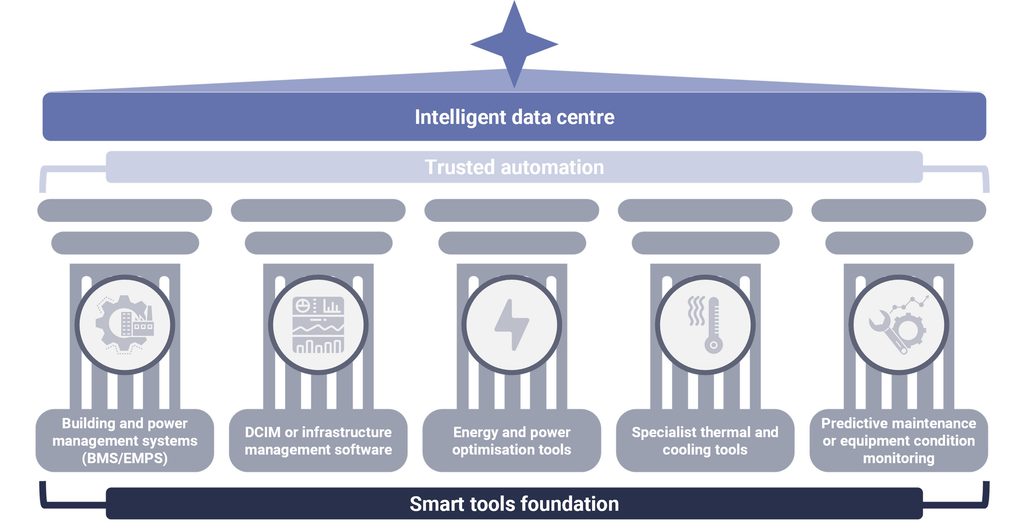
Progress towards this model rests on two complementary capabilities: smart tools and trusted automation. Smart tools are the software, control and monitoring systems that give operators visibility into facility conditions and the intelligence to identify risks, diagnose issues and optimise performance. Automation determines how far systems can act on that intelligence, from alerting and recommending changes through to executing actions with progressively less human intervention. Together, these capabilities underpin the intelligent data centre, where connected operational data and automated control are used to understand and optimise operations.
The intelligent data centre combines smart tools with trusted automation
Source: STL Partners
If you are not a subscriber, enter your details below to download an extract of this report.
Smart tools can be broadly categorised into five technology domains:
- BMS/EPMS for core building and power control: Monitors and controls core building and electrical infrastructure.
- DCIM for infrastructure visibility and management: Provides visibility across assets, space, power and capacity.
- Energy and power optimisation tools: Identify opportunities to reduce or better manage energy use.
- Specialist thermal and cooling tools: Monitor thermal conditions and optimise cooling performance.
- Predictive maintenance or equipment condition monitoring: Identify emerging faults and maintenance needs before failure
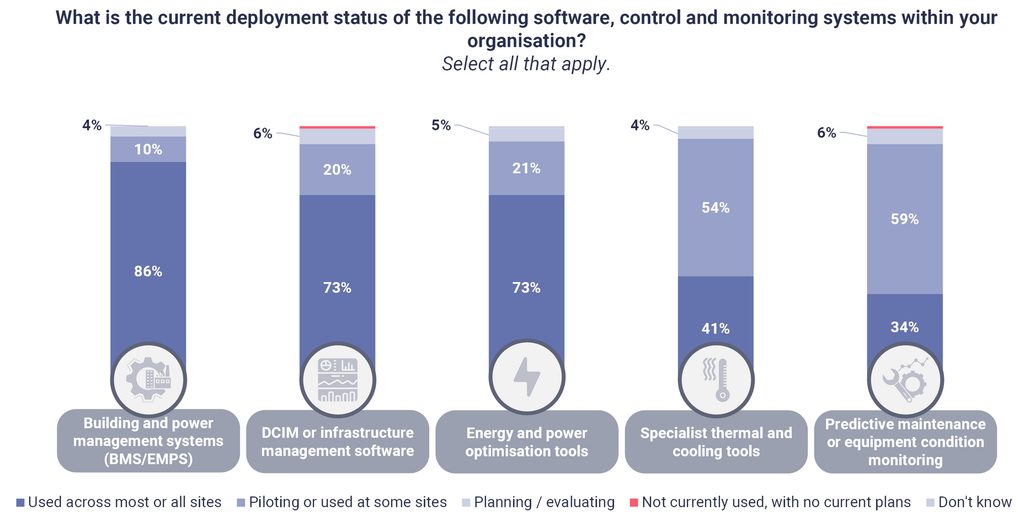
Survey results (see figure below) suggest that the smart tools foundation is already relatively well established. Core systems such as BMS, DCIM and energy and power optimisation are widely deployed across operators’ estates, while specialist thermal, cooling and predictive maintenance capabilities remain less mature and are more commonly piloted or used selectively. This points to a layered evolution, implying that more specialised operational intelligence will be built on top of an established controls and management foundation.
Core tools are widely deployed while specialist tools are less mature
Source: STL Partners
How these tools translate operational intelligence into action depends on the second building block: trusted automation. Figure 6 illustrates this as a spectrum, from monitoring and diagnosis through recommendation-led operation to systems that can make changes automatically within predefined limits. How far each tooling domain can progress along this spectrum varies. Established systems such as BMS are often better suited to rules-based automation because they have typically been deployed longer, so their operating parameters, failure modes and appropriate safeguards are better understood. Newer analytical or predictive tools may initially play a more advisory role while operators build confidence in their outputs and establish the guardrails needed for more autonomous action.
Table of contents
- Foreword
- Methodology
- Editorial independence
- Executive Summary
- Introduction
- The value story for intelligent operations is evolving
- AI and HPC will raise the operational importance of intelligent operations
- Guidance for operators: Unlocking more value from intelligent operations
Related research
- The retrofitting roadmap: An evolution of liquid cooling
- Telco AI data centre forecast: Where will the compute live in the AI era?
- Futureproofing datacentre interconnect: The backbone of an AI strategy
