Login to access
Want to subscribe?
This article is part of: Edge Insights
To find out more about how to join or access this report please contact us
Rising demand for AI and HPC is accelerating the shift towards liquid cooling, but greenfield capacity cannot always keep pace. This report, kindly sponsored by Airedale, examines when retrofitting existing data centres makes strategic sense and how operators can move from assessment to execution.
Methodology
This report presents insights from a recent research programme, where we conducted in-depth interviews with eight senior individuals across the data centre ecosystem, including data centre operators, developers, design specialists and cooling experts. These interviews were supplemented by STL Partners’ existing data centre expertise, developed through more than twenty data centre strategy and advisory projects over the past three years. The aim was to understand when and where retrofitting for liquid cooling makes sense and how operators should tailor their retrofitting strategy by facility type, market conditions and customer demand.
Executive Summary
As the demand for AI and high-performance computing (HPC) rises, rack power densities are increasingly exceeding the practical limits of air-cooling systems, and liquid cooling becomes necessary for high-density workloads. While greenfield development remains the strategic ideal for liquid-cooled capacity, power constraints, permitting delays and time-to-market mean some operators are examining how they can upgrade or ‘retrofit’ existing facilities.
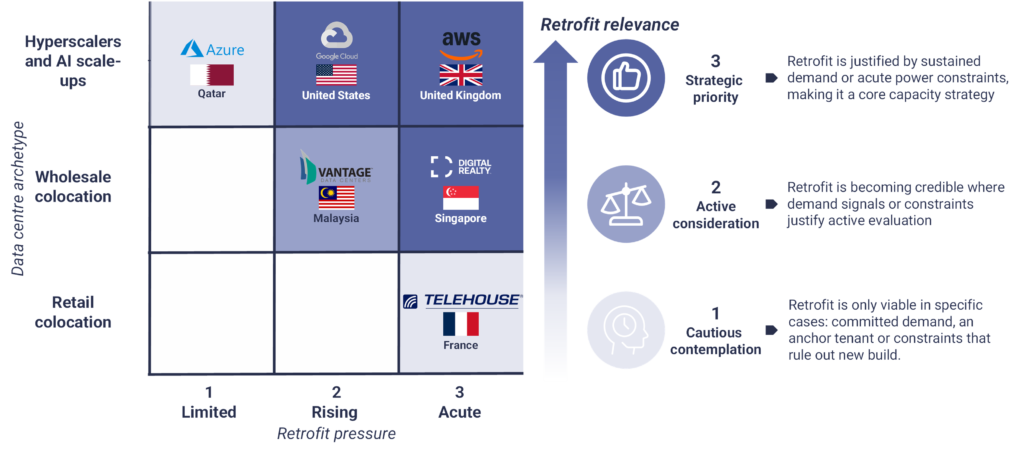
Retrofitting for liquid cooling requires approximately USD2 million per MW of capex, in comparison to a greenfield build that would cost upwards of USD11 million per MW. Nonetheless, liquid cooling conversions are also operationally complex and highly disruptive as they risk impacting customer workloads, tenancy revenues and require significant infrastructure upgrades. Ultimately, liquid cooling retrofits will not suit every operator, site or market. To help operators decide whether a retrofit makes strategic sense, STL Partners has developed a retrofit viability framework. The framework assesses retrofit relevance through two lenses: retrofit pressure and operator archetype.
To help operators decide whether a retrofit makes strategic sense, STL Partners has developed a retrofit viability framework. The framework assesses retrofit relevance through two lenses: retrofit pressure and operator archetype.
When does liquid cooling retrofit become a strategic priority?
Source: STL Partners
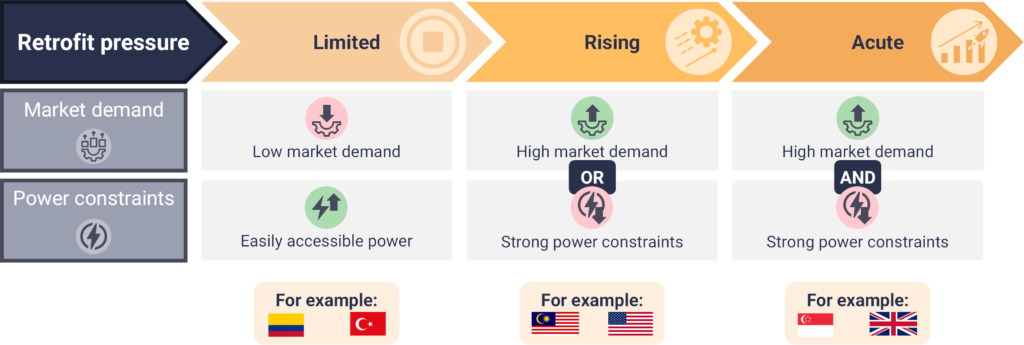
Operators can use this framework to assess whether retrofit should be treated as a cautious option, an active consideration or a strategic priority. The figure below provides STL Partners’ more detailed guidance on how market demand and power constraints combine to determine market-specific retrofit pressure.
Retrofit pressure varies materially by market
Source: STL Partners
Once retrofit is strategically justified, operators need to move from market assessment to asset selection and execution planning. The technical checklist for retrofit execution includes assessing power, physical flexibility and operational headroom as well as selecting the right high-density cooling strategy. STL Partners recommends that operators evaluating liquid cooling retrofit should take five actions:
- Use the retrofit relevance matrix to determine whether retrofit is a cautious option, an active consideration or a strategic priority. Operators in a cautious contemplation position should treat retrofit as a narrow, conditional option, while those in active consideration or strategic priority territory should progress into more detailed commercial and technical planning.
- Assess customer demand quality, not just customer demand volume: Operators must weigh up multiple factors including customer commitment, lease strength, nearby greenfield competition and the risk of investing speculatively before an anchor tenant or an internal AI workload guarantees demand.
- Define a trigger point for action based on your archetype: Hyperscalers can move earlier because they can underwrite demand internally. Wholesale colocation providers should move once customer commitment and lease economics are strong enough to protect cost recovery. While retail colocation providers should typically wait for a much narrower set of conditions, such as a major lease event, to clearly anchor demand across multiple customers.
- Treat cooling vendors as strategic partners: Prioritise suppliers with strong capabilities in monitoring, controls and software integration, as well as solutions that align with your long-term liquid cooling roadmap. Vendor choice should support not only deployment today, but future flexibility and operational resilience.
- Ensure you have the ongoing operational capabilities to support high-density facilities, once the upgrade has been completed: The installation itself is only one stage of the transition, and operators need the right people, processes and monitoring capabilities in place to manage commissioning and ongoing performance over time. Ongoing maintenance, fluid management and operational oversight are just as important as the retrofit if the site is to deliver reliably at higher densities.
If you are not a subscriber, enter your details below to download a free copy of the report
Editorial independence
STL Partners prepared this report under comission from Airedale. STL Partners maintains strict editorial independence. Mentions or allusions to companies or products in this document are intended as illustrations of market evolution and are not included as endorsements or product/service recommendations.
Related research
- Liquid cooling: The next consolidation wave in data centre infrastructure
- Data centres and water: Understanding the real impact
