Login to access
Want to subscribe?
This article is part of: Enterprise Platforms
To find out more about how to join or access this report please contact us
After more than a decade of steering customers away from the phone call, businesses are rediscovering the value of voice, thanks to AI. This report explores what is driving this shift, and where and how telcos can compete in the emerging voice AI market.
Introduction
Voice is becoming valuable again
For more than a decade, enterprises have tried to reduce the cost of customer calls by steering customers towards websites, apps and chatbots. Yet voice remains one of the most natural ways to communicate, particularly for complex, urgent or sensitive issues.
Voice AI is changing this trade-off. It lets businesses:
- Handle more conversations without a corresponding increase in staffing costs
- Add new capabilities such as real-time translation, fraud detection and call analytics
Investment in voice AI is accelerating
- Startup activity: Y Combinator’s Summer 2025 Requests for Startups identified voice AI as a focus area, pointing to the more than one trillion calls between businesses and their customers, and CB Insights identified 16 companies in that batch building specialised voice AI systems.
- Record funding: Newcomer’s analysis of PitchBook data shows venture investment in voice AI startups exceeded USD7 billion in Q1 2026 alone, compared with USD8.8 billion raised across the whole of 2025.
Claiming the telco right to play
For telcos, voice AI offers an opportunity to restore value to a core service, but the time to act is now. Unlike network APIs, which have been slow to monetise as customers develop use cases, programmable access to voice presents a more straightforward proposition; developers already know how to build customer experience applications around conversations. Meanwhile, consumer-to-business communications have long shifted to digital channels, a trend agentic AI could accelerate, while businesses increasingly adopt IP-based services such as WhatsApp for their lower costs and richer features.
As the voice AI market evolves rapidly and competition intensifies, telcos must make their voice services more competitive and convenient or risk ceding much of the value to AI specialists and communications platforms.
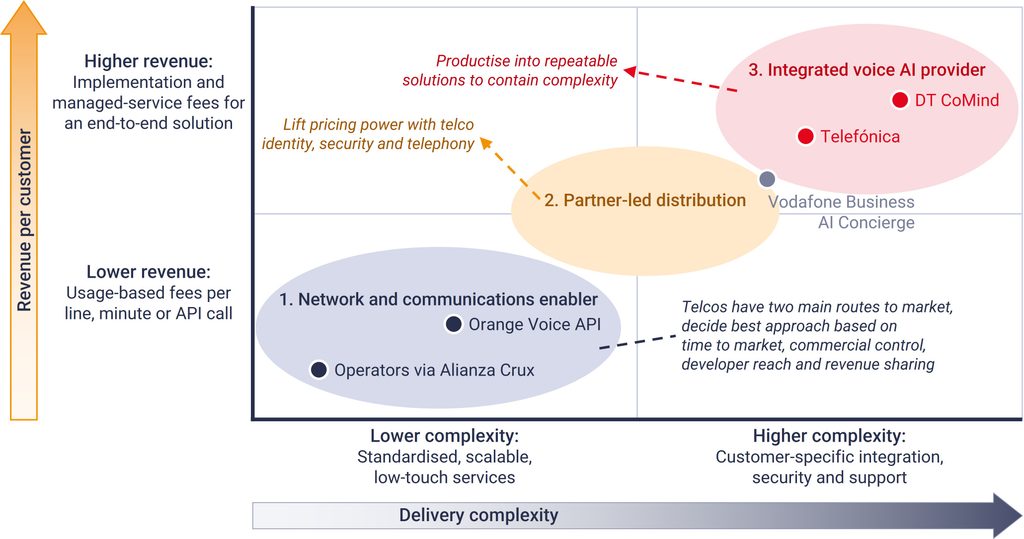
To compete effectively, telcos need to identify where their strengths allow them to create and capture value. Our analysis of telcos’ early moves into voice AI identifies three broad commercial models, each with distinct trade-offs in revenue potential, delivery complexity and commercial control.
Three commercial models with different revenue potential and delivery
complexity
Source: STL Partners
If you are not a subscriber, enter your details below to download an extract of the report
Table of contents
- Executive summary
- Introduction
- A rapidly growing market
- Why is voice AI reaching a turning point… and what still stands in the way
- Claiming the telco right to play
- Mapping the voice AI market
- Three ways voice AI is deployed
- Anatomy of a voice AI agent
- Speech-to-speech: Is the stack about to collapse?
- Understanding the telco right to play
- What telcos bring to the table
- First movers: Telcos putting voice AI to work
- Following the money: Emerging commercial models
- Recommendations
- Conclusion
Related research
- Embracing AI without alienating customers
- How telcos generate AI revenue
- Telco generative AI adoption tracker