
Operators are pursuing agentic AI, but many are building on technology foundations that already raise fulfilment costs, slow down change and leave customers uncertain. This article explains why modernising order management cannot wait, and how it can fix today’s friction while paving the way to autonomy.

Consultant · Published · 5 min read
Legacy technology is a transformation bottleneck
Changing a product’s name should be a simple commercial decision. But for one operator interviewed by STL Partners, it touches 42 systems and requires a major assessment before any work can begin.
This illustrates the complexity many telcos face as they pursue more autonomous operations, with fragmented legacy systems and processes creating significant barriers to progress.
“Just changing the name of a product touches 42 systems and requires a major assessment even before we can undertake changing it…”
Group owner, Activations & Orchestration, National telecoms operator
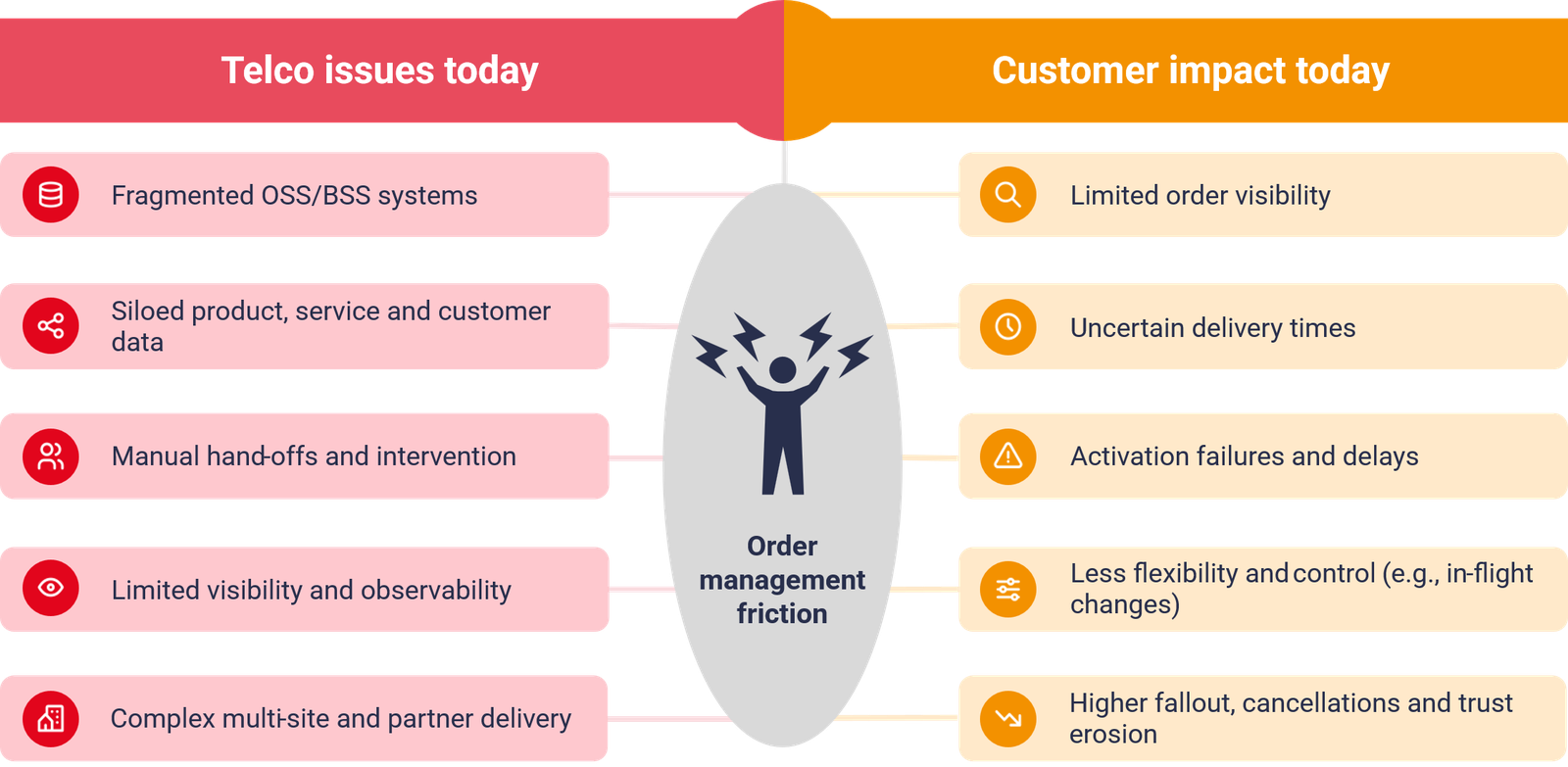
Order management is a clear example. Legacy systems leave customers with uncertainty and limited visibility of their orders, push up delivery costs through manual hand-offs, and make launching or changing products slow and expensive (see Figure 1).
For operators pursuing agentic AI, order management modernisation can address existing delivery constraints while establishing the execution capabilities greater autonomy requires. An AI agent can codify a customer’s request, identify a delivery issue or undertake a corrective action. But completing the task requires reliable order information, a clear view of dependencies and a controlled way to execute changes across systems and partners. Without that foundation, even the most capable agentic AI will not get far.
Research by STL Partners, commissioned by Amdocs and drawing on interviews with eleven senior telecoms professionals, shows how modern order management can fix these issues today while providing the trusted order state, orchestration and execution capabilities that increasingly autonomous workflows depend on.
Figure 1: Fragmented order management creates friction for operators and their customers
Source: STL Partners
How can order management enable telco transformation?
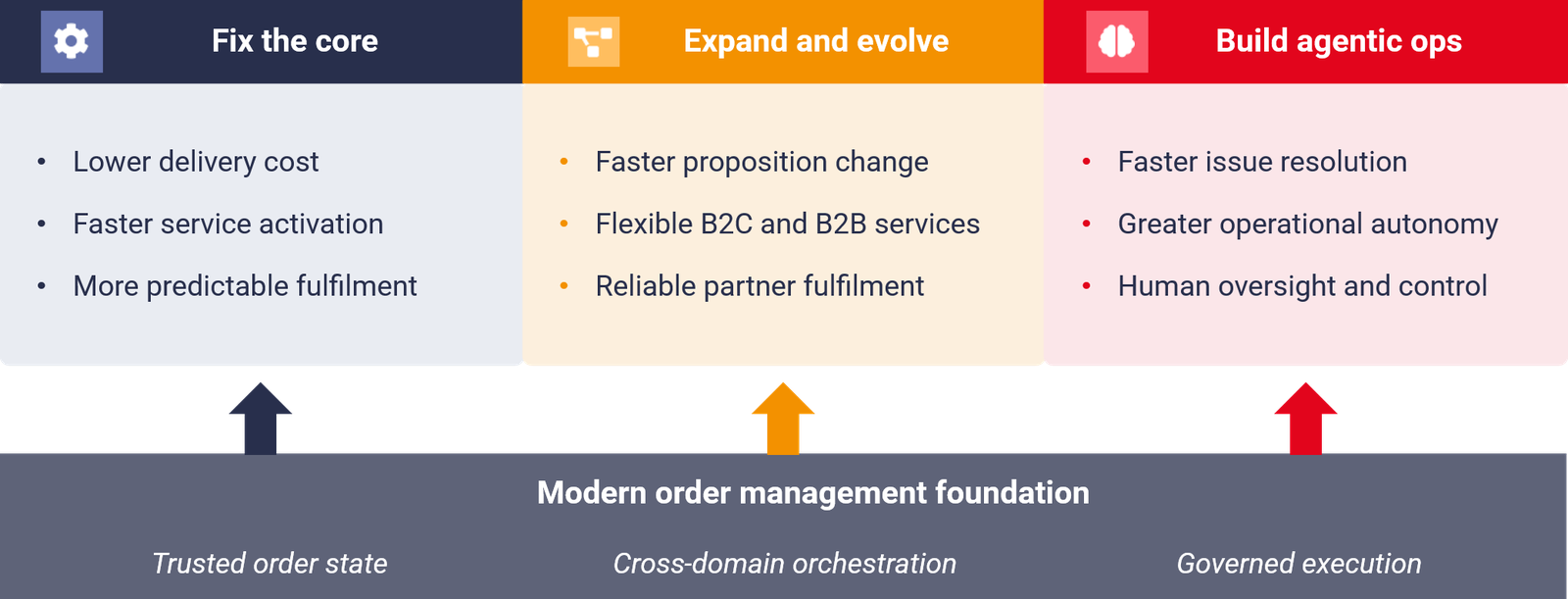
Our interviews with operators highlighted three main transformation priorities, each of which modern order management can support.
Figure 2: Modern order management underpins three transformation priorities
Source: STL Partners
Fix the core: Reduce fulfilment costs, manual intervention and delays
For about half of the operators we spoke to, the immediate priority is to simplify and stabilise delivery of existing services. When an order stalls today, identifying the cause and the team responsible for resolving it often requires another round of manual coordination. Greater automation, end-to-end visibility and better exception management reduce that effort, shorten fulfilment times and lower cost-to-serve, while giving customers more dependable delivery commitments. Value does not have to wait for full agentic AI. One operator trialling intermediary automation in its order flow is targeting a cut in fallout from around 20% to 5%, but its legacy estate, where quoting and ordering systems are not joined up, limits how far it can go.

Expand and evolve: Launch and adapt services faster, without extensive customisation
Operators are combining connectivity with cloud, security and partner services, and each new combination adds fulfilment dependencies. One interviewee described SD-WAN propositions involving four or five partners, each with its own licensing model, technology and responsibilities. In consumer markets, customers expect to add, remove or swap devices and digital services easily. Configurable product and partner onboarding, reusable service components and flexible orchestration reduce the cost of launching, adapting and retiring propositions. That cost shapes whether an operator can afford to test new ideas, how quickly it can respond to demand and whether a successful offer can scale.
Legacy constraints can also rule out some commercial models altogether, as the head of go-to-market at one global operator explained.
“Sometimes we can’t offer the commercial models we’d like to because of constraints in our OSS and BSS […] We might want to introduce usage-based billing, for example, but either the systems can’t support it or the cost of making the changes is just too high.”
Head of GTM, Global telecoms operator
Order management cannot create demand on its own, but it can stop fulfilment complexity from undermining a proposition once customers want to buy it.
Build agentic operations: Enable accurate, reliable and governed autonomous execution
Human-intensive work, such as resolving exceptions and coordinating across systems, is a natural target for agentic AI. An agent investigating a stalled enterprise order needs to ‘know’ which components are complete, what is blocked, who owns the next step and which corrective actions it is permitted to take. Modern order management supplies the trusted order information, together with the orchestration and governance, that allow agents to act within defined permissions and escalate to people where needed. Agents can reason across systems and handle exceptions, then invoke deterministic workflows to execute permitted actions. This can reduce manual intervention, accelerate exception resolution and improve fulfilment efficiency, while retaining visibility and control. The underlying data needs equal attention: one operator described data cleansing and enrichment as foundational work that must happen before agentic AI can be layered on top. Greater autonomy therefore increases, rather than reduces, the importance of strong order management.
Operators should start where delivery already causes friction
Operators do not need to replace their entire estate before making progress. A practical starting point is a journey where fragmented order information, repeated manual intervention or difficult product changes already create problems. Improving that journey can support existing customers while building capabilities for selected agentic use cases.
New services can also be introduced on modern platforms while existing services migrate progressively. Data quality, process ownership and governance should develop alongside the technology. This allows operators to connect their AI investment to a concrete business need: delivering services more reliably, supporting more flexible propositions and resolving exceptions with less manual coordination.
For telecoms executives, order management belongs in the discussion about how agentic AI will create value. The intelligence layer can identify what should happen next. A trusted execution backbone enables the business to follow through.
Download the full report
How mature is your order management today? Which capabilities should you prioritise, and where will modernisation deliver the greatest business value?
Download STL Partners’ Modernising Order Management for the Agentic Telco, commissioned by Amdocs, for a seven-capability maturity framework, transformation roadmaps and six practical recommendations to help guide your next steps.
This article was produced by STL Partners and kindly sponsored by Amdocs. To discuss the findings in more detail or explore how to modernise order management, please contact Amdocs here and STL Partners here.

Looking for advisory services in AI? Schedule a call.
Download the AI insights pack
Download the AI insights pack
Our overview explores the evolving role of telcos in the AI ecosystem—examining how they act as consumers of AI, as enablers of AI adoption across industries, and as providers of AI-driven solutions to others.

AI token costs: Why enterprises need to stretch AI budgets, not just cap them
Token prices have been falling, yet enterprise AI token costs keep rising. Most organisations respond with caps and quotas that make spend predictable but ration the value AI can deliver. Here are four levers to get more from every token.

AI cybersecurity incidents: risk or opportunity for telcos?
This article explores what telcos need to do in order to protect themselves and capitalise on the opportunity.

From showcase to shelf: MWC Shanghai highlights how Chinese telcos monetise AI
three demos from China’s telcos at MWC Shanghai 2026 illustrate the different ways telcos are trying to build businesses around AI.

Legacy order management: the hidden bottleneck for the agentic telco
Operators are pursuing agentic AI, but many are building on technology foundations that already raise fulfilment costs, slow down change and leave customers uncertain. This article explains why modernising order management cannot wait, and how it can fix today’s friction while paving the way to autonomy.
AI cybersecurity incidents: risk or opportunity for telcos?
This article explores what telcos need to do in order to protect themselves and capitalise on the opportunity.

What the Mythos ban means for AI sovereignty
On 12 June 2026, the US ordered Anthropic to disable Claude Fable 5 and Mythos 5 for any foreign national worldwide. The directive turned the frontier model itself into a sovereignty question, not …