Case study overview
STL Partners worked with a global application security and infrastructure software vendor to validate two emerging AI solutions: an AI security control platform and an AI-driven network predictive analytics solution. The engagement provided an independent outside-in assessment of market opportunity, customer demand and competitive positioning, helping the client quantify the commercial potential of each proposition and define the most attractive routes to market.
STL supported the client to:
- Validate customer demand, pain points and willingness to pay for AI security and network predictive analytics solutions
- Quantify the addressable market opportunity and model commercial potential across priority customer segments
- Refine each product’s value proposition, competitive positioning and go-to-market strategy
What was the approach?
STL Partners delivered a six-phase programme, combining primary research, market sizing and go-to-market strategy development.
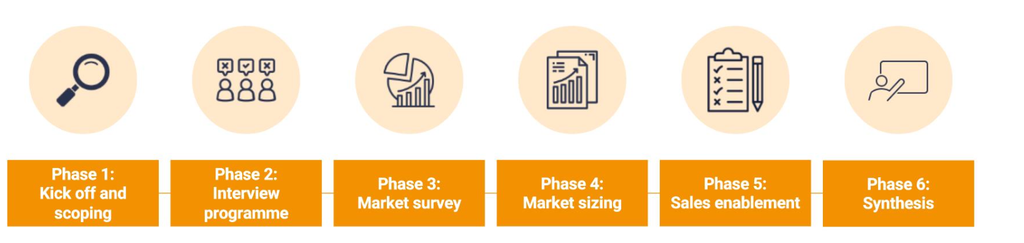
1. Product briefings and hypothesis definition
STL defined the commercial hypotheses, priority customer segments and use cases for each AI solution through a series of product and strategy workshops. This established the research framework and ensured subsequent analysis tested the client’s key commercial assumptions.
2. Qualitative customer interviews
STL conducted structured interviews with senior enterprise security and network operations decision-makers to validate customer pain points, buying criteria, willingness to pay and solution fit. The interviews also identified common adoption barriers, purchasing triggers and customer language to inform proposition development.
3. Quantitative demand validation
STL designed and delivered two dedicated surveys – one for the AI security solution (300 qualified respondents) and one for the AI-driven predictive analytics solution (100 qualified respondents). The surveys quantified customer demand, pricing expectations, willingness to pay, deployment priorities and buying behaviour across enterprise and service provider markets.
4. Market sizing and commercial modelling
STL built five-year TAM, SAM and SOM models for both AI opportunities, incorporating customer adoption assumptions, willingness to pay and scenario analysis. The modelling quantified market size by region and customer segment, identifying the highest-value commercial opportunities.
5. Competitive and proposition analysis
STL benchmarked competing solutions to identify positioning gaps and sources of differentiation, and defined customer archetypes to guide product positioning, sales prioritisation and go-to-market planning.
6. Go-to-market and sales enablement
STL developed commercial strategy and sales enablement materials, including segment-specific messaging, competitive positioning, differentiation frameworks and partner engagement recommendations. These outputs equipped the client’s sales and product teams with evidence-based messaging for customer engagement.
Key results from the project
- Conducted eight director-level customer interviews and two dedicated surveys covering 400 qualified respondents (300 AI security; 100 predictive analytics)
- Developed five-year TAM, SAM and SOM models for both AI opportunities, identifying the highest-value regions and customer segments
- Validated AI security as a high-growth opportunity, driven by enterprise AI adoption, governance requirements and emerging inference-layer security risks
- Confirmed strong demand for AI-driven predictive analytics among service providers seeking to reduce outages and predict the impact of network changes before deployment
- Defined customer archetypes and competitive positioning to support sales prioritisation and go-to-market planning
- Produced strategic recommendations spanning proposition refinement, go-to-market strategy and sales enablement to support commercialisation