
Download
Listen

Nordics emerge in Europe as key AI power-led zones
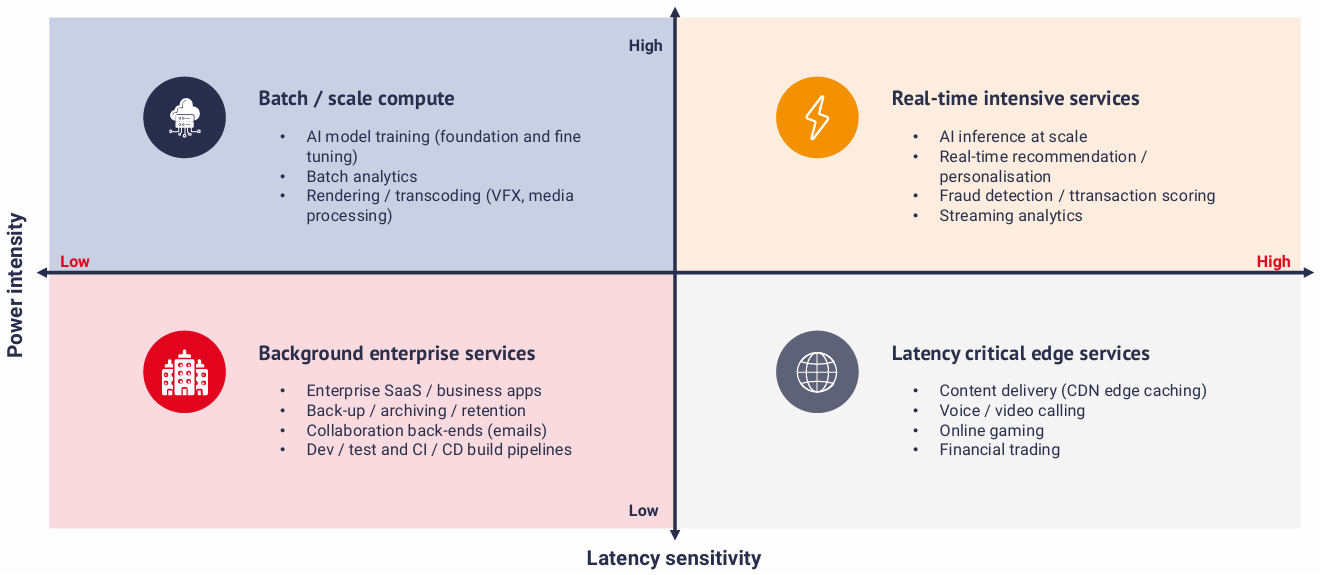
Figure 4: Workload location drivers (latency vs power intensity)

Data centre location strategy is shifting from connectivity-led hubs to power-led availability zones as AI makes power deliverability the key constraint on new capacity. Historic Tier-1 markets remain vital for interconnection and latency-sensitive workloads, but limits on power, land and permitting are driving expansion into adjacent and energy-advantaged regions.
Introduction
For most of the modern data centre era, the question of “where to build” has had a fairly stable answer: build where networks converge and where enterprise demand is concentrated. This is why a small number of metro hubs became the default “availability zones” for cloud regions, colocation campuses and enterprise infrastructure. However, this is all now changing.
The driver is not just that legacy hubs are “full”, it is that the workload mix is changing, and AI, in particular, is making power availability the defining variable. The industry is shifting from zones shaped by fibre density and interconnection gravity to availability zones shaped by access to scalable energy, land and permitting certainty. Connectivity still matters, but it is increasingly something data cetnre operators engineer into these sites rather than something the site inherently provides.
This article outlines how availability zones formed, why they are expanding between traditional hubs, and how AI is altering the geography.
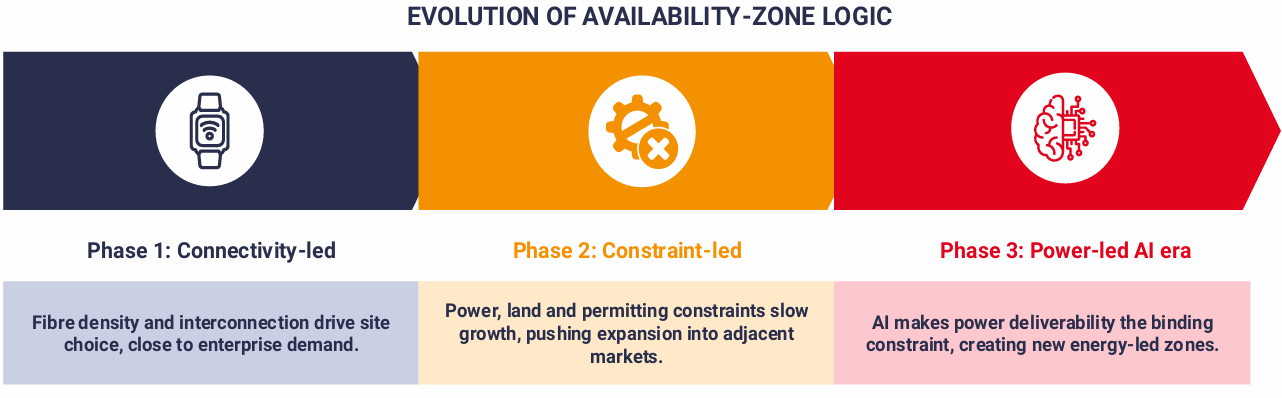
Figure 1: Availability zone logic has evolved through three distinct phases
Source: STL Partners
Phase 1: Establishment of traditional availability zones
Early data centre location strategy was connectivity and proximity-led. Data centres had to sit close to major fibre routes, internet exchanges and enterprise clusters because those were the places where you could fill racks quickly and keep network costs under control.
Three are two reinforcing dynamics that shape the emergence of dominant hubs:
- Clustering effect: Once a city established itself as a credible data centre market, it became easier for other operators to follow. Regulators and utilities grew familiar with data centre requirements, supply chains strengthened, specialist skills accumulated, and the local ecosystem became “data centre literate”. Together, these factors reduced delivery risk and shortened the time from site selection to live capacity.
- Hub (multiplier) effect: Interconnection creates its own gravity as customers want access to multiple carriers, clouds and counterparties, and they prefer to find those options in one place. As hubs grow, the marginal cost and complexity of connectivity falls. Carriers benefit too: dense clusters lower the cost of serving additional tenants, because a single network build can reach a wider customer base.
These dynamics created a small number of dominant traditional ‘Tier 1’ global hubs that effectively became the industry’s default availability zones. In Europe, this emerged in FLAP-D markets (Frankfurt, London, Amsterdam, Paris and Dublin). In the US, Northern Virginia emerged as the standout concentration, underpinned by dense fibre infrastructure, proximity to major national customers around Washington, DC, available land and reliable power, all reinforced by supportive state policy and incentives. In Asia-Pacific, Singapore established itself as a critical hub due to it’s exceptional digital infrastructure footprint with over 25 submarine cable landings alongside it’s positioning at the crossroads of major shipping and data trade routes.
Phase 2: Constraint driven expansion
However, the same success that made these hubs dominant also created bottlenecks. As utilisation rose and build-out accelerated, core zones began to face constraints on the fundamentals that actually determine whether you can add capacity: power, land and permitting. Ireland is a clear illustration of how quickly “buildability” can become the binding constraint. Official statistics show data centres accounted for 21% of Ireland’s total metered electricity consumption in 2023, up from 5% in 2015. As a result there was a moratorium on data centre build up until 2026 and even as of today new projects need to provide onsite generation, support the grid during peak times, and source 80% of their energy from new renewables.
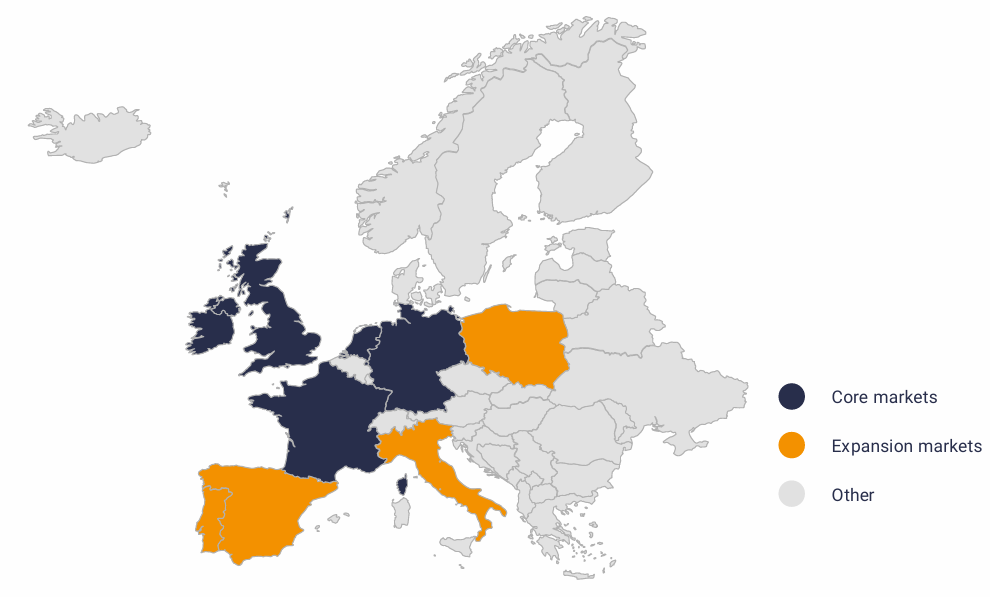
The outcome has been a shift in how operators thought about “Tier-1”. The traditional hubs remained strategically important, for interconnection density, enterprise proximity and ecosystem depth, but they were no longer the only viable growth path. To sustain expansion, operators began to build into adjacent and alternative Tier-1 markets that offered relief from congestion while preserving acceptable connectivity and access to customers. Examples of this constraint-driven expansion include:
- Southern Europe (e.g., Spain, Portugal, Milan)
- The Middle East (as a connectivity bridge and growing demand centre)
- Additional major US metros and states beyond Virginia
- Leading capital cities across Asia-Pacific that pair demand with improving connectivity
Figure 2: Expanding availability zones across Europe
Source: STL Partners
The practical logic of Phase 2 was straightforward: if the core hub cannot deliver power and permits fast enough, then build where you can still reach customers, but with fewer bottlenecks. Latency and interconnection remain important, but the industry increasingly recognises that the “best” market is not always the biggest or most established. It is the market that can be built, scaled and monetised within a realistic time horizon.
Phase 3: AI geographical revolution
The third phase is not simply “more of Phase 2”. AI changes the demand profile and, in turn, reshuffles the hierarchy of location decision-making factors. The key shift is that power deliverability (how quickly and reliably megawatts can be secured and connected) becomes the binding constraint for a growing share of new capacity, particularly for GPU-dense deployments. Crucially, AI also intensifies the importance of speed to market: the urgency to stand up capacity quickly has rarely been higher, so locations and partners that compress permitting, grid connection and build timelines are becoming disproportionately valuable.
These pressures do not apply equally to all AI workloads. A useful way to frame the difference is to distinguish between training and inference workloads:
- Training is the heavy industrial workload: large clusters, long runs, extreme power densities and specialised cooling.
- Inference is the customer-facing workload: serving responses, recommendations, search and real-time interactions, typically with tighter latency expectations.
For training, the crucial factor is that latency is often not the primary constraint. Many large-scale training workloads can tolerate greater distance from end users, as long as the site can deliver reliable, scalable power and the supporting infrastructure (cooling, water and logistics) required for high-density compute (Figure 3 illustrates how workload types vary by latency sensitivity and power intensity). That creates a profound change in availability-zone logic: if the most power-intensive workloads can be sited outside the metro core without materially compromising performance, then the “best” availability zones are increasingly defined by energy access rather than fibre density
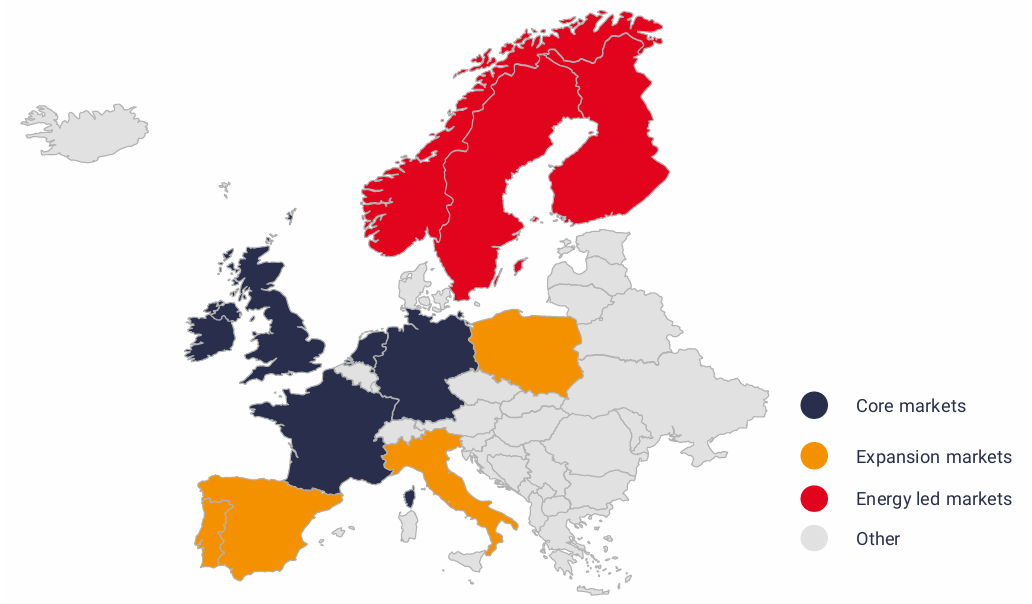
This is opening up new, energy-led availability zones, including:
- Nordic countries, combining strong energy potential with favourable climates for cooling
- Latin America (e.g., Chile, Argentina), where new generation capacity and energy projects can create fresh infrastructure gravity
- Non-traditional US states with stronger power headroom, enabling hyperscalers to expand beyond the established coastal and Tier-1 hubs (e.g., moves into states such as Louisiana, Meta and Ohio, Google)
Nordics emerge in Europe as key AI power-led zones
Source: STL Partners
This does not mean fibre and latency stop mattering. Inference-heavy deployments, sovereign workloads and many enterprise applications still pull capacity towards population centres and regulated jurisdictions. The shift is that AI introduces a second gravitational force: power-first availability zones optimised for scale compute, alongside traditional connectivity-first hubs optimised for interconnection and low latency.
Figure 4: Workload location drivers (latency vs power intensity)
Source: STL Partners
What this means for data centre operators: turning geography into structural advantage
The concept of a “Tier-1” data centre location is being rewritten. In the next cycle, Tier-1 will be less about being closest to everything and more about being best placed to scale sustainably. There are three strategic implications that stand out for data centre operators to consider:
1. Availability zones will become more geographically diverse driven by changing workload requirements: As AI reshapes demand, the market is segmenting into different facility types (e.g., training campuses, inference platforms, enterprise/regulated environments), each with distinct requirements for power, latency, resilience, security and connectivity. That specialisation drives location choice: energy-advantaged markets will become “Tier-1 equivalents” for scale compute, while interconnection-rich metros will remain essential for latency-sensitive and ecosystem-dependent workloads. For developers, this raises the importance of being explicit about what kind of data centre they are building and matching design and go-to-market to the realities of the local market (power headroom, land availability, permitting pathway and connectivity).
2. Power becomes a core commercial and strategic capability: Winning operators will treat power strategy like network strategy. Portfolio planning, supplier and utility relationships, long-term contracting, and risk management (price, availability, grid timelines) will be differentiators, not hygiene factors. “Time-to-power” becomes as commercially important as “time-to-market”.
3. Early positioning can create structural advantage: In emerging AI-driven zones, first movers can shape the ecosystem: interconnection points, carrier presence, supply chains, workforce skills and local policy frameworks. As in Phase 1 hubs, clustering effects can emerge, but this time around energy access and compute density, not just fibre routes.
Overall, the market is moving towards a two-stage model: connectivity-first hubs for latency-sensitive services and ecosystem access, alongside power-first zones optimised for scale compute. For data centre operators, the strategic question is less “where should we build?” and more how to assemble a footprint that matches workload needs without being limited by power availability, land constraints or permitting delays. In the AI era, advantage will increasingly come from securing time-to-power early, and converting it into buyer value through capacity guarantees and clear expansion pathways.
Looking for advisory services in data centres? Schedule a call.
Download the data centre insights overview pack
Download the data centre insights overview pack
Get a concise, practical summary of the data centre market: the impact of AI and sovereign strategies, the differentiators that win in a crowded landscape, and proven frameworks for market entry, channel partnerships and customer acquisition—backed by case studies and sample deliverables.

Five things we learned at Datacloud Global Congress 2026
We were at Data Cloud Congress 2026 in Cannes last week to evaluate the key narratives among data centre operators, investors and vendors.

The hidden economics of liquid-cooled data centre retrofits
This article, kindly supported by Airedale, explores when liquid cooling retrofits make commercial sense, showing why the decision depends on HPC pricing, facility fill, market constraints and disciplined execution.

Key takeaways from the launch of the Quantum Infrastructure Council
STL Partners attended the launch of QIC to explore what it will take to deploy
quantum technologies in real-world data-centre environments.
Five things we learned at Datacloud Global Congress 2026
We were at Data Cloud Congress 2026 in Cannes last week to evaluate the key narratives among data centre operators, investors and vendors.
The hidden economics of liquid-cooled data centre retrofits
This article, kindly supported by Airedale, explores when liquid cooling retrofits make commercial sense, showing why the decision depends on HPC pricing, facility fill, market constraints and disciplined execution.

Modular data centres: can prefabricated design speed up construction?
A look at whether modular data-centre design can help operators deliver capacity faster, scale more flexibly and respond to rising demand.