Login to access
Want to subscribe?
This article is part of: Executive Briefing Service, Network Innovation
To find out more about how to join or access this report please contact us
To deliver on their AI visions (especially agentic AI), operators must transform their data foundations and capabilities to avoid “garbage in, garbage out”. We identify the steps operators can take to get their data ready for AI on the journey towards level 4+ autonomy.
Data is key to unlocking level 4+ autonomy through trusted intelligence
Many telcos are striving for level 4+ network autonomy by the end of the decade. This is defined as cross-domain, closed-loop automation, enabling networks to autonomously assess real-time conditions and adjust operations based on high-level intent, such as business goals or customers’ service requirements.
A core part of reaching level 4+ will be integrating trusted intelligence into network operations. This means integrating AI (including GenAI, agentic AI) and automation in a way that ensures complete accuracy, reliability and transparency for optimal outcomes. If AI can be successfully deployed and integrated into the telco operations without performance, security or reliability issues, it will earn more of the operators’ trust and gradually enable more of the day-to-day operations of the network to be augmented and automated with AI solutions
Level 4+ autonomy is driven by trusted intelligence
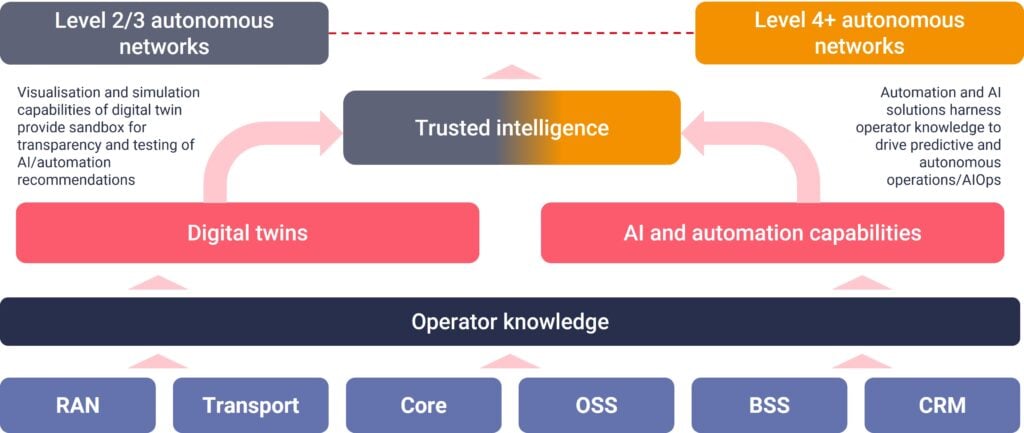
Source: STL Partners analysis, Digital twins: Accelerating progress towards autonomous networks
If you are not a subscriber, enter your details below to download a free copy of the report
Trusted intelligence is built on two key components – the AI and automation capabilities themselves (large language model [LLM]/small language models [SLMs], other AI/machine learning [ML] models, rule-based or simple automation) and the digital twins that allow operators to visualise, simulate and optimise actions before they are executed (see our recent report). In turn, both components rely on a strong data foundation – AI capabilities will fall prey to “garbage in, garbage out” and without accurate, granular and real-time data, digital twins will be unable to emulate real network conditions to support AI/human decision making.
This data foundation is the building of operator knowledge – raw data that has been transformed into actionable insights. In short, trusted intelligence can only be as good as the operator knowledge, and thus the data, that feeds it. However, for many telcos, network data that feeds operator knowledge is currently messy, siloed, uncontextualised and inaccurate.
To make data ready for trusted intelligence, it must be:
- Well-governed and accessible: Enabling rapid innovation while maintaining compliance and control.
- Cross-domain: Consolidated systems and platforms across network, customer and operational data sources.
- High quality and real-time: Accurate, timely and continuously validated.
- Deeply contextualised: Relationships and dependencies mapped through an ontology and metadata management is automated.
Without investment in their data and knowledge foundations, operators will not be able to truly embed trusted intelligence in their operations and unlock the use cases promised by advancing towards full network autonomy. Furthermore, the significant investment in AI tooling and capabilities to support the automation journey will be wasted, as these models are also built on the knowledge foundations of the operator (“garbage in, garbage out”).
In this report, we highlight the North Star guiding principles for operators in advancing their data capabilities, as well as practically where and how to start on the data journey, given the capital and skills constraints of the operator.
Table of contents
- Executive Summary
- Data is key to unlocking level 4+ autonomy through trusted intelligence
- Start with a use case-driven approach to solve the data challenge
- Target use cases addressed by simple agentic AI systems
- Operators should build use cases with scalability in mind
- What is the data North Star telcos should strive towards?
- Data architecture should focus on flexibility and scale
- Data governance should follow data mesh principles
- Data technology investments should enable the data fabric
- Establishing the data mesh will be the biggest challenge in the short term
- Partner to accelerate the transformation journey
Related research
- Digital twins: Accelerating progress towards autonomous networks
- Autonomous networks: The role of multi-agent systems
- The journey to a self-healing network: Intelligence, agents and complexity