
Download
Listen


This article explores how data centre design is shaped by the chipsets they house, giving rise to distinct data centre archetypes, and how these architectures have evolved – and continue to evolve – over time.
Different data centre archetypes require different balances of chipsets
Although data centres broadly use a common set of silicon – CPUs, GPUs, storage controllers, DPUs, and network ASICs (see our article on chip definitions) – the balance between them varies widely depending on the purpose of the facility. Each archetype places different demands on compute density, storage scale, and network throughput. As a result, the “chip mix” tilts in different directions. Understanding these tilts helps explain why data centre infrastructure is diverging rather than converging in the AI era.
Hyperscaler general-purpose cloud
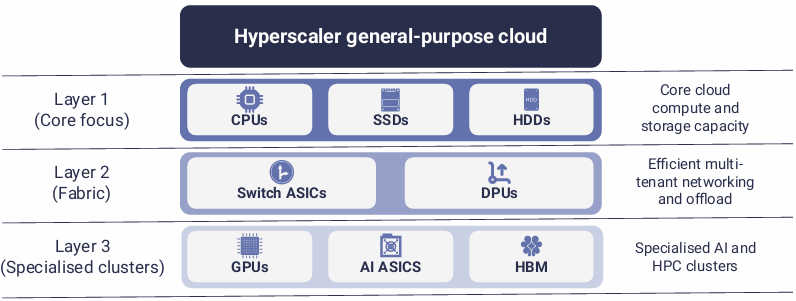
Traditionally hyperscalers have operated primarily CPU-led environments, as most customer IT workloads and platform services run on large estates of general-purpose compute. Alongside this, they operate very large storage fleets: vast pools of HDDs and SSDs, managed by storage-controller ASICs for error correction, wear-levelling, and distributed erasure coding. These compute and storage layers are tied together by dense network fabrics built from switch ASICs, NICs, and optical modules, with DPUs increasingly offloading virtual networking and storage I/O. Most racks run within conventional air-cooled power envelopes, with liquid-cooled zones reserved for high-density GPU clusters.
GPU-first AI factories
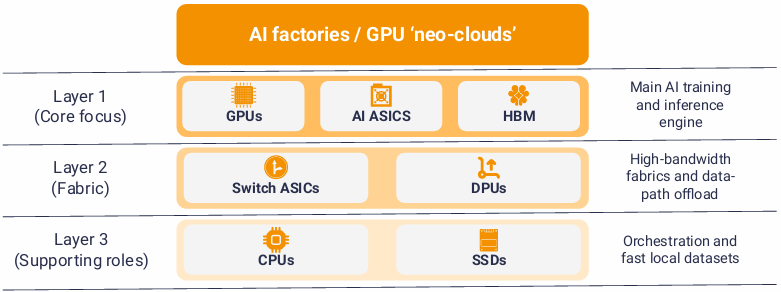
GPU-centric providers – such as neoclouds – centre their designs on dense GPUs and AI accelerators, supported by high-bandwidth fabrics built from advanced switch ASICs, high-speed NICs, and 400G-800G optical modules for the networking. CPUs serve orchestration and feeder roles, and DPUs offload data-path tasks to keep accelerators fully utilised. The extremely high power density of accelerator racks requires liquid cooling, enhanced power delivery, and tightly engineered interconnect layouts.
Enterprise and private cloud data centres
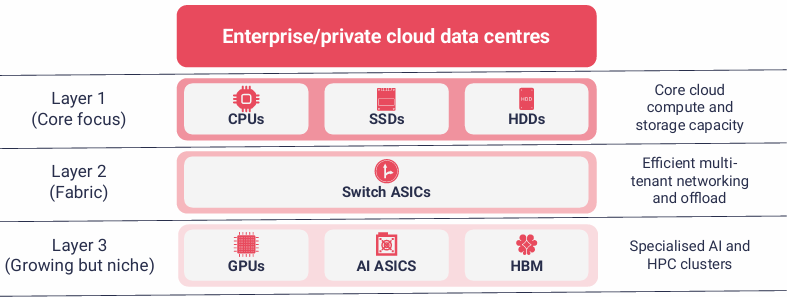
Enterprise environments remain CPU-heavy, supported by proprietary storage controllers and moderate-scale networks based on switch ASICs, NICs, and conventional optical modules. GPUs and DPUs are limited to small, specialised deployments. Because their dominant chip types run within typical heat and power limits, these facilities mostly rely on traditional air cooling and standard rack densities, adding liquid-cooled pods only when adopting denser AI workloads.
CDN
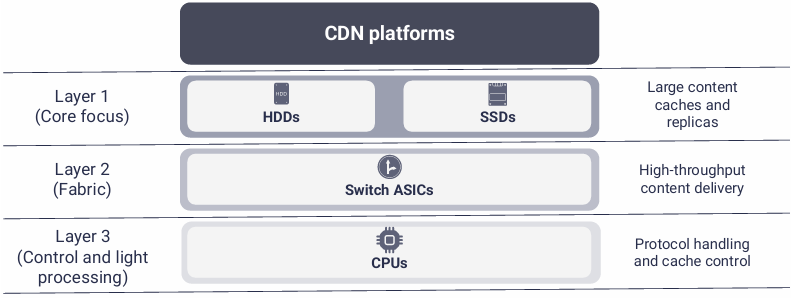
CDN environments are CPU-first for protocol handling, encryption, and cache logic, with storage as a close secondary component because of the need to hold distributed replicas in SSD/HDD pools managed by storage-controller ASICs. Some also rely strongly on network silicon – switch ASICs, NICs, and optical modules for high-throughput content delivery. These sites typically operate within moderate power and standard air-cooling constraints, particularly at the edge.
The evolution of chips in data centres
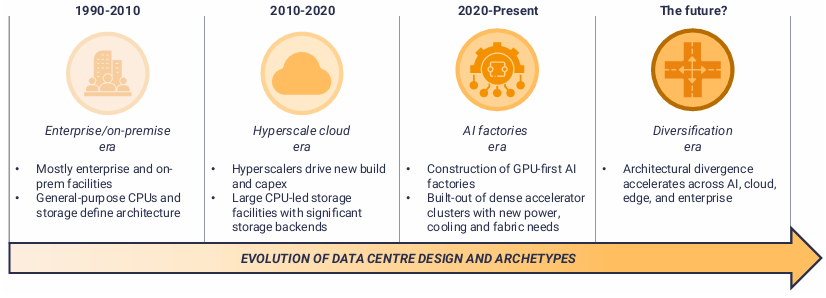
The different data centre archetypes seen today – CPU-led hyperscale cloud, GPU-centric AI “neoclouds”, storage-heavy CDNs, and enterprise/private clouds – are the result of a steady shift away from homogeneous, CPU-only designs towards increasingly heterogeneous, workload-specific compute.
1990-2010
In the 1990s and early 2000s, most data centres were enterprise-owned or on-premise facilities, often supplemented by early colo and hosting providers. Architectures were almost entirely built around general-purpose CPUs, with networking, storage and security delivered by separate hardware appliances. Virtualisation and multi-core processors then allowed far greater utilisation, but the basic model remained CPU-centric. This period is important because it set the expectation that data centres were fundamentally defined by general-purpose compute, with storage and networking operating as supporting subsystems.
2010-2020
In the 2010s, hyperscalers drove most of the new build investment in data centres, refining a broadly standardised cloud architecture: large, CPU-led regions supported by substantial storage backends and increasingly capable networks. The design challenge was scaling general-purpose compute for millions of tenants, and most facilities followed the same template — dense racks of CPU servers, vast storage pools, and consistent operational tooling. Even as early GPU clusters appeared, they remained specialised and relatively small within the overall estate.
2020-Present
The 2020s have marked a decisive shift. The rise of large-scale AI has created a new class of data centre – the AI factory – that is fundamentally different from traditional cloud regions. These environments concentrate dense accelerator clusters, far higher power and cooling requirements, and specialised interconnect fabrics. Rather than being just another workload running on the cloud, AI now drives its own architectural pattern, with constraints and economics that diverge sharply from the hyperscale model of the previous decade.
Alongside AI factories, other specialised environments, such as edge computing deployments, GPU-first “neo-cloud” providers, and enterprise data centres modernising at a slower cadence -have emerged. The result is a far more diverse data centre ecosystem than before. Where the 2010s saw convergence on a single hyperscale playbook, the 2020s are defined by the coexistence of multiple, purpose-built data centre types, each optimised for a different class of workload and each relying on its own balance of silicon, power, cooling and network demands.
The future
The infrastructure of data centres is evolving faster than ever. As AI factories scale, traditional cloud regions grow, edge footprints expand, and enterprise environments modernise the industry is moving into a period of unprecedented architectural divergence. There is no longer a single template for how a data centre should be built or operated – each workload domain now demands its own balance of compute, storage, networking, power and cooling.
This growing fragmentation makes strategy more complex for operators, vendors and enterprises seeking to compete in the next decade of digital and AI infrastructure. This is precisely where STL Partners supports clients, helping them navigate this accelerating diversity, clarify investment priorities, and build strategies that align with the direction of future data centre evolution.
Looking for advisory services in data centres? Schedule a call.
Download the data centre insights overview pack
Download the data centre insights overview pack
Get a concise, practical summary of the data centre market: the impact of AI and sovereign strategies, the differentiators that win in a crowded landscape, and proven frameworks for market entry, channel partnerships and customer acquisition—backed by case studies and sample deliverables.

Five things we learned at Datacloud Global Congress 2026
We were at Data Cloud Congress 2026 in Cannes last week to evaluate the key narratives among data centre operators, investors and vendors.

The hidden economics of liquid-cooled data centre retrofits
This article, kindly supported by Airedale, explores when liquid cooling retrofits make commercial sense, showing why the decision depends on HPC pricing, facility fill, market constraints and disciplined execution.

Key takeaways from the launch of the Quantum Infrastructure Council
STL Partners attended the launch of QIC to explore what it will take to deploy
quantum technologies in real-world data-centre environments.
Five things we learned at Datacloud Global Congress 2026
We were at Data Cloud Congress 2026 in Cannes last week to evaluate the key narratives among data centre operators, investors and vendors.
The hidden economics of liquid-cooled data centre retrofits
This article, kindly supported by Airedale, explores when liquid cooling retrofits make commercial sense, showing why the decision depends on HPC pricing, facility fill, market constraints and disciplined execution.

Modular data centres: can prefabricated design speed up construction?
A look at whether modular data-centre design can help operators deliver capacity faster, scale more flexibly and respond to rising demand.