Non-proprietary network APIs have emerged as a highly anticipated means for telcos to monetise their 5G investments by meeting as yet untapped B2B2X customer needs. This forecast estimates the size of the opportunity for telcos in the 2025–2030 period.
This dashboard presents the key findings of STL Partners’ demand forecast model for network APIs. Its purpose is to:
- Assess the demand from 53 B2B2X use cases which can benefit from network APIs, unlocking new value for telecoms operators by giving developers access to their networks.
- Identify the total value of this demand, attributed to 26 APIs and broken down into directly realisable revenue (both direct and indirect) and enablement value for edge computing and private networks.
- Output results for the world as well as 33 individual countries and seven regions, per API, use case and industry vertical.
Network API revenue, by API family, 2025-2030
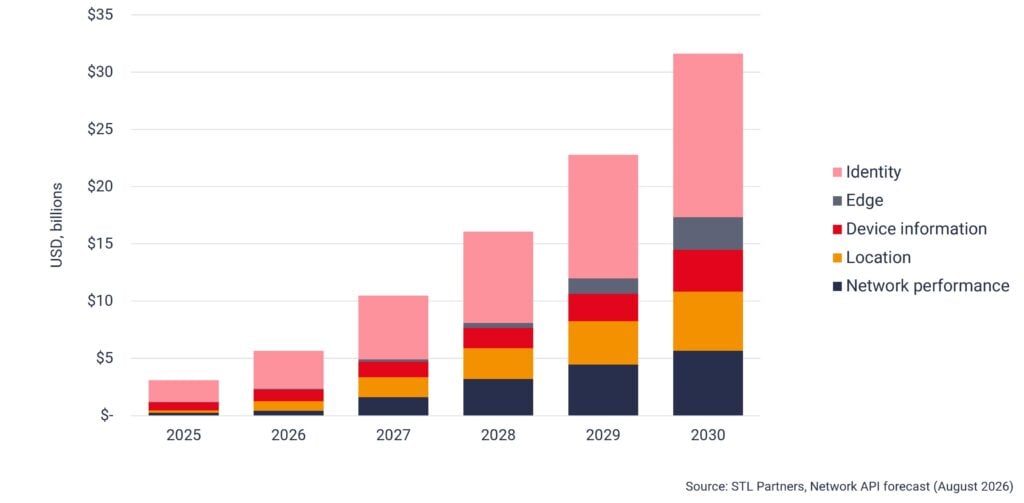
The value of network APIs will reach USD31.6 billion by 2030
High-level findings from the analysis indicate that:
- GSMA’s Open Gateway continues to be the driving force behind network APIs in 2026.
- The standards-led nature of the opportunity today benefits the APIs that go through indirect channels, such as the identity family, particularly as existing channels provide an easy route to market.
- The industry has been slow to rally behind APIs in the other families where there are not as clear existing use cases to go after, except for location verification in the location family and connectivity status in the device status family, both of which are relevant to the same authentication and anti-fraud use cases as the identity APIs.
- In line with the broader industry trend, the conversation is also turning to AI, with key players positioning identity APIs as trust infrastructure.
- APIs in the network performance, edge and device status families address emerging use cases rather than existing markets, creating new value with longer-term growth potential than identity APIs.
Segments
The forecast details the opportunity in USD for:
- 26 network APIs grouped into five API families:
- Device status
- Connectivity status
- Device management
- Device identifier
- Roaming status
- Edge
- Edge workload mobility
- Adaptive cloud usage
- Identity
- Number verification
- SIM swap
- Device swap
- Number recycling
- Call forwarding
- Scam signal
- KYC tenure
- KYC match
- KYC fill-in
- Verified caller
- Number retrieval
- Location
- Hyper-precise location
- Location retrieval
- Location verification
- Location geofencing
- Footfall data
- Network performance
- Network performance information
- Predictive network performance
- Quality on demand
- Slice configuration
- Device status
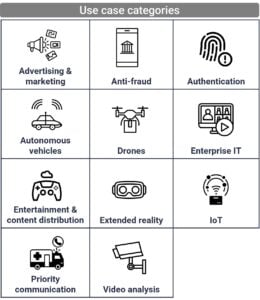
- 53 use cases grouped into 11 categories:
- Seven regions
- East Asia & Pacific
- Europe & Central Asia
- Latin America & Caribbean
- Middle East & North Africa
- North America
- South Asia
- Sub-Saharan Africa
- 33 individual countries
- Australia
- Belgium
- Brazil
- Canada
- Chile
- China
- Colombia
- Egypt
- Finland
- France
- Germany
- India
- Indonesia
- Italy
- Japan
- Korea, Rep.
- Malaysia
- Netherlands
- Nigeria
- Norway
- Poland
- Russian Federation
- Saudi Arabia
- Singapore
- South Africa
- Spain
- Sweden
- Thailand
- Turkey
- United Arab Emirates
- United Kingdom
- United States
- 16 industry verticals
- Agriculture
- Architecture, engineering and construction
- Defence
- Emergency services
- Extractive industries
- Financial
- Government
- Healthcare
- Logistics
- Manufacturing
- Media and entertainment
- Professional services
- Retail
- Tourism, hospitality and events
- Transport
- Utilities